
The University of Birmingham is commercialising a ‘game-changing’ platform that extracts and analyses real-world healthcare data from any source, with results within minutes.
Dexter AI taps into analysable datasets from electronic health records across primary and secondary care, claims data, private prescriber records and other sources.
The platform enables medical researchers to rise to the challenge of delivering actionable insights and testable hypotheses, quickly and securely. It reduces the time needed for epidemiology studies, drug safety and effectiveness studies, clinical audits and clinical trials.
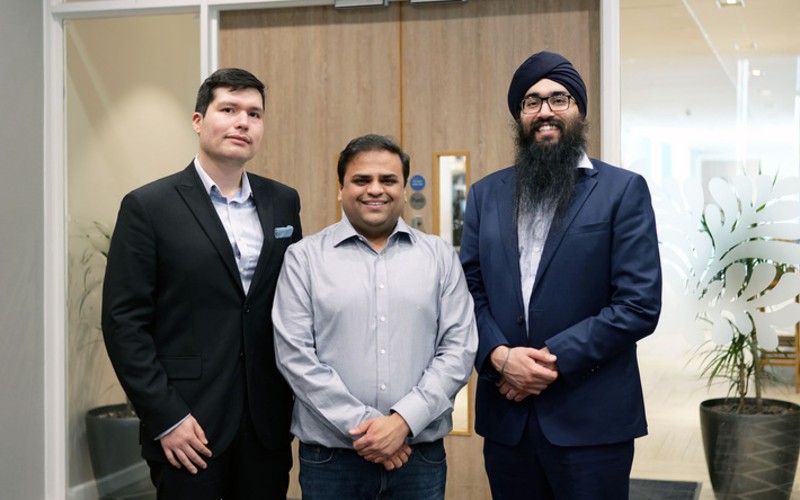
It is based on software developed by Professor Krishnarajah Nirantharakumar, Dr Krishna Gokhale and Professor Joht Singh Chandan at Birmingham’s Department of Applied Health Sciences.
Professor Nirantharakumar, now based at King’s College London, will be Dexter’s chief scientific officer, Dr Gokhale its chief technology officer, and Professor Chandan, who became the UK’s youngest clinical professor in 2024, its chief medical officer.
Prof Nirantharakumar said: “Dexter was originally developed at the University of Birmingham to make health data research faster, more accessible and more reproducible. Since then, it has enabled more than 150 studies, including publications in Nature Medicine, The Lancet journals and the BMJ.
“Most importantly, it has helped democratise access to large-scale health data research, supporting over 100 early-career researchers and contributing to more than £30 million in research funding.”
Dexter AI Ltd will be led by CEO Christian Billinghurst, who has worked with the team over several years while Dexter incubated in a University of Birmingham Enterprise commercialisation programme, and transitioned from an academic project to a commercial venture.
During this time, the platform has been used in more than 150 high-profile peer-reviewed studies, including work identifying the full spectrum of symptoms associated with Long COVID. It has also generated important evidence to inform the management of common health conditions such as thyroid disorders and atrial fibrillation, and supported data-enabled clinical trials from planning and feasibility assessment through to recruitment, outcome evaluation and safety monitoring.

Billinghurst said: “Dexter has proven transformative in a university setting, contributing to the department’s growth in scale, impact and grant success. Our move into industry through the University has enabled us to build key partnerships while evolving Dexter into an industry-ready platform tested across diverse data types.
“We have demonstrated our platform can support a wide range of different studies, from incidence and prevalence analysis and cohort building to clinical trial emulation, pharmacoepidemiology… even the automation of clinical audits.”
The scientist-founder using AI to make language learning ‘magical’
Dexter has ambitions beyond healthcare and is now looking at applications involving justice data and social inequality, where its technology platform could be used to handle diverse datasets.
Professor Chandan said: “Dexter has expanded well beyond primary care electronic health records. We have successfully delivered projects using secondary care datasets and primary care data from across Europe, as well as claims and private prescriber records. We are also exploring exciting opportunities to support the police, and in the future local government and social care, by leveraging Dexter to analyse their records and help answer complex operational questions.”
Dr Gokhale added: “Dexter has spun out from a position of strength, with an established record of trading success, and forged deep and productive partnerships with external organisations, including University Hospitals Birmingham, which is using Dexter to rapidly extract data from maternity and acute care records.”
“Birmingham has benefitted enormously from working with Dexter. The entire Department of Applied Health Sciences adopted the software, and it has now been used in over 150 published studies. A team that used to be just three people, publishing one or two papers a year, is now a centre with over 60 people, and publishes one or two a week.”