
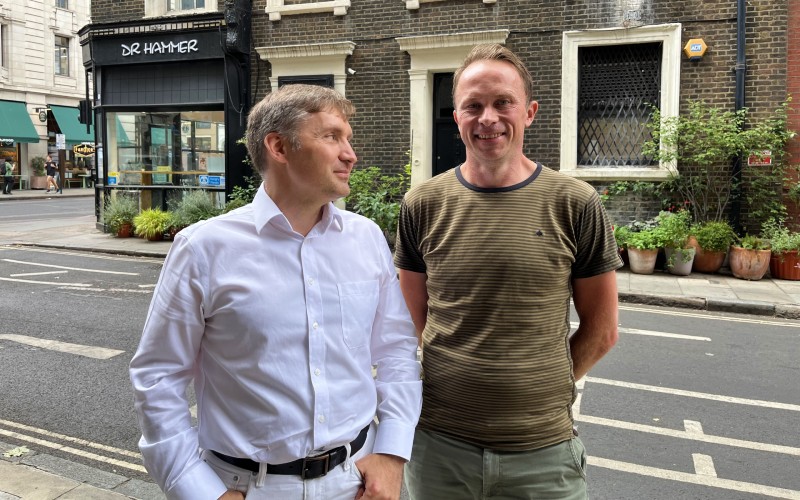
Vassili Philippov has spent his life immersed in science – yet it is education which has dominated his entrepreneurial career in recent years.
As a child in St Petersburg, his parents were scientists; he won national prizes in physics and programming at school; he then studied mathematics and physics, earning a PhD in Applied Mathematics at the Russian city’s university.
Around the turn of the century – while studying for that PhD – he co-founded mobile software company SPB Software with friends. The initial focus was on apps for Pocket PCs before they moved to Android development with the rise of smartphones; in 2011 Yandex, the largest internet company in Russia, acquired the business for $38 million.
That left Vassili considering his next move. “When you sell your first company, you reflect on what really matters to you in this life. For me, that was science,” he tells me at The Hoxton in Holborn for Founder Friday.
“But I realised that what I liked most was not the discovery itself – surprisingly – but more the communication of it… the teaching.”
MEL Science
After moving to the UK, he founded MEL Science to improve science education through a combination of an app and physical product sent by post to subscribers.
“It allows parents to build science experiments – chemistry, physics, biology – with their children. It helps them to love science,” he explains.
“I’m a true believer that science is very important for all of society: if you look at what’s changed during the last 1,000 years, it’s mostly due to scientific innovations.”
Just last week, one of my children uttered the words: ‘When am I going to use maths in real life?’
While I spoke to Vassili a few days before that exchange, he had the perfect – if unknowing – riposte: “Maths is a skill that is useful – and universal – even if you’re not a mathematician. And the same with science.
“Do I recommend people to learn science? Yes, everyone. Will they be scientists? 99% won’t. Will they use science in their life? 95% won’t. Is it still useful? Yes – because it’s a language. It’s a way of thinking.
“I also recommend learning programming to children, even if we don’t know whether developers will exist in 10 years [due to AI]. When you’re a student, you need to be able to look at the world from different, diverse angles – to apply mathematical language, apply scientific language, apply programming language.
“When we give instructions, we deconstruct things, split projects into sub parts, understand how they communicate…”
Indeed, when his children were younger, he struggled to find them a maths club and so founded a charity, We Solve Problems, which taught kids how to apply maths – debating style – to their critical thinking.
Eleven years on – and with the teaching long since handed over to student tutors – there are now more than 16 of them, including clubs based at Oxford University, Cambridge University, King’s College and UCL.
MEL Science has rebranded as Inquisitive and is now led by CEO Tara Hamilton-Whitaker, with Vassili remaining as its largest shareholder and chair of the board. Was it hard to let go?
“Yes – it’s my baby!” he laughs. “It took me about almost a year to hand over all the business to her. She’s doing great.
“I have four sons – my real babies – but you have to understand that they won’t stay with you all the way (forever).” Indeed – the eldest of them is currently studying for a PhD at Cambridge.
So why did Vassili hand the business over? Enter AI.
Glite
“I’m a software developer myself and although as a CEO you don’t have much time to code, I did a bit in my spare time. About six years ago, I started actively being involved in machine learning, and I thought ‘wow – what’s happening here is kind of big’.
“I was thinking a lot about how it will change education, and how to make education better using those technologies. I realised – and this is where I probably disagree with many people – that it’s all about data. We need a lot of data.”
Vassili’s view is that approaching education scientifically shows how learning and knowledge are very multi-dimensional.
“You can’t just have one number to describe your knowledge,” he explains. “You need thousands, maybe hundreds of thousands. When you have that, you can make models that predict what you know; what you don’t know; and find the optimal way of actually teaching you.
“The most magical moments in machine learning and AI usually come when people have found a way to use a lot – and I mean really a lot – of data. With ChatGPT, they found a way to process more or less almost all text in the world.
“So we have the vision of how to make education better – but we need tens of millions of student journeys, and this data doesn’t exist today.”
EdTech 50 – UK’s most innovative education tech creators for 2026
Realising that it was “almost impossible” to find tens of millions of customers in science education, he turned his attention to language learning – and Glite was born.
“Billions of people are learning languages [which means we can collect enough data]. But when you’re not a beginner, there are no really good solutions for you,” says Vassili. “It is easier to create a product for beginners.
“If two people have spent five years learning a language, they might go along with the teacher’s lesson plan – but if they want to continue improving, they will need completely different things. You need a system that understands where they are, where the gaps are, and customise for them.
“That’s the power of machine learning.”
Glite, founded two years ago and now employing 12 people in London, is an English-learning app for people who have moved beyond the basics but still struggle to become fluent. Where Duolingo helps people get started, Glite is aimed at ‘day 1,000’ and beyond. Data from around two million people who have already taken its English vocabulary test is helping the team understand where learners become stuck.
Fails
“We built our first models; decided it was time to make an app; then it failed,” Vassili smiles. “We had good algorithms, but we didn’t understand well enough when and how people learn.”
He says the first version was like a ‘TikTok for language learning’ and mostly focused on learning words.
“This micro learning is not the only time when people learn – it’s one of at least three,” he continues. “There are also times when you can’t watch your screen, but you can listen – while you’re running, walking, cooking in the kitchen, driving. That’s a very different scenario. The third situation is where you actually can focus – ‘zoom time’ – and can speak, listen, watch.
“They all need a distinct user experience.”
The team then realised that at an advanced level of learning, people don’t just learn words – but their various specific meanings.
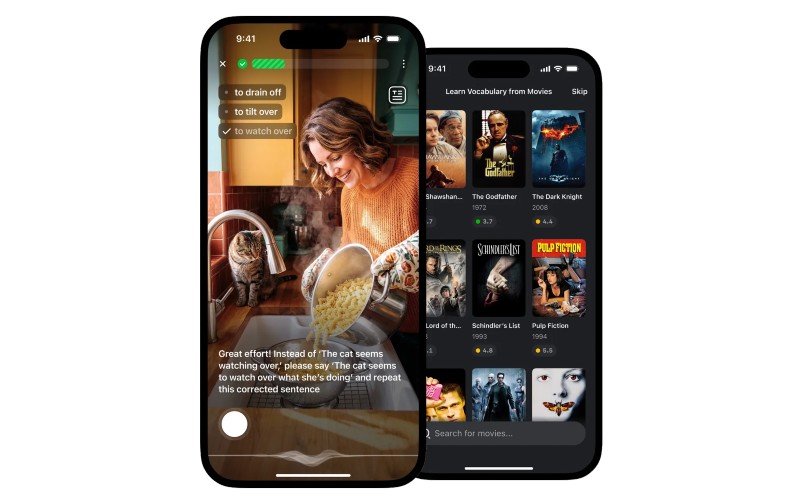
“Yesterday I was watching Line Of Duty, and they were talking about grassing someone [up]. I was like: ‘I know the word grass, but it seems like this is probably a different meaning’,” says Vassili, who speaks very good English but clearly not as his first language.
“We redid everything not just around words, but around their meanings, idioms and so on.”
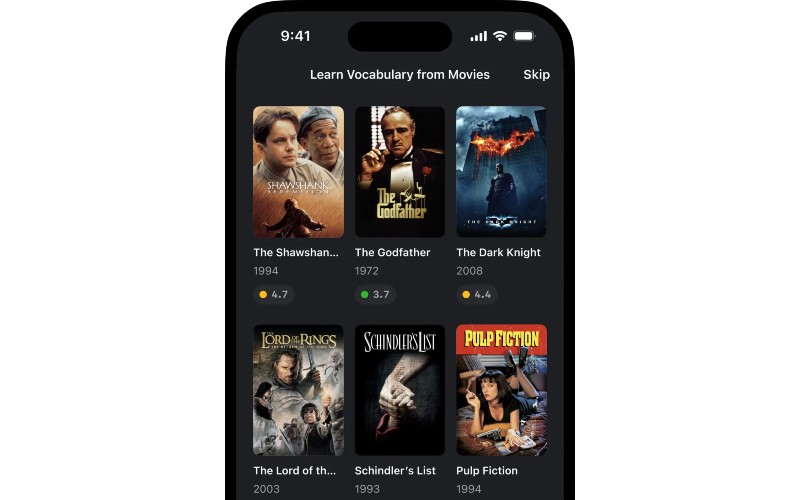
This enables Glite to guide the user through their learning journey via very specific scenarios.
“If I want to watch a TV series – such as Line Of Duty – I can enter the name into the app and it will tell me about words, meanings, expressions and idioms that I might not know [understanding my knowledge as it does].”
The models developed by Glite can be applied to other languages and subjects in future, says Vassili. “But we need subjects which hundreds of millions – if not billions – of people use,” he qualifies.
He adds: “With adaptive learning, we understand what you have already learned; what you haven’t; and what’s the optimal next activity to give you.
“That, I think, is the most magical part.”