


Traffic is a popular metric when it comes to online SaaS visibility. It makes sense: it’s easy to measure and influence.
But is it really the most effective KPI? Hardly.
Traffic is essentially clicks. Yet, are those relevant? Do the people who click already know your brand? And more importantly, do they trust you?
These are all open questions, and that’s exactly why traffic alone doesn’t drive growth.
If you want your SaaS brand to grow and get more conversions, you first need online credibility and audience trust. That’s why authority is a much better focus than just traffic.
Let’s figure out what online authority actually means in SaaS and how you can build it.
Why digital authority matters for SaaS brands
Digital authority refers to how credible and recognizable you are in your niche.
If you just pause for a moment and think of different industries and product types, what brands come to your mind? Think of cybersecurity, project management, meeting software, or even daily things you use, like coffee, cars, and so on.
The brands that quickly popped into your head most likely have very strong authority.
And that’s exactly why it matters for any business, especially in the SaaS industry. Because you know it first-hand:
• The competition is quite serious here,
• There are usually several decision makers,
• Your audience is often much more skeptical than in other niches,
• You’ll rarely have people randomly sign up for a demo or trial if they don’t trust you and so on.
But once you have online authority, your prospects start to treat you differently. They value your expertise and know that they can rely on what you’re saying and offering.
The only issue is that to build that authority, you need a really strong strategy.
Ideally, it should cover everything, from the overall brand recognition and content expertise to external visibility and link authority.
How can SaaS companies build authority?
Now, it’s time for us to get practical. Let’s take a look at the exact seven steps you can take to build authority for your SaaS brand.
1. Define your main pillars
You can’t build brand authority unless you know exactly what your business stands for. So, make sure you brainstorm the exact things you want and need to communicate.
The more precise you are, the better. The idea here is to understand:
1. Your exact target audience: How proficient they are in a topic, what problems they face daily, how you can help them, and so on.
2. Topics related to your product: List the subjects that make sense for your software. Here, the idea is to find both a broad topic and some relevant subtopics. Don’t try to come up with anything artificially. Instead, ask your customer support and success teams what questions your users have, or scroll through Reddit to find something useful.
3. Knowledge gaps: SaaS often requires audience education. So, you can think about the actual doubts and unclear topics in your industry, and how you can clarify them.
2. Make sure your positioning is consistent
Once you know your pillars, you have to make sure that everyone on your team understands them. This is important because you have to be consistent in your communication across channels.
Essentially, online authority isn’t just about good ideas. It’s also about execution.
So, whether it’s your community manager, email marketer, SMM, customer support agent, or your product team member, they all have to be on the same page.
It’s hard to build authority when the information you post online is inconsistent.
It includes your business details, positioning, target audience, messaging, and everything else in between. Your goal is to build strong reputation signals. And you can’t do that unless you’re consistent everywhere online.
So, it’s also useful to do a quick audit and check whether your image is the same on different platforms. You can even ask a focus group that isn’t involved in your business as much as you are.
3. Create expert content
When SaaS companies first start using SEO for lead generation, they often focus on the wrong things. It’s easy to get consumed by keywords, search intents, and meta descriptions.
But what matters most is the message you actually deliver and whether it resonates with your target audience.
So, when you build your SaaS content strategy, make sure you:
• Focus on articles that address actual pain points and doubts of your audience,
• Avoid generic blog posts written just for the sake of SEO,
• Make your content practical, helping your readers solve their problems.
This is exactly how you get expert positioning, instead of being another SaaS brand that has an SEO blog on its website.
4. Get more people from your team to create content
Once you start working on your SaaS visibility, you’ll quickly see that in order to gain trust, you need a thought leadership strategy. And that’s actually true.
But how do you build it? What do people really want to see?
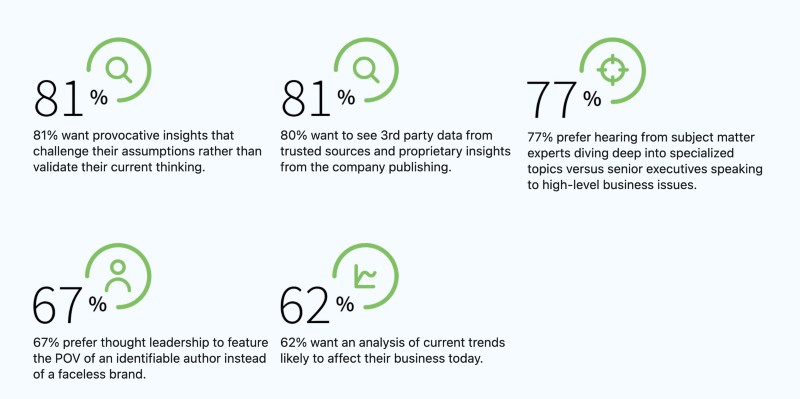
The majority of decision-makers are essentially looking for five things:
1. Atypical insights that challenge their current worldviews,
2. Original data and research,
3. Deep dives from subject matter experts rather than senior executives,
4. Insights from an actual person, not a faceless brand,
5. Analysis of the trends that can affect the industry.
One of the simplest ways to give that to your audience is by letting your team members talk on behalf of your brand.
Say, you develop software in the cybersecurity space.
In this case, you need to take your detection engineers or threat hunters and let them share their experience with your readers and followers.
You can do that through webinars, tutorials, social media posts, Q&A sessions, interviews, insights you use in your blog posts, etc.
The general idea is to provide real-life insights from people who face the same issues your audience does.
And it isn’t your marketing team, unfortunately (unless you have a marketing SaaS brand).
This is how you build real expertise and create content that’s actually valuable, instead of reiterating the same insights ChatGPT can generate in seconds.
5. Show proof to build trust
As a brand, you deal with humans. And let’s be honest: trust doesn’t always come easy to us. So, if you want to get online credibility, you have to first build digital trust signals.
This social proof can come in many forms. For example:
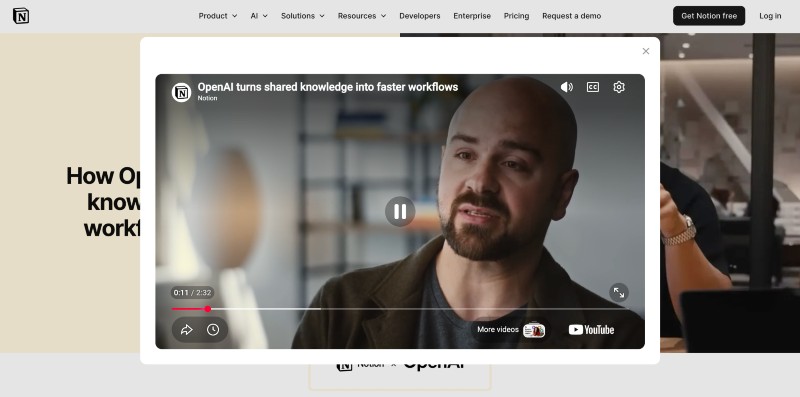
• Customer reviews, especially in the video format. It can be a simple selfie video your client films in 20 seconds, or something more elaborate like this Notion’s example:
• Case studies and customer success stories. Here, make sure you focus on tangible results. If you have some numbers, use them.
• Any publications in trusted media. It can be a press release, your founder’s column, or any other type of content. When you get some media mentions, share them to build more credibility over time.
• Partnerships with well-known brands. This is one of the really strong reputation signals. When people associate you with other businesses they already know, trusting you becomes much easier.
Of course, you can’t just get one publication on Forbes or publish a couple of customer reviews and gain audience trust. It is a long process.
But all the social proof you put out there will eventually compound and help people convert.
6. Build brand authority beyond your website
When we think about authority, most of our effort often goes to our owned channels (website, email marketing, social media profiles, etc.).
But everything that happens externally is generally even more important.
When people see what you say about yourself, they don’t trust that nearly as much as something they read elsewhere.
That’s why it’s so important to:
• Show up in podcasts and someone else’s YouTube videos,
• Giving/exchanging interviews or participating in expert roundups,
• Having a profile on review platforms and encouraging your customers to leave their opinion about your product,
• Doing community management on Quora, Reddit, and other relevant forums,
• Writing a column on a reputable website (your founder might want to join Forbes Councils or any similar initiative),
• Post quality articles on other pages (aka guest posting), etc.
Of course, you don’t have to do all this at once. The idea is simply to get more high-quality brand mentions beyond your own channels.
This also has another benefit: better exposure and visibility.
First of all, it works great for your SEO and especially GEO, as AI systems tend to evaluate overall brand exposure before recommending it.
Besides, 78% of B2B buyers ultimately get products they already knew about before starting the research process. So, by showing up across the internet, you get more chances of being discovered and eventually chosen.
7. Stick to your authority marketing
This is the step that will put everything else in motion.
The previous six tips were all about practical things you can do to understand your expertise and communicate it, building trust and visibility.
But none of that matters if you aren’t being consistent with your authority marketing.
You know what they say: the most successful people aren’t necessarily the smartest and most educated. But what really differentiates them is that they were willing to show up when everyone else had already given up.
While this sounds a bit cheesy and slightly philosophical, consistency is the only thing that will actually bring you real SaaS growth.
Of course, if you’re being consistent with the right things.
Practically, this is where you can test AI’s full potential:
1. Take notes of everything we’ve been talking about, from your positioning and target audience to the experts you have on your team.
2. Then, feed all that data to any LLM you prefer and ask it to find the actual pain points your audience has, generate content ideas, and so on.
3. Also, make sure you think about how you can automate your content creation process. AI can be really useful for repurposing, scheduling, etc. But at all costs, avoid using it to create AI slop. That’s really not how you build authority.
Final words
After all, digital authority is all about knowing what your SaaS brand brings to the table and communicating it consistently.
Before you start anything, think about whether that initiative can help you become more recognizable and grow your credibility.
If the answer is “no,” maybe it’s not the most effective thing to do for your authority.
FAQ
What is digital authority?
It’s how your brand is perceived in the online space. Do people trust you? Would you end up on their short list? Would they choose over your competitors?
Essentially, online authority is a broad concept that shows how expert and recognizable you are.
Why is authority important for SaaS?
Authority is what gives you credibility. And credibility is what gives you a better chance of people choosing you, not the next brand on the list.
Does traffic guarantee SaaS growth?
Not really. Traffic is one single metric, and it can’t guarantee anything. While it’s hard to give any guarantees at all in this world, building a strong authority online is much more effective for SaaS growth.
Authority is much more comprehensive, as it covers visibility, trust, expertise, external validation, social proof, and many other things. That’s why it’s a much stronger predictor of growth, compared to traffic alone.
How do SaaS brands build trust?
There are many components to this.
First, you have to be visible across channels because when people repeatedly see you, they tend to subconsciously trust you more.
Second, your content has to be actually valuable to prove that you’re the expert in your niche.
Third, you need social proof from people on forums, social media, review platforms, etc.
What signals increase digital authority?
You have to think about this in two directions: internal and external.
Internally, you have to do everything to build trust and expertise. You can do that by publishing specialized content and generally showing that you know your thing.
And externally, your goal is to build great social proof. It includes having good reviews on listing platforms, getting published on high-quality websites, having some positive media attention, etc.
Is authority more important than traffic?
Not necessarily. It will depend on your goals.
But traffic alone usually isn’t enough for conversions and business growth.
Unless your prospects actually recognize your brand and trust it, selling anything to them is often much harder, especially in SaaS and B2B.