
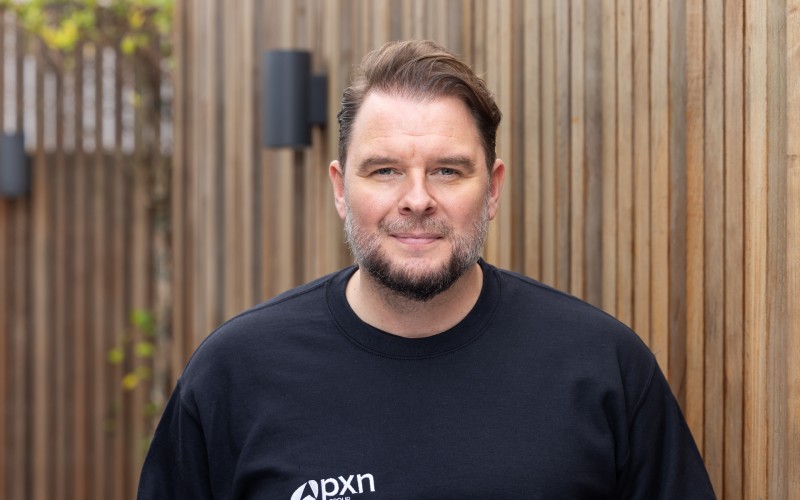

Andy Barrow, managing director of ventures at PXN Ventures, says a new era of Northern venture capital is taking shape after the merger of Praetura Ventures and Par Equity.
The serial investor, who sits on the board of multiple companies, took on the role last month following the creation of a ‘£670 million Northern investment powerhouse’.
It is aiming to create what Barrow describes as a scaled-up platform to back breakout successes across the North of the UK.
From apprentice to VC lead
Barrow, who has spent his career moving from engineering into cybersecurity and then venture capital, says technology was always his route.
“Engineering and technology have always been at the heart of what I was interested in since being a child,” he told BusinessCloud.
“I started my career at 16 as an apprentice in advanced manufacturing before joining a small startup specialising in advanced cyber security technologies, where I doubled down on this as a career path.
“I joined a very early stage cyber security consultancy that later folded into ANS Group, where I became CTO and with the management team took the business to PE exit in 2021.
“In my new role, I’m responsible for overseeing our investments into early-stage tech and life sciences businesses, in line with our goal to be on the cap table of every early-stage business in the North of the UK that grows into a breakout success story.”
The merger explained
Barrow said that the merger comes down to one thing – venture capital needs scale to work properly.
In his view, building bigger funds is essential if PXN is going to back the next wave of breakout Northern businesses and become the go-to investor for early-stage founders across the region.
Praetura, where he served as a partner for four years, has already proven it can grow a regional ecosystem and attract outside capital into the North West, but there is far more of the North still to support.
He argued that Par Equity strengthens that ambition because of its strong record in Scotland and shared focus on funding Northern success stories, including in Yorkshire.
He added: “Our partnership with the British Business Bank on NPIF II – Praetura Equity Finance has enabled us to fund a wide-range of businesses far outside of Manchester, such as in Cheshire, Cumbria and the Liverpool City Region, including those at the very early pre-seed stage through ‘PraeSeed’ – our cohort-based investment programme for very early stage businesses.
“Par’s funds, including its focus on DeepTech, dovetails perfectly with this. It’s rare to get a 50:50, no funds exchanged merger of equals, but shared values and ambitions have brought us both together and I’m beyond excited to see what we do as PXN Group.
“I think founders across the North of the UK have a lot to look forward to.”
More firepower
Barrow says the enlarged group immediately increases firepower and footprint.
“First and foremost, we have more funds, which will enable us to raise more capital to deploy into early-stage businesses across the North,” he said.
“Currently, we have £670m assets under management and the aim is to significantly increase that.”
The business is currently a team of 58 and has a portfolio of 115 companies. It is also supporting around 3,100 jobs.
He continued: “In terms of reach, it’s about having more boots on the ground. We have a physical presence in Manchester, Edinburgh, London and Leeds currently, but the reality is, we’re often travelling across the North on a daily basis, playing an active role in the ecosystem, meeting founders and banging the drum as well as telling our story to independent financial advisers, family offices and investors.
“One of the biggest points to mention is Par Equity’s PIN network. This is a growing community of entrepreneurs, investors and highly skilled operators we can draw on to help support the businesses we back, as well as those already in our portfolio, so we can help them make a significant impact.”
After Deliveroo’s 20-minute revolution, what’s next for hospitality?
What changes for founders
Barrow has argued that the biggest difference will be flexibility in funding across the lifecycle.
“I think one of the biggest opportunities for new and existing founders will be our ability to provide a range of cheque sizes from £200k up to £8m and further follow-on funding,” he said.
“Because we have much more scale and capital, we have more funding options that will help founders through the investment lifecycle.
“As well as NPIF II and Par’s EIS fund, there is our VCT, Par’s PEV I LP Fund as well as various other institutional funds, such as the GMC Life Sciences Fund By Praetura. It’s about having the capital to service our ecosystems, which are only growing.
“We are now the fastest growing venture capital investor outside of the South East, and that comes at a time when more and more businesses are setting up in the North.”
The value of the North
He also sees the North building genuine global advantage in a cluster of sectors.
He explained: “This is an opportune time for the North, which has already excelled in multiple areas with regards sector specialisms.
“If we look at where the North currently excels, it’s areas such as cybersecurity, AI, FinTech, life sciences, DeepTech and beyond.
“We have the talent, the lab facilities, the universities and the network to truly blaze a trail on the world-stage and compete against the US.”
He also noted the alignment to this with the government’s Modern Industrial Strategy, which is aimed at boosting investment, enhancing regional growth and strengthening the country’s economic resilience.
He continued: “As software becomes more democratised, it’s those more moated industries, such as IP-rich deep tech that are really coming into their own.
“They require the sort of lab space, talent and resources that are abundant across the North of the UK.”
The scaling challenge
However, he is clear that growth still comes with familiar hurdles, particularly around people and funding.
“The two biggest challenges founders relate to talent and funding,” he said.
“On the talent front, while the London brain drain has been quelled over the last several years, there is naturally competition among businesses for attracting the best talent.
“What we’ve really excelled at in the North is convincing talent to stay and work in the region after they leave university, with many choosing to spin out here and stay local.
“This has been helped by a multitude of factors, not least affordable housing, an excellent hospitality offering and access to world-class facilities.
“On the funding front, it’s about tech founders in the North having consistent access to funding and the ability to raise locally. People often ask why having a local funder is so beneficial to founders, particularly those at the early-stage, and my answer is always that it comes down to support.
“For first time founders, having a funder that’s down the road who you can have a face-to-face meeting is so important.”
Support your local
Some startups still look South or to the US when it’s time to raise larger rounds.
Barrow argued that the case for staying local is tied to regional growth and long-term ecosystem strength.
He said: “The North is home to cities that are beating the UK average when it comes to GDP. The latest figures from the ONS, for instance, show that Edinburgh has the highest GDP per capita in the UK.
“Elsewhere, Manchester’s GDP is now growing at 11% per year, outstripping the UK with the city creating three times as many jobs as the UK average.
“Founders in the North of the UK are bound to be excited reading those figures but it’s also about showing the role raising locally plays in this growth.
“If a business floats on the London Stock Exchange, it benefits the UK economy. If a business raises money from the North of the UK, it benefits the region.
“Yes, the US is a bigger market, and yes there is an abundance of funding available there, but we need to show founders that they can raise locally and get access to all the benefits that come with doing so, such as a supportive funder that’s local to and understands the ecosystem and market they’re in.
“Local follow-on funding is equally as important, as is recycled capital. In other words, capital from exits going back into the ecosystem through exited founders investing in local funds and becoming angel investors in their own right.
“As the ecosystem grows and matures, this will continue to be the norm and raising locally, in the North, will be much more prevalent than it has been in times gone by.”
ASOS revenues down but losses narrow during ‘recovery period’