


Building a FinTech business can feel like straddling two stools – staying compliant with regulation and good governance principles, while also securing customers and growing revenues.
Yet the former can drive the latter if approached across the business as a whole.
Robbie Lambert is a co-founder and the COO of Sheffield-based Bumper, which is regulated by the Financial Conduct Authority.
Bumper provides an interest-free ‘Buy Now, Pay Later’ product to drivers facing hefty car repair, service and MOT bills.
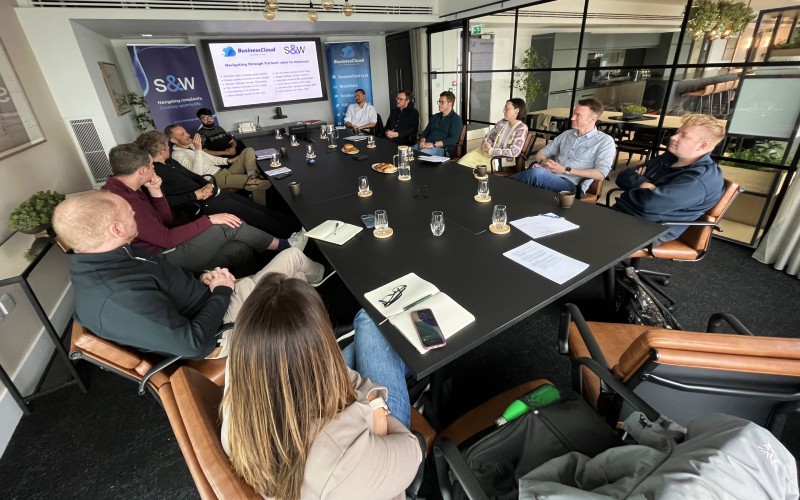
“There’s lots of ‘black and white’ to regulation – but there’s also a lot of nuance,” he told a roundtable of cutting-edge firms brought together by BusinessCloud and S&W to discuss the regulatory landscape.
“Regulators like the FCA are very much outcomes-based, rather than mandating specific things, so you can do regulation well – and you can do it poorly.
“The biggest key to doing it well is fostering strong relationships with the regulator, with your peers, and working out how you can use regulation as a competitive advantage and to drive volume through giving really good customer experiences that differentiate you from your competitors.”
Blueprint
Nicola Weedall is the founder & CEO of Hydr, which provides B2B invoice financing to small and medium-sized enterprises (SMEs). Hydr is paying out an average of £1 million a month despite an average invoice size of just £2,500, with virtually no bad debt.
“Regulatory guidelines should be used as a blueprint when you build in – there’s everything to be gained and nothing to be lost by doing that,” she said.
“That’s where everybody should start when they build their first MVP, whether they need to or not, because you will build a better business as a result.”
Pete Casson is a co-founder and the CTO of Collctiv, a group payment app that allows the pooling of money from multiple people for group gifts, trips, sports clubs or events. Like fellow Manchester startup Hydr, it is not yet directly regulated by the FCA.
Collctiv moved into profitability last year while Casson has been appointed to the Bank of England’s Payments End User Forum, which will help to shape the future of retail payments in the UK.
“Regulation is not something to run away from, or to be seen as a burden,” he said. “If you reframe it as an opportunity, it does give you the blueprint to build really good businesses.
“It’s there because the mistakes that have been made over decades of learnings have now been put into a piece of paper that you can read and learn from; then enhance and build on.”
He added: “It’s vital to keep people at the centre of everything: don’t just comply with the rules, understand what they are trying to achieve from a human perspective – then hopefully you can work out a product around that.”
Accessibility
Like Casson – who will champion the needs of the end consumer on the Bank of England forum – ClearCreator founder Hannah L Morrison is crystal clear on the need for building inclusion into financial products and services.
Her Liverpool startup is an accessibility consultancy which works with FCA-regulated financial services firms to understand where their digital customer journeys are falling short of Consumer Duty obligations, and help them to build the processes and governance to properly address this.
Consumer Duty is a regulatory framework from the FCA that requires financial firms to ‘act to deliver good outcomes for retail customers’ by focusing on fairness, transparent pricing and robust support.
“Good governance is good business,” said Morrison. “People are vulnerable – if we design for that, then Consumer Duty is a blueprint for how we can build trust and do better for our customers.”
Andy Mathews is CFO of Conferma, which specialises in generating, managing and streamlining virtual cards for corporate expenses, with a focus on the business travel sector. It issues an astonishing 600,000+ cards a week via almost 100 card issuers such as banks, procurement platforms and travel agencies.
While Didsbury-based Conferma itself does not issue funds, hold client money or issue cards it works alongside partners such as Monavate to ensure it is compliant with best practice.
“It’s about striking the right balance between agility and a good governance framework,” was Mathews’s first takeaway from the roundtable. “Ultimately it’s about managing risk, which is what the FCA is essentially set up to manage and govern.
“A new aspect I’ve picked up on today is that it’s also about inclusion and accessibility.”
Regulated by proxy
The FCA and the Prudential Regulation Authority are now placing more emphasis on the downstream risk that suppliers to banks need to be aware of.
One such supplier is Manchester firm BankiFi, which provides embedded banking and open cash management software to the likes of the Co-op. Its head of strategic growth Nick Reid says that while not strictly a FinTech itself – and therefore not regulated – this is like being regulated by proxy.
“We use the term ‘bank grade’,” he continued. “What I’ve heard today on the roundtable, which resonates with that, is that if you try to meet these regulatory standards – regardless of whether they apply to you directly or by proxy – by retrofitting them, it will cost you multiple times over in the longer term.”
Company-wide
Luis Hernandez is an associate director of the regulatory consulting team at S&W, one of the fastest-growing advisory and accountancy firms in the UK and Ireland. It supports fast-growing FinTechs and founders with comprehensive consulting, accounting and tax support.
Hernandez has worked with a wide range of clients, including retail and commercial banks, insurers, FinTechs and consumer lenders to help them not just to achieve compliance – but also how to do right by the internal and external customers that it often aims to protect.
“What’s been interesting to take from this conversation is that everyone is having these discussions across their businesses. Where we see real challenges is where there’s a focus of ‘well, that’s compliance’s job’,” he said. “The FCA has a focus on these matters being seen as everyone’s responsibility across the business.
“People like you sharing knowledge with others in the industry is going to be really important, because there’s a lot to learn from each other – such as what best practice looks like.
“The other point that resonated today is bringing [discussions around compliance] into the process as early as possible. And as the business scales, continuing to have it as part of the conversation is really important as well.”
Regulatory moat
Joe van Gelder is a co-founder and the CEO of Powdr, a Manchester-based financial modelling company helping banks, funds and investors to assess businesses, as well as assisting SMEs with cash flow forecasting and business planning.
While not regulated itself – as a software provider – he says that achieving FCA accreditation can serve as a ‘regulatory moat’ which differentiates a FinTech business from its peers.
“In an age where the speed to build things is much quicker, the ability to have real specialisms in what you do is absolutely critical – and relying on the people that you have is your defensible moat,” he added.
James Garner is founder and CEO of Sticky, developer of NFC-powered smart stickers that people can tap with their phone to instantly trigger digital experiences, order food or make payments. The firm works with larger payment providers such as Worldpay, Barclaycard and Compass Group, as well as challenger brands such as Boodil.
He offers a consumer parallel. “A bank might let someone use a credit card to pay their mortgage, and they would argue that this is fair because if they don’t pay the mortgage in any way, then they will repossess the house – and that would be worse for them.
“Ask yourself: Would I want to be offered that service personally? That’s how I guide underwriting here.”
Reading up
A new founder is Zeejah Qazilbash, founder of SharePay, a Lancashire-based group payment and expense-splitting service.
“I’d say my biggest takeaway today is to build with regulation in mind,” he said. “I’m going to go and read up on the regulations and make sure that my developers and my team keep them in mind when they build.
“I need to look into the future and see the problems I can solve right now, as I’m building, so I don’t have to deal with them later.”
Andy Nicol is the founder and MD of Sputnik Digital, a digital transformation agency based in Manchester that builds customer journeys for regulated companies around financial products such as insurance.
“If you build for the customer, you’ll probably comply with the regulations,” he said. “There’s a lot of good practice to be learnt.
“If you are compliant, you’re also probably making the customer journey better – which means better conversion, better loyalty, better brand, better longevity.”
Gary Fenemore, tax director at S&W, had the final word. “The amount of onus that buyers put now on checking how you sit within the framework you’re in is huge,” he said. “Investors will tell you they have capital to deploy – but they are understandably very cautious at the moment in deploying it, particularly in regulated or adjacent markets.
“It’s really encouraging to hear that everyone in this room recognises the space that they’re in and the obligation they have. Yes, there’s clearly a customer and consumer benefit, but there’s also a business benefit – because dotting your I’s crossing your T’s is key to giving you an investable business.”