
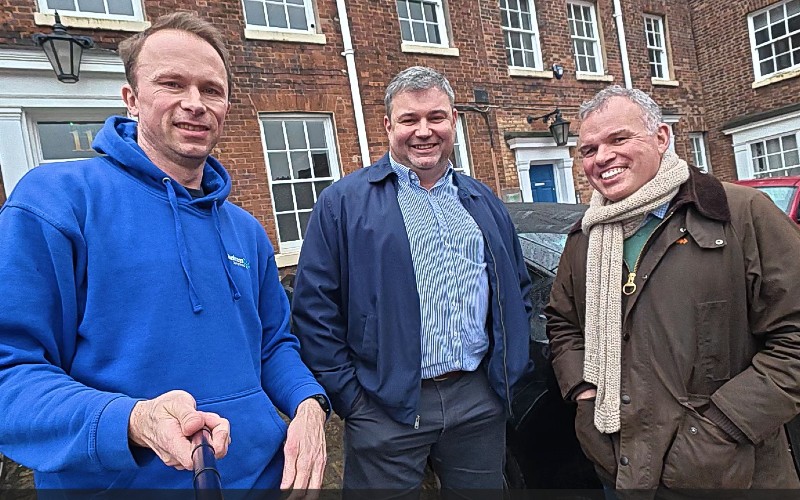
“There are way too many lawyers in the world.”
David Richards MBE, founder of Yorkshire AI Labs, is unequivocal in his view of where the legal profession is heading – and intends to be at the forefront of the disruption.
Yorkshire AI Labs operates a sweat equity and cash model. Among the startups being incubated within it is Lexcelerate, a LegalTech which is targeting remortgages initially but has grander plans long-term.
LEXcelerate has been launched by Yorkshire AI Labs and aims to do for conveyancing what Uber did for taxis. Mark Hewitt, architect of the firm’s proprietary AI platform, has spent the last 30 years helping manufacturing, legal, insurance and property companies to transform their operations using tech.
“The starting point was a remortgage,” recalls Mark to BusinessCloud for Founder Friday. “The whole process, from start to finish, was atrocious: the lack of communication, the lack of interaction, and actually the mistakes that were made.
“So I decided that I would have a go – connecting to the land registry, allowing AI to read and understand and interpret documents such as a mortgage offer. And that started to work.”
Mark previously led legal software startup Rebmark from concept to more than £1 million in annual recurring revenue before its acquisition by Verisk Analytics, a NASDAQ-listed data analytics group headquartered in New Jersey.
The software was subsequently expanded into the insurance sector and is now used to manage more than £10 billion of catastrophic injury claims reserves.
“I had a lot of legal contacts and so I started to look at whether it could be a piece of software that could be packaged up,” says Mark. “But the reality was that wasn’t going to work – because you would have to throw away everything that a law firm currently does and start from scratch.”
Thinking bigger
He had known David, a multiple-exit entrepreneur, for more than 20 years. As founder of WANdisco, David had dual-headquartered the data firm in Sheffield and San Francisco but stepped down in 2023 after the actions of a rogue sales employee triggered a fraud scandal. The firm subsequently rebranded to Cirata plc.
“I knew him in passing – and from the pub! – and saw that he was back in Sheffield and launching Yorkshire AI Labs. I basically made it so that he couldn’t avoid me!” says Mark.
“Dave sent me off to speak to mortgage brokers, and also to have my idea sense-checked by Paul.”
This isn’t any old Paul from down the pub, but Paul Firth – a highly respected figure in British commercial property law who built DLA Piper into one of the world’s largest law firms and also served as UK regional managing partner at Irwin Mitchell for almost seven years.
“After those conversations, I told Dave that this didn’t work as a software play. He smiled and said: ‘I know – you need to think bigger. You have to ‘be’ the law firm.”
So rather than bolting software into a law firm, the idea is to replace the case management and practice management systems themselves, rewriting the whole process.
So starting with remortgages, an established law firm might have 20-25 stages, says Mark: “We’re past 150 steps, and a lot of them can be automated.
“So our starting point is to take the mortgage offer and effectively deconstruct it; then go to the land registry and get the title for property.
“The simplest check is: are the people that are listed on the mortgage offer the people that are listed as the owners of the property? 99.9% of the time that will be the case. But maybe they’ve got married since, leading to a difference in name; maybe there is a spelling mistake in the name; or an incorrect address or date of birth.
“Within about seven seconds of taking that mortgage offer we can highlight any issues that might come down the line; we can then go through the KYC (know-your-customer) and identity checks.
“The reality is that the computer is better at validating all this than a human is ever going to be.”
Lexcelerate’s target market is mortgage brokers who ordinarily suggest a law firm to their clients.
“If you ask a mortgage broker what their key issue is, it’s communication,” says Mark. “They are forever chasing up to find out where the law firm is in the process.”
Uber model
David draws a parallel with taxi disrupter Uber. “Minicabs existed – but what Uber did very cleverly was put it into an app; tell you exactly how much it was going to cost; exactly when it was going to arrive; and exactly where it was going to drop you off. All of it tracked.
“And what else did Uber do? They’re the biggest taxi company in the world without actually owning any taxis.”

He expands: “So Lexcelerate is a law firm – but in the same way that you can order an Uber, or sign up as an Uber driver, you can find a conveyancer, or register as one in under five minutes.
“We think we can become the world’s largest virtual law firm, in the same way that Uber is the largest virtual taxi firm.”
Of meeting Mark, he recalls: “Mark came in and he had the technology, but he didn’t have the customers. So we went out and signed up mortgage brokers straight away. What we then needed was the deep domain expertise.”
The Three Amigos
Enter Paul. “At DLA we had a troubled subsidiary called DLA Direct, that were basically doing remortgages for Halifax, Lloyds Bank and people like that, at scale,” Paul says. “It was losing money when I got involved; we turned it round and sold it, ultimately, to Capita for about £14 million.
“What I learned during that process was how much of remortgaging could be basically done by cutting the process down and breaking it up into the constituent parts. This was way before AI [as we know it], but even then we could find significant cost reductions and efficiency improvements on each job.
“That’s what first triggered my interest in this. And now, what Mark has produced is highly impressive.”
So impressive, in fact, that Paul agreed to lead Lexcelerate. “It’s ready to roll out, and we really do think we can change the market.”
Back to David, the computer scientist who envisions a sea-change of tsunami proportions across industries.
“In the same way that [large language model] Claude makes a software engineer 25 times more effective, we make lawyers 25 times more effective – which means that there are 25 times too many lawyers,” he says. “The disruption is going to be across the entire sphere – most of the tasks are going to be gone.
“But what this platform actually does is give lawyers a chance of surviving. It won’t be hard to find a lawyer that’s looking for work – starting now.”
Meet Sheffield founder unlocking healthy device habits for kids
Luddites
Referencing the Luddites who protested against the Industrial Revolution, he continues: “There’s going to be massive unemployment. People still live in cloud cuckoo land.”
Yorkshire AI Labs is also looking to build disrupters across orthodontics; journalism; advanced manufacturing; and football scouting.
The next step for Lexcelerate is to buy a law firm, says David. “We’re looking at two or three different opportunities. Given what we’re doing, we don’t need to buy something with 100 lawyers in it.
“We can buy something with zero lawyers, and we will be able to execute. It just needs to be a shell. It just needs the operating license.”
There will be rival startups with the same idea, he admits. “Our philosophy is that we’re not bothered about competition. This is a £6 trillion global market – I’m okay with the 10% of that! A few hundred billion would be perfectly fine.”
Paul, who acquired tens of businesses at DLA Piper and loves deal-making, says: “What I like about this project is just seeing where we can take it.
“I’ve seen the legal business from the inside and, in many ways, it is very complacent. They think that the chargeable hour is here forever. Big commercial law firms are now charging £1,200 an hour for a partner.
“Why would you want to pay that when you can do it for a fraction of the price and get a better service?”
He adds: “This will scale far quicker than DLA, where we were acquiring law firms, trying to integrate cultures from different countries and having to deal with all the regulatory side of international business.”