
TidalSense has raised £14 million to take on the UK’s third-biggest killer.
The Cambridge firm is aiming to transform respiratory diagnostics, starting with a breath test for COPD (chronic obstructive pulmonary disease).
At least 600,000 people in the UK are currently waiting for a formal COPD diagnosis. The test they are waiting for – spirometry – requires forceful exhalation, specialist training to administer, and can take the best part of an hour per patient when factoring in wait and recovery time.
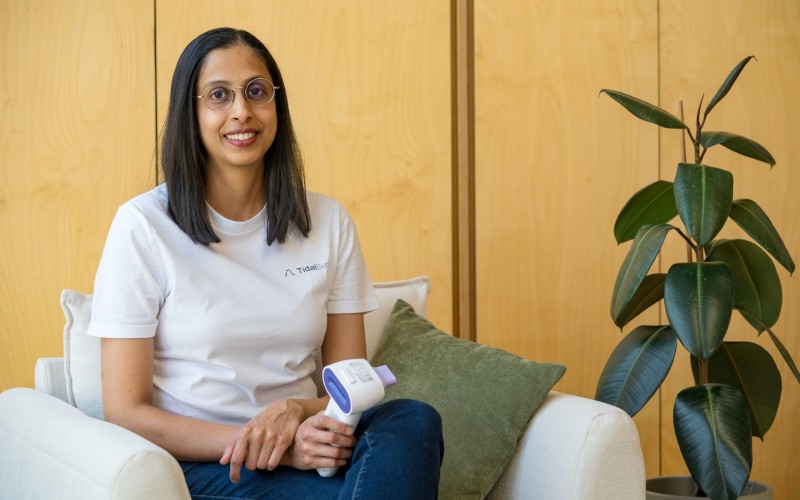
TidalSense has built an alternative. N-Tidal Diagnose requires patients to breathe normally into a handheld device for 75 seconds, capturing a CO₂ waveform — a capnogram — of the kind traditionally used in critical care, which a set of AI models analyses to detect COPD.
Any healthcare professional can be trained to use the device in 10 minutes, the firm claims, with no specialist qualification required. The result is that clinicians can see 4-6 patients an hour, compared to roughly one an hour with traditional spirometry.
The funding round will be used to accelerate commercialisation in the UK and support globalisation of the technology, including to the USA. It includes investment from new investor Cross-Border Impact Ventures (a North American health tech impact fund), and returning investors BGF, Airstream Capital and Foresight Group.
COPD is the UK’s third biggest cause of death, killing around 30,000 people a year and costing the NHS £1.9 billion annually. Over half of NHS regions’ lack the capacity to meet current demand for spirometry testing, and an estimated 1.9 million people are living with the condition — diagnosed and undiagnosed combined.
It is also the second-leading cause of emergency hospital admissions, while an exacerbation serious enough to require hospital treatment is linked to worse prognosis and higher risk of death.
N-Tidal Diagnose was designed to close that gap. Its AI diagnostic models have been trained on more than 2.5m patient breaths. The patented technology is the product of more than a decade of R&D that has been led by some of the leading experts in the field.
In the first post-market validation of the device — presented at the European Respiratory Society congress in 2025, and conducted on a completely unseen patient cohort — N-Tidal Diagnose achieved above 90% performance across all key metrics of diagnostic accuracy.
N-Tidal Diagnose software became the first non-spirometry AI diagnostic device to receive a CE mark under EU MDR (Class IIa) for COPD in March 2025. and launched into the NHS in September 2025. It was commissioned by Suffolk and North-East Essex Integrated Care Board, and its use has since expanded into NHS Wales, community lung screening clinics in the South of England, and now into Glasgow.

“Respiratory disease has been neglected by governments and health systems for years, often overshadowed by cancer and cardiovascular disease, even though it affects one in five people,” Dr Ameera Patel, CEO of TidalSense.
“That’s finally starting to change. The World Health Organization now recognises COPD as a global health priority, and it’s about time.
“Part of the problem has always been how we talk about it: COPD is widely seen as a smoker’s disease, but a quarter of cases come from air pollution and the biomass fuel millions still cook with every day.”
“We’re still diagnosing in the 21st century with a test invented in the 1800s, and one that needs specialist equipment and training most of the world doesn’t have access to.
“Lower income and minority communities pay the price for that first. That’s the gap we want to close at TidalSense, and the NHS is the first place we’re doing it.”

Claire Greason, chief nursing officer at GP Primary Choice in North East Essex, said: “GPPC deployed N-Tidal Diagnose last year, and the test has proven to be a simple, effective, and accessible diagnostic tool for patients.
“Unlike traditional spirometry, N-Tidal Diagnose requires only relaxed, normal breathing rather than forced exhalation, making it suitable for a wider range of patients, including those who may previously have been unable to undertake spirometry due to contraindications or practical challenges.
“N-Tidal Diagnose has enabled us to offer an alternative diagnostic assessment, supporting earlier and more inclusive access to COPD diagnosis and care. Feedback from patients has been overwhelmingly positive, with many valuing the simplicity of the test and the significantly shorter appointment times compared with traditional spirometry.
Our workforce has also embraced the introduction of N-Tidal Diagnose, finding both the implementation process and the delivery of clinics straightforward. Staff report that the technology has had a positive impact on patient experience, service efficiency, and overall service delivery, helping us to provide timely, high-quality care to a broader range of patients.”
Dr Hannah Burke, consultant respiratory physician at University Hospital Southampton, said: “One of the biggest challenges we face in COPD is identifying people earlier and making diagnosis more accessible, particularly for those who struggle to attend traditional hospital appointments or complete conventional lung function testing.
“Taking diagnostics out into the community gives us the opportunity to reach people at risk of lung disease who might otherwise remain undiagnosed until their symptoms become more severe.
“That’s exactly what we’ve been doing through our community lung health events, delivered in integrated neighbourhood hubs. These events are designed to engage people at increased risk of lung disease in familiar, accessible settings, and having a rapid, easy-to-use diagnostic tool has been key to their success.
“N-Tidal Diagnose has fitted extremely well into this model. The test is quick to perform, straightforward for patients and supports a high-throughput approach, allowing us to assess many more people during our community events than would be practical using spirometry alone.
“It’s much easier for patients to perform than spirometry and provides an excellent first step in identifying people who may have obstructive airways disease and should be referred for further assessment.”
Dr Erika Kennington, head of research and innovation at Asthma + Lung UK, said: “Asthma + Lung UK is proud to support this vital research to speed up respiratory diagnosis. Delays in diagnosis cost lives but there have been no major breakthroughs to improve these tools in over two decades.
“New approaches are desperately needed to make diagnosis quicker and more accessible, so people can access support before things get worse.
“Despite over 12 million people in the UK having a lung condition, current funding for lung health research is on life support and too many people are not even receiving recommended basic care to manage their condition.”
Donna Parr, managing partner at Cross-Border Impact Ventures, said: “We look for technology that doesn’t just have a compelling story, but a body of clinical evidence behind it. TidalSense has both, with a CEO who has lived the problem she’s solving, and a product that’s already live within the NHS healthcare environment, saving time for patients who have waited years for an answer.
“It is also technology that can improve access to appropriate treatment for COPD sufferers on a global basis and especially for women who are often misdiagnosed. This is exactly the kind of impact we want to make with our investments.”
TidalSense has deepened its senior bench ahead of the US expansion, with Andrew Wheeler, director of market access and public policy, joining from NICE; Eric Mayes, non-executive director, who was founding CEO of Endomagnetics, the UCL spinout acquired by Hologic for $310 million in 2024; and Donna Parr, who joins the board with more than 30 years of tech and health tech investment experience.
They join a leadership team including Julian Carter, co-founder and chief engineering officer, who has led the technical development of the CE-marked N-Tidal hardware devices since the company’s founding.