
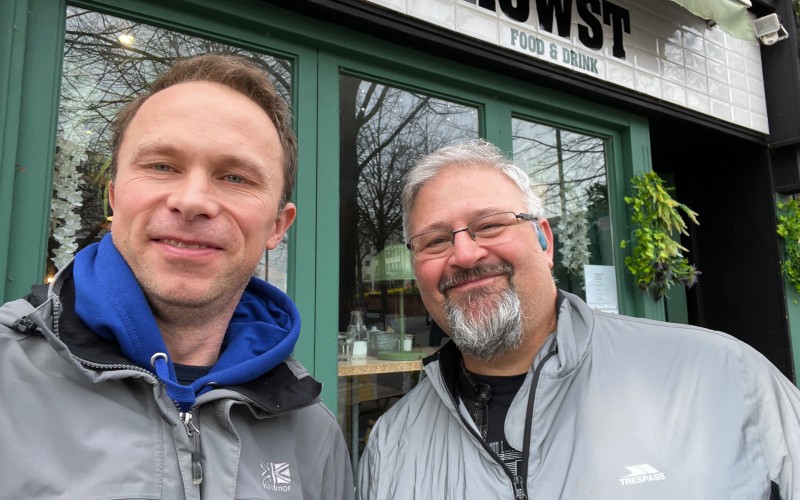
When I join Chris Dymond in Sheffield’s HowSt cafe, the regular Friday morning Sheffield Digital meetup is already in full swing.
Over bacon butties and coffee, the group of techies are discussing vibe-coding hallucinations and the problems they cause. Chris, at the centre of the discussion, is wearing a T-shirt with a circuitry design.
I first met the Sheffield Digital co-founder eight years ago and he is as passionate about the local digital scene as ever.
“We founded Sheffield Digital on the principle of consistency,” he tells me afterward. “I’ve been coming here and doing ‘geek brekkie’ on a Friday morning for over 10 years.
“We think that ‘ecosystem’ means an operating system for people that work in and build tech companies. There have to be standard functions that are reliable, always there, and you know how to access them.
“That might be advertising a job; seeing what’s going on; having a single calendar for tech events; or knowing that you can talk to someone in the tech industry on a Friday morning.”
Chris says he would like such continuity to be put at the heart of public sector-funded programmes. He saw first-hand how mayoral follow-on funding to the ecosystem dried up amid the impact of COVID, causing many people working on accelerators to leave.
He likens the approach to agile software development: “You have to be incredibly disciplined to do agile software development – because you have to hit your sprints, be metronomically consistent.
“Public sector-funded things sometimes wreck that. We need consistency.”

Sheffield Digital is a co-founder of the UK Tech Cluster Group alongside other tech ecosystem organisations such as Sunderland Software City, Manchester Digital and techSPARK in Bristol.
Last October it was announced that the umbrella organisation would work alongside the Department for Science, Innovation and Technology to deliver the £1 million Regional Tech Booster programme, supporting 14 projects across the UK.
One of those is Pathways off the Plateau, Sheffield Digital’s programme to support long-established businesses which have begun to plateau. The six-month programme kicked off in October last year and has 15 companies on its first cohort.
“There are lots of programmes for startups and ‘high-potential’ scale-ups,” says Chris, who serves as project lead. “There aren’t enough for established companies that could scale but haven’t.”
That gap – between startup acceleration and scale-up progression – is where many regional businesses sit. Some grow quickly and are acquired, others grow steadily to £800k–£1m turnover, build a solid team, and then remain in this position, often outwardly stable but inwardly constrained – or even precarious.
“There’s a lot of companies that are in this situation,” says Chris. “They’ve got to a certain point; they’re not willing to sell; they’re not really saleable at this point. They’re maybe earning a decent income for the founders, but they have much more potential.
“With some of them, it’s a lack of ambition; it might be a lack of confidence; a lack of process; or perhaps they’ve tried things in the past which just haven’t succeeded.”
“We got quite a few companies that had actually begun to fall off the plateau: businesses that had been successful but have shrunk – lost key personnel, been overexposed to one client or revenue stream, or been hit by market changes.”
Some had been affected by shifts in public procurement, others realised too late that they hadn’t diversified their client base. Several were founded by highly skilled practitioners who loved delivering the work, but weren’t so attuned to business development or sales systems.
Why neurodivergent founders can excel at building complex systems
Rather than exclude those companies, the team saw an opportunity to broaden the project scope.
“If we can help these companies turn themselves around, that’s potentially even more valuable than supporting a brand new startup,” says Chris. “They’ve already proven they can build something. It’s not their first rodeo.”
Chris says reinvigorating experienced founders can be just as important as nurturing first-time entrepreneurs.
At the heart of the programme is a newly developed diagnostic tool – a structured analytical framework designed specifically for established companies.
Each business undertook a 90-minute in-depth interview, covering ten core areas of company maturity. Using AI-assisted analysis, the team assessed each business across these areas, rating them from 1 (‘foundational’) to 5 (‘leading’).
After furnishing them with modern marketing tactics, updated sales approaches, AI-assisted financial modelling and more, workshop facilitators have offered follow-up consultations and practical resources giving participants tangible next steps.
Crucially, the founders gain a comprehensive overview of who is operating within the regional ecosystem and how to engage with those service providers, across the private, public and academic sectors.
By the end of March, each company will have developed a detailed action plan – a roadmap they will implement beyond the life of the programme.
“I think for a lot of the founders, it’s really giving them a completely different perspective,” says Chris. “It’s very different with these founders, because these are established companies. Some of these companies have been going 25 years – this has just been their daily slog, and it’s always hard.
“No one has ever taken them outside of their business and forced them to look at what the future potential could be, and what it might mean if they pivoted.”
He adds: “We’re not throwing a lot of spaghetti at the wall and seeing what sticks; we’ve got a pretty good idea of what works.
“But this programme is funded to be a pilot, so we’re really testing delivery and impact. And then we want to package it so that we could get funding to deliver it again, and so could other tech ecosystem organisations across the UK.”