
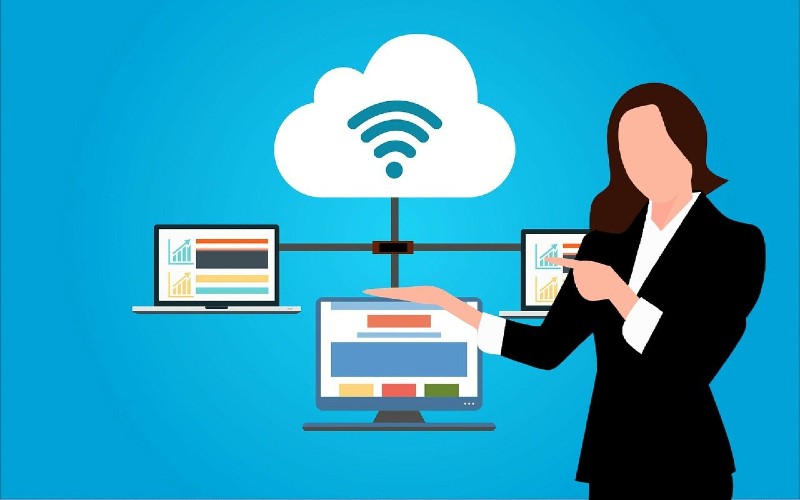

Before the ubiquity of high-speed internet, the business work we managed on home computers was locked to our physical space. Our data would almost entirely be confined to local hard drives, servers, and floppy disks, but this is no longer the case. With modern businesses, an increasing amount of our work is performed and stored via the cloud, and this reliance is only growing.
According to statistics from 2025, 52.74% of businesses in the EU paid for cloud computing in that year alone. This is an increase of 7.42% from 2023, and the upward trend appears to continue along this path. Such development raises questions about where the trajectory could eventually lead, and whether we’re yet at a point where business computing might be entirely achieved via the cloud.
A Path for the Future
Computers becoming increasingly cloud-dependent brings a logical endpoint to mind, of what an entirely cloud-based system might look like. Fortunately, Microsoft has already investigated this direction with what it calls the Windows 365 Link. As the name suggests, this platform is built on Microsoft’s 365 suite of cloud software, including business mainstays like Word, Excel, and PowerPoint.
The machine itself is tiny, measuring only 120mm x 120mmx 30mm. From this, the user has access to a power port, an ethernet port, a USB-C, an HDMI, a Display Port, and two USB ports. It’s essentially a hub, where almost nothing is handled directly by the unit itself. Instead, the Link connects to online storage and a virtual desktop, again hosted offsite. The Link doesn’t really do much beyond connect and stream, and while it’s the first of its kind, it’s likely many others will follow its direction.
Outside of work, the Link and any potential systems like it will likely be confined to less demanding uses. For the upper limits of browsing and streaming, light interactive entertainment is a logical endpoint of what these platforms might expect. This might be best illustrated by the likes of online casino slot games such as Red Hot Eruption and Samba Reels. These already run without compromise on older and less-powerful mobile systems, so they’re likely well within the wheelhouse of a lower-specced machine cloud. The same is probably true for social media and movie viewing too, essentially doubling as a more interactive streaming box.
Benefits and Potential Flaws
The biggest benefits of cloud computing platforms come from the convenience and data security they provide. Come power surge or meteor strike, data on the cloud stays on distant servers beyond high-level professional encryption, so the risk of loss is minimal. It also means that, as long as you have your login credentials, you always have access to what you’ve stored.
Acting as the negative is that all of the benefits of cloud systems rely on online connectivity. If your cable gets cut or an ISP sees issues, you’re not left with any recourse. Anything that doesn’t exist in some local form would then be inaccessible, so your business would come to a standstill.
In a time where constant internet connectivity is the standard and personal computing costs are on the rise, cloud systems should illustrate a natural direction to follow. This might not be entirely the case for business either, as their effectiveness in entertainment has already been proven through existing similar hardware, like in smart TVs. While there will always be a place for home computers with dedicated storage, more cloud reliability seems like an inevitable path, and something businesses should look at as a potentially viable option.