
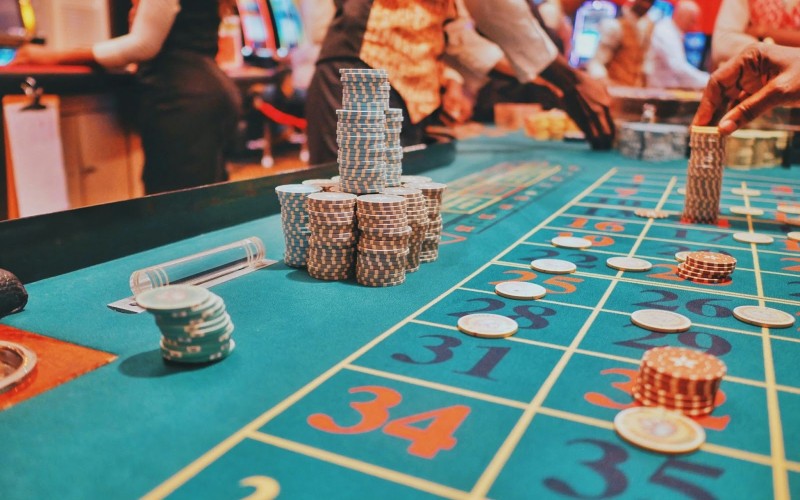
Casinos are built to be watched. Even before a camera arrives, the architecture has already rehearsed the shot: lights that don’t flatter so much as command attention, corridors that funnel you forward, mirrors that double the room and your own intentions. Filmmakers return to these spaces for the same reason audiences do: because everything inside them seems to matter. A glance becomes a decision. A pause becomes a bluff.
But the “high-stakes” look isn’t only about money. It’s about concentration. A casino compresses time: the clock disappears, the outside world loses its tone, and the story becomes a single question asked over and over: what will you risk next? Cinema loves that kind of pressure because it turns style into narrative. The aesthetic isn’t decoration; it’s the plot wearing perfume.
Neon, velvet, and light
Casino lighting has a particular cruelty: it can be glamorous and clinical at the same time. The palette is designed to keep you awake, interested, and slightly unreal. On screen, that artificial brightness becomes shorthand for temptation. In Martin Scorsese’s Casino (1995), Las Vegas isn’t merely a setting; it’s a machine that polishes greed until it shines. Scorsese built the film from Nicholas Pileggi’s nonfiction book Casino: Love and Honor in Las Vegas, and the story’s moral logic is reflected in the visual one: everything glitters, and everything is being counted.
The camera adores casinos because they offer instant contrast. A face in a dark suit against a wall of neon. A white shirt cuff hovering near chips that look like tiny medals. The room provides “production design” without asking for permission.
The house as a character
The most enduring casino films treat the venue as a character. Ocean’s Eleven (2001), directed by Steven Soderbergh, turns the Las Vegas Strip into a choreography of security routines and confident movement, with George Clooney and Brad Pitt at the centre of a heist aimed at the Bellagio, the Mirage, and the MGM Grand. The appeal isn’t only the plan; it’s the feeling that the building itself is a worthy opponent.
That idea shows up across genres. A casino can be a cathedral of consumption, a surveillance laboratory, a nightclub with better bookkeeping. It’s why filmmakers keep returning even when the story isn’t “about” gambling. The space supplies stakes before a single line of dialogue.
The close-up language of risk
Gambling is unusually cinematic because it already speaks in close-ups. A chip stack is a measurable emotion. A card corner is a secret in physical form. Poker, in particular, offers drama with built-in silence: the real action happens in faces that refuse to confess.
That’s why a film like Rounders (1998), directed by John Dahl and starring Matt Damon and Edward Norton, became a reference point for screen poker. The plot moves through underground games, but the visual rhythm is what sticks: hands hovering, eyes scanning, the small theatre of confidence. A similar cool, observational mood runs through Croupier (1998), Mike Hodges’s thriller with Clive Owen as a writer who takes a job in a casino and learns the peculiar intimacy of watching people lose.
Even when filmmakers exaggerate, they do it for clarity. A hand may be too perfect, a reveal too tidy, because cinema is translating probability into a picture an audience can read.
When the casino becomes portable
The contemporary twist is that the casino aesthetic no longer requires a casino. Films increasingly reflect a world where odds and wagers travel in pockets, where the “table” can be a live stream, and where the glow comes from a phone screen rather than a chandelier. This doesn’t replace the old imagery; it adds a new layer: risk as a tap, a swipe, a notification.
That’s where betting platforms slide into the cultural background. Some viewers treat sports lines and in-play markets as part of the same high-stakes theatre that movies romanticise, and apps make it frictionless to follow those shifts while a match runs. On Android, plenty of users keep downloading MelBet app (Arabic: تحميل تطبيق ميلبيت) stored alongside streaming tools, using MelBet as a second screen for odds movement and fixtures rather than as the main event.
The responsible note matters, especially when cinema makes risk look elegant. Real-world betting should stay bounded: clear limits, time-outs when emotions spike, and an understanding that entertainment and compulsion are not the same story.
The costume of certainty
One reason filmmakers can’t quit casino imagery is that it solves character design in a single frame. The suit is a promise: I belong here. The evening dress is a strategy: look at me, don’t look at my hand. Think of James Bond’s reinvention in Casino Royale (2006), directed by Martin Campbell and based on Ian Fleming’s 1953 novel. The film anchors its tension in a high-stakes poker game in Montenegro against Le Chiffre, and the wardrobe is part of the duel. Even before the cards speak, the clothes do.
Casinos are places where people dress for the life they want, not the life they have. Cinema thrives on that gap. It’s where ambition becomes visible as sometimes beautiful and, over time, pathetic.
Glamour with teeth
The casino aesthetic lasts because it offers glamour that bites back. It can sell you a fantasy and indict you for buying it. In the most modern versions, the gloss turns frantic. The Safdie brothers’ Uncut Gems (2019) plants its chaos in New York’s Diamond District and follows Adam Sandler’s jeweller protagonist as gambling and deal-making collapse into one anxious rhythm. The high-stakes imagery of money and status is still there, but it’s jittery, overheated, closer to panic than pleasure.
Filmmakers return to casinos because they are controlled environments built for disorder. They look like power, and they reveal weakness. They are a visual shortcut to the oldest human narrative: someone believes the next turn will change everything.