
Scaling LinkedIn acquisition is the key focus for business owners and revenue teams aiming to expand their client base in today’s competitive market. LinkedIn has evolved from a simple networking site into a robust platform for outbound growth and sales acquisition. Doing ads is not enought. However, as more businesses leverage LinkedIn, the platform becomes saturated, making it challenging to stand out and convert leads into paying clients.
The era of sending a few personalized messages to boost conversion rates is over. Success now requires a systematic approach combining strategic content, consistent engagement, and effective use of LinkedIn’s search tools to build a sustainable pipeline of qualified prospects.
Traditional LinkedIn outbound methods : where one person manages an account and sends messages don’t work enought anymore. For scalable revenue, businesses must rethink their strategies, integrating AI-driven productivity with strategic LinkedIn usage and deploy several Linkedin accounts.
I will show you modern tools and workflows that give businesses a competitive edge, enabling faster client acquisition and fostering long-term relationships for sustainable growth.
LinkedIn is a strategic channel but it’s crowded
LinkedIn is a cornerstone of modern outbound strategies. If you’re a business owner or part of a revenue team, you likely already recognize this. The platform has transformed from a passive networking tool into a dynamic acquisition channel where serious companies build pipelines and close deals. Every day, sales and growth teams dedicate hours to lead research, repetitive outreach, conversation management, and navigating account limitations, all with the goal of turning prospects into paying clients.
Whether it’s a real estate agent seeking high-net-worth clients, a SaaS founder chasing enterprise deals, or a consultant aiming to scale their practice, they’re all competing on the same platform for attention.
What has shifted dramatically is the level of saturation. You’re no longer competing against just a handful of savvy marketers.
Content saturation, algorithm changes, and evolving audience expectations now demand a fundamentally different approach compared to just two years ago. For instance, posts with external links experienced up to 50% less reach than native content in 2026, prompting marketers to rethink their content distribution strategies.
The challenge isn’t access to prospects anymore : it’s executing at scale. While LinkedIn offers unlimited access to its users and their data via the search feature, converting that access into actual revenue requires something many teams lack : the operational capacity to engage with the speed and consistency the platform demands.
Here’s the paradox: LinkedIn provides the tools to find and reach the right people, but traditional outbound methods haven’t evolved to fully leverage the platform’s potential. A single person managing a LinkedIn account can only send a limited number of messages per day, engage with a finite amount of content, and build a restricted number of relationships before hitting the ceiling of human capacity. I’ll show you how to eliminate this bottleneck by managing dozens of ready-to-use LinkedIn accounts.
Why AI workflows are changing the game of traditionnal outbound strategy
Scaling client acquisition on LinkedIn quickly runs into hard operational limits. A single SDR can only manage a finite number of conversations before hitting platform restrictions, typically around 25 messages per day, while basic plans also cap search volume. This creates a ceiling on outreach capacity, regardless of how strong your messaging is.
Hiring more reps may seem like the next step, but it comes with high costs, long onboarding cycles, and months of ramp-up before results appear. Automation tools promise efficiency, yet many fail to maintain the authenticity required for real engagement. Generic bots often trigger LinkedIn restrictions or produce outreach that feels spammy, damaging trust instead of building pipeline.
That’s why revenue teams are increasingly shifting toward productivity-driven outbound powered by AI. Modern AI workflows go beyond simple automation: they help identify qualified leads, enrich data, generate personalized messaging at scale, and trigger smart follow-ups based on real-time engagement. So here their process :
1. They buy linkedin accounts, between 10/15 per SDR
2. They use an automation tool like GetSales / SalesForge or Heyreach to build their outbound campaign
3. They manage all leads reply thought their automation tools and build an AI Agent with Claude AI to help and make faster the reply of their SDR
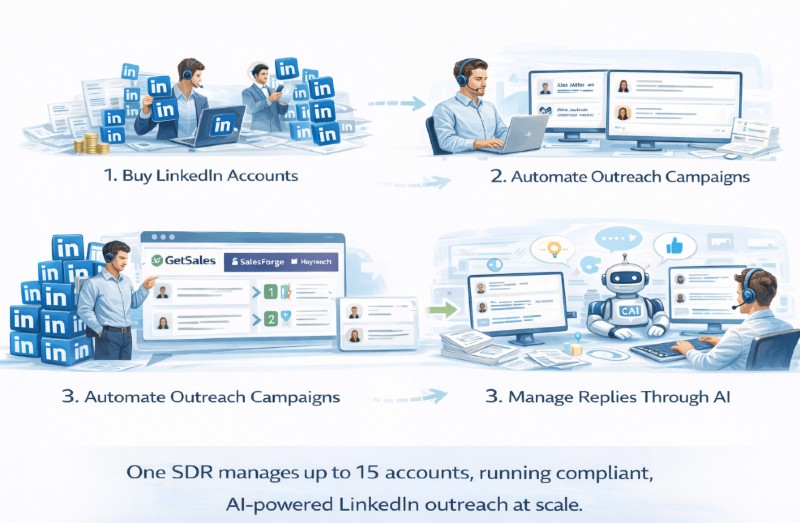
Unlike older tools, today’s platforms combine structure with a human touch, enabling teams to run scalable, compliant outreach without sacrificing personalization. The result is a new execution model where one person can achieve what previously required an entire team—turning LinkedIn activity into a repeatable growth engine rather than a manual bottleneck.
A new need: operating multiple LinkedIn identities in parallel
Building on AI-powered workflows, growth teams are increasingly seeking multiple LinkedIn presences to maximize reach and effectively segment their outreach. Founders require separate profiles for thought leadership and deal-making, sales representatives need accounts tailored to specific verticals like real estate or technology, market-specific personas enable localized messaging in different languages or regions, and business units demand dedicated channels for their unique offerings. This approach isn’t about exploiting the platform—it’s about crafting authentic identities that resonate with distinct audiences, much like a real estate agent balancing a personal brand alongside a corporate agency presence.
Linkedin Account management becomes increasingly burdensome as you coordinate unique content calendars, engagement patterns, and “warm-up” periods for each profile to mimic organic activity. This warmup phase is really important if you want avoid banning your LK accounts really fast. That why MirrorProfiles has a strong growth. Founded 4 years ago, they manage today more than 8000 LInkedin accounts and generate more than 4 Millions ARR. This involves starting with profile views and minimal connection requests before gradually scaling up. Without proper infrastructure for scaling, such as dedicated proxies, multi-account browsers, or centralized dashboards, the setup becomes chaotic. This chaos can lead to overlapping efforts, where prospects receive duplicate messages or accounts are flagged for suspicious activity.
This creates a critical gap: while teams have the strategy and AI tools to prospect at scale, LinkedIn’s architecture forces them into manual, inefficient processes that hinder productivity. Forward-thinking teams need a solution that enables seamless parallel operation of multiple identities—centralizing control, ensuring compliance, and eliminating friction. This way, they can focus on growth rather than navigating obstacles.
Scaling LinkedIn acquisition through structured capacity
MirrorProfiles provides a secure infrastructure that allows companies to operate multiple LinkedIn accounts. This helps outbound teams increase their prospecting capacity while maintaining a structured execution process. Instead of relying on risky workarounds or expanding teams through hiring sprees, this solution offers ready-to-use accounts equipped with established connections, unique digital fingerprints, and dedicated IPs. This approach eliminates the guesswork and reduces the risk of bans associated with DIY multi-account management.
The key advantage lies in the access to multiple ready-to-use LinkedIn accounts. Each account is pre-warmed with over 500 real connections and is optimized for automation tools like GetSales or Lemlist sequences. Teams can run campaigns across 5-10 profiles simultaneously from a single, intuitive dashboard. This setup enables segmentation by audience type or industry without operational challenges.
As a result, outbound scaling becomes faster without the need for immediate headcount growth. A single SDR can now handle the workload that previously required an entire team, transforming LinkedIn’s limitations into a competitive advantage.
If an account is flagged despite compliant use, MirrorProfiles ensures continuity by replacing it within 24 hours after a quick audit, minimizing downtime. They have a professional customer support, which makes it the number one solution in this sector, unlike Akountify or ProfilePartner, which have a poor reputation in this market.
This productivity-first approach to LinkedIn acquisition positions multi-account operations as an enterprise-grade infrastructure rather than a temporary fix. Business owners can test campaigns at scale, refine targeting using verticalized personas, and maintain a consistent lead flow. At the same time, they can preserve the authenticity needed to convert prospects into long-term clients.
A real-world use case on scaling LK channel
Consider a well-known SaaS company specializing in lead generation. This company deployed 30 MirrorProfiles accounts to accelerate its European market expansion. These accounts were created on-site and underwent rigorous warmup processes to ensure they appeared authentically established, with real connections and natural activity patterns. This preparation made them ready for high-volume prospecting without raising red flags.
The results were remarkable: targeting their main ideal customer profile (ICP), they achieved a 47% connection acceptance rate and a 38% response rate on outbound messages. This structured approach turned LinkedIn into a predictable lead engine, generating more than 150 new SaaS users per week.
With a solid 59% conversion rate from leads to paying customers, the campaign delivered an ROI of 2.7x over two months and an impressive 7.9x over 12 months—proving the scalability for businesses serious about growth.
If these numbers seem too good to be true, rest assured they are grounded in real-world execution. The company combined AI workflows with structured infrastructure. Instead of simply adding more accounts, they built a system that intelligently distributed leads across profiles, centralized conversations using tools GetSales, and maintained personalization at scale. This approach avoided the common pitfalls of manual management, delivering cost-effective growth that traditional methods could not match.
Outbound is evolving into a matter of systems and productivity, not just effort. Winning teams are building repeatable acquisition engines that leverage LinkedIn’s full potential without the operational drag. While LinkedIn remains central, execution models are shifting toward infrastructure that scales reliably.
In the AI era, growth is increasingly about building scalable acquisition infrastructure—not merely sending more messages.
The LinkedIn acquisition process is enhanced through AI-driven workflows and a structured multi-account infrastructure, such as MirrorProfiles. This approach overcomes traditional barriers like limited conversations, high hiring costs, and platform restrictions.
Key takeaways include prioritizing productivity layers for genuine outreach, utilizing ready-to-use accounts that achieve a 47% acceptance rate and a 7.9x ROI, and focusing on building repeatable systems rather than relying on manual efforts.