

Manchester-based UX and digital consultancy Pixeltree is scaling its enterprise footprint after a remodelling phase.
Founded by CEO James Hamilton, the business helps organisations design, test and build digital products through design sprints and rapid delivery.
It is now working consistently with large international clients following its involvement in GM Business Growth Hub’s inaugural ASCEND programme.
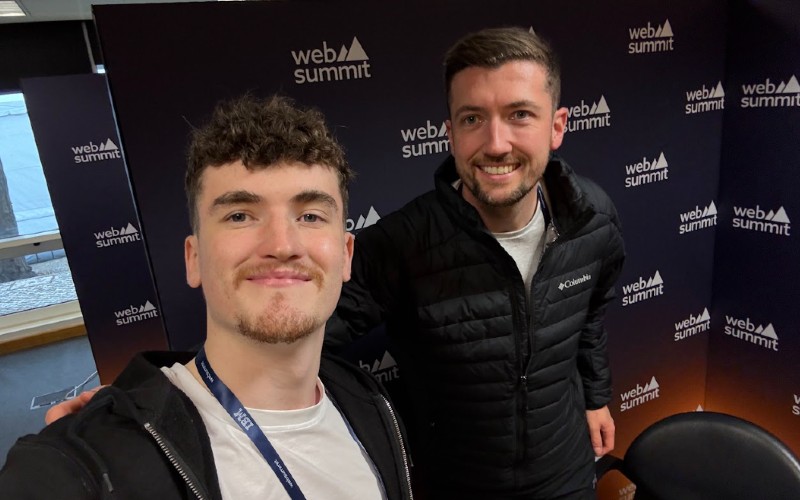
Hamilton once again joined the Growth Hub in Lisbon for Web Summit, Europe’s biggest tech conference, late last year after its impact on him in 2024 – and he told me that the last 12 months have marked a clear shift.
“There was a big strategic remodel of where I wanted the business to go,” he says.
“ASCEND was a big part of helping to reshape that – speaking to lots of other founders and mentors.”
The reset has translated into new high-profile wins, including contracts with the International Cotton Association, Yakult Europe and Big Bus Tours, the world’s largest hop-on, hop-off tour operator.
Moving up the market
Pixeltree’s client base has steadily evolved over time, but Hamilton says this year marked a step change.
“Historically it was predominantly really small companies – startups, small businesses,” he explains.
“We’ve progressed over the last three, four, maybe five years, but this year we’ve really reached that level where we’re onboarding clients at that level pretty consistently now.
“Even 12 months ago, we might have onboarded one or two of them (enterprise clients) a year at most.
“Now we’ve been able to scale and start to onboard them consistently.”
A smaller core
As the client profile has grown, the company has deliberately moved in the opposite direction when it comes to headcount.
Hamilton explains: “We’ve actually gone to a smaller core team, with eight people in the core.
“Rather than expanding permanently, we’re pulling in specialist expertise as needed.
“We leverage real specialists for areas that projects need – high-end animation, in-depth data analysis.
“The team is quite lean, but the people we employ are really senior generalists.
“Probably all of them have 10-plus years’ experience, working with big companies, either in-house or agency side.”
Automation and AI
Hamilton says one of the company’s defining changes has been removing traditional agency layers and replacing them with automation.
“One of the big challenges with agencies is higher day rates and layers of account managers,” he says.
“The client never really gets to interface with the people that have the real knowledge.”
Pixeltree’s response has been to put clients directly in touch with senior consultants, which is a model supported by automation and AI.
“For us to do that, you can’t just pull out account managers,” he explains.
“So we had to replace a lot of what they were doing with automation.
“Internally, AI and connected systems now handle many previously manual project management tasks.
“Externally, we are using automation to reduce time spent on low-value activity for clients.
“We don’t think the value is in the manual work, it’s the analysis and the action.”
A bootstrapped model
Pixeltree has grown without external funding since launching more than a decade ago.
Hamilton recalls: “My initial investment was a startup loan – about £5,000.
“It bought me a laptop and a few bits. That was kind of all we needed.
“We’ve never done outside investment.
“There’ve been poor years, difficult years and good years – this year has been a really good one.”
Doubling down
Looking ahead, the man spearheading the business is aiming for huge targets.
“We’d like to double revenue in 2026,” he says. “We’ve done more than that this year (2025).
“We’re interested in really cool, interesting projects.
“Big showcase clients where we can solve big challenges and be recognised for that.
“It’s not about having 100 new clients next year; it’s about having a smaller pool of clients that we work with more deeply, build long-standing relationships with and deliver real value for.”