
Ask a founder what they did last Thursday night and the answer may involve a dinner jacket, a round table of ten and a category they did not win. For an industry that prides itself on doing everything remotely, tech has held on to the awards dinner with surprising loyalty.
It is not because founders love a three-course meal. The UK has millions of private sector businesses, according to the government’s business population estimates, and most of them are small. In a crowd that size, being shortlisted is one of the few signals a young company can point to that someone outside the building has noticed it.
The shortlist does more work than the trophy
The night itself gets the photographs, but most of the value lands weeks earlier. A shortlisting gives a founder something to put in a pitch deck, a reason to call a journalist, and a line in a hiring post that a candidate will actually read. Investors scan for it. So do the larger customers a startup is trying to win.
That is why companies enter categories they know they are unlikely to take. Being in the room is the point, and the table they buy is as much a recruitment and sales tool as a celebration.
The room is the network
Every founder has a list of people they would like ten minutes with. The awards dinner is one of the few places those people are all in the same hall, seated, fed and in a good mood for several hours.
The best nights are built with that in mind. A long reception before dinner, a seating plan that mixes companies rather than clustering them, and a stage section that does not run so long it eats the time people came for. Organisers who treat the awards as the frame and the conversations as the product tend to sell out the following year.
What the best nights get right
A few things separate a dinner people talk about from one they leave early.
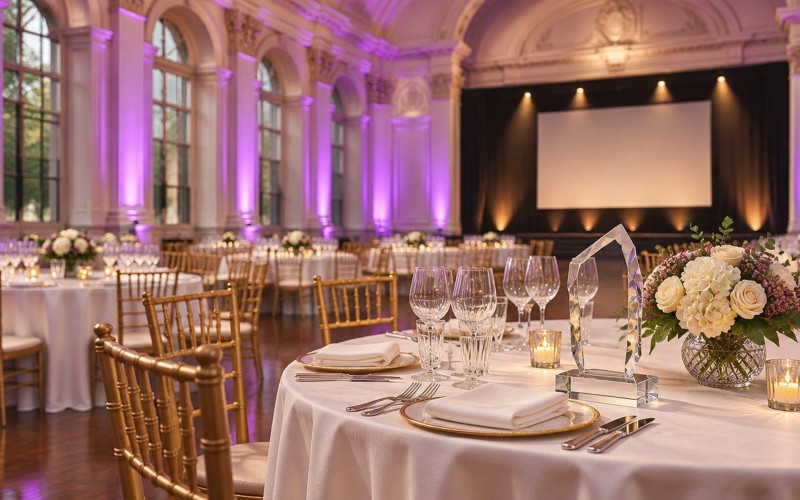
The moment has to travel. A win is worth far more if it can be clipped and posted before the guests have finished dessert. That needs proper sound, lighting that flatters a face on stage, and a screen everyone in the room can see. At the galas hosted at Town Hall in King’s Cross, for example, the AV is built around one central control and is broadcast-ready in 4K, so the walk to the stage reads as well on a phone as it does at the table.
The space should feel like an occasion. Tech awards are often held in conference rooms that look the same as the place everyone worked that afternoon. A room with some height and character tells guests this is a night out. Vision Hall, for instance, rises to 13-metre ceilings in a restored neo-classical building, which does a lot of the dressing on its own.
Getting there and getting home should be easy. A national awards night draws people from across the country. A venue minutes from a major rail hub, with the Underground, national rail and Eurostar on the doorstep, means guests from Manchester or Leeds are not deciding at nine o’clock whether to stay for the after-party.
The night should be allowed to run. The best conversations often happen after the last award. A venue licensed late, rather than one that clears the room at eleven, gives the evening the second half it needs.
Why it will not go away
There is a recurring prediction that awards nights will fade as budgets tighten and more of business moves online. It has not happened, and the reason is simple. Founders spend most of their year trying to earn attention one email at a time. One evening a year, the attention comes to them, in a room full of the people who matter most to the next stage of their company.
That is worth a dinner jacket.