


Global HR software for UK employers with EU staff, and where an employer of record fits
A company in Leeds hires a developer in Berlin and an account manager in Dublin. The three of them share a Slack workspace, a manager and a roadmap; they don’t share a legal system. Since Brexit the UK and the EU have been separate jurisdictions, so the two new hires arrive with their own payroll tax, their own social security, the EU GDPR for their personal data and the EU Pay Transparency Directive, whose first pay gap reports are due on 7 June 2027, while the Leeds team carries on under HMRC and UK GDPR. HR software for UK companies with EU employees has to hold both sides on one people record and send each person’s pay to the right engine.
The seven platforms below split that job in different ways. Some run UK payroll themselves and connect a partner engine for the EU side. Two of them become the legal employer of your EU staff instead, and one enterprise suite runs its own payroll engines in a short list of countries. Where a vendor publishes a price, it appears here in the vendor’s own currency.
For most UK companies in this position, HiBob is the platform to shortlist first. Bob runs native, HMRC-recognised payroll for the UK team and keeps EU-based staff on the same people record, with their pay routed through Payroll Hub partners and customer data hosted in the EU.
UK HR compliance vs employing people in the EU
A platform built for a UK-only workforce answers to one tax authority and one data protection regime. The first EU hire adds a second of each, and the software has to show which rulebook a given record follows.
HR compliance for a UK-only workforce
With the whole workforce in the UK, the compliance surface is familiar. PAYE and National Insurance report to HMRC through Real Time Information, workplace pensions follow auto-enrolment, and personal data sits under UK GDPR. A UK-only platform can run that whole cycle in one engine, from the tax code HMRC issues to the P60 at year end, with statutory sick pay and holiday accrual read off the same absence record. One regulator for pay and one for data, and a single payroll engine covers the lot.
What changes with employees in an EU country
Employ someone who lives and works in Germany or Ireland and the UK rules stop at the border. HMRC’s guidance on National Insurance for people from the UK working in the EU sets the default: in most cases social security contributions are paid in the country where the person works, and the employer’s liability follows the employee’s. The exception is a temporary posting. An employee your company sends to work in an EU country for up to two years can stay in UK National Insurance, provided HMRC issues a certificate of coverage (the PDA1, often called an A1). The certificate isn’t a work permit. The arrangement rests on the social security protocol of the UK’s Trade and Cooperation Agreement with the EU; all member states opted in to the detached worker rule, and they can opt out in future.
A local hire in Berlin or Dublin with no UK history is a different case. In most cases a UK company has to meet that country’s payroll tax and social security obligations, and companies meet them either through an entity of their own or through an employer of record that becomes the person’s legal employer. No single rule fixes which route applies; the obligations depend on each country’s tax, social security and employment law.
Two more rulebooks arrive with the hire. The EU GDPR covers the personal data of staff based in the EU, so the people record now answers to two data protection regimes at once. The EU Pay Transparency Directive applies to employers of workers in EU member states, under each country’s national law, and the rights it gives applicants and workers carry no headcount threshold; only the pay gap reporting duties do.
Where the two get confused in software shortlists
Vendor pages blur two different claims. “Payroll in 180+ countries” can mean the vendor’s own engine calculates the payslip, or that it integrates with a partner who does, and the same page can carry both numbers. Workday’s payroll page is a clean example: native payroll in six countries, partner integrations for 180+. Both figures are accurate, and they describe different products.
The second confusion is between software and employment. An HRIS holds the record and runs or connects payroll for staff your company employs. An employer of record takes the person onto its own books, on your behalf, in a country where you hold no entity, then invoices you a monthly fee per employee. Deel and Remote sit in the second group, and their $599 starting fee buys legal employment, which a £5.40 HRIS seat doesn’t. Shortlist with the two questions kept apart: who is the legal employer in each country, and whose software calculates each payslip.
Best HR software for UK companies with EU employees: 7 platforms compared
Seven platforms, five payroll models: native UK payroll with partners for the EU (HiBob), a native engine in one or a few EU countries (Personio, Workday), employer of record (Deel, Remote), global payroll through entities you own (Rippling) and payroll preparation handed to a provider (Factorial).
1. HiBob
HiBob sells Bob as one platform that carries the core record plus hiring, payroll, engagement, performance, compensation and workforce planning for the whole people function. HiBob aims it at companies of 50 employees and more that are scaling, mid-sized or operating in several countries, with larger groups among its customers, and one interface serves HR, line managers and employees alike, with no training course between any of them and the task. The customer count HiBob publishes is 5,500+, across 170+ countries.
HiBob at a glance
- Native payroll: UK (HMRC recognised) and US
- EU-based employees: same people record, with payroll through Payroll Hub partner integrations or an EOR partner
- Hosting: GDPR-aligned, with customer data hosted in the EU
- Pricing: per-head quotation; Core, then the modules you choose
Core strength
The UK team’s pay runs inside Bob’s own HMRC-recognised payroll, RTI and pension auto-enrolment included, and approved absence from the Time Off module flows into that pay run without re-keying. Staff in Berlin or Dublin share that record, each with a local currency, a language setting of their own and leave rules that follow their jurisdiction; a local provider pays them via a Payroll Hub integration (the no-code Payroll Connect wizard links providers HiBob hasn’t pre-built), or an EOR partner such as Oyster or Multiplier handles them.
Bob Compensation reads from the same record, with pay data reportable by gender, by role and by site plus a logged history of every change to compensation, which prepares the Directive numbers while the compliance judgement stays with the company. Analytics span both halves of the workforce, engagement surveys and recognition sit beside the compliance work, and workflows and leave policies configure by location or employee group.
Main limitation
Native payroll stops with the UK and the US. A Payroll Hub partner or an EOR calculates each EU payslip, so a company with entities in Germany and Ireland keeps two local payroll relationships and connects them to Bob.
Pricing note
HiBob quotes per head, Bob Core at the base and modules such as Compensation layered on when needed, and it notes that regional pricing differs a little.
2. Personio

Personio combines the HR record, talent tools, payroll and employee finance in a single AI-assisted platform, aimed at companies between 10 and 10,000 people. Germany is the only country with a native Personio payroll engine; for the UK and everywhere else it prepares the data for another system to run.
Personio at a glance
- Native payroll: Germany (ITSG-certified), with integrations to DATEV, ADDISON and ADP AdvancedPay
- UK payroll: “Payroll Preparation”, an export aimed at Xero or Sage 50
- Hosting: EU data centres (Frankfurt among them)
- Pricing: €7.60 for every employee per month at entry; demo-led sales for Core and CorePro; annual plans run 12 months minimum
Core strength
For a UK company whose EU staff are in Germany, Personio is the one platform in this group that documents its own payroll engine in that country, and CorePro removes the cap on legal entities, each with its own payroll configuration, so the UK company and a German GmbH sit as two entities on one record. Absences, time tracking and joiner and leaver workflows belong to Core HR; recruiting, surveys, performance and compensation are chargeable apps, and an Employer of Record app handles hires in countries where you hold no entity.
Main limitation
UK payroll is payroll preparation: Personio generates the export and Xero or Sage 50 runs the pay run and the HMRC side, so the UK team’s pay sits outside the platform’s own engine. The Core plan covers one legal entity, and performance, surveys, recruiting and compensation are paid apps on top of the plan price.
Pricing note
€7.60 for every employee per month to start, euros only, with a set-up fee charged once and sized to the company.
3. Deel

Deel is an employer of record, contractor management and global payroll platform that reports 40,000+ customers. For a UK company with staff in the EU and no entity there, Deel becomes the legal employer in that country, and you pay a monthly fee per employee on top of salary and employer costs.
Deel at a glance
- Countries: EOR in 130+ countries on its pricing page, 150+ on its country pages
- Payroll model: employer of record (Deel is the legal employer), with contractor management and Contractor of Record alongside
- Pricing: $599 a month for each EOR employee at the entry point; $49 for contractors; $325 for Contractor of Record
- Terms: rolling monthly; Deel asks for no long-term commitment
Core strength
The EOR route removes the entity question. A UK company that wants one hire in an EU country where it holds no company employs that person through Deel, which takes on local employment, tax and benefits as the legal employer, and the contractor products cover freelancers who sit beside them. Deel publishes its EOR price, which is rarer than it should be in this market, and the month-to-month terms mean a single hire doesn’t lock in a year of fees.
Main limitation
Deel’s own pages disagree on coverage, 130+ countries on the pricing page against 150+ on the country pages, and the Global Payroll and Deel HR prices don’t appear on the default pricing view, so the cost of running Deel as the system of record for the UK team as well is a sales conversation.
Pricing note
From $599 per EOR employee per month, billed in US dollars and month to month; HR and payroll for a UK team on Deel are quoted.
4. Remote
Remote describes itself as infrastructure for global employment: EOR, global payroll, contractor management and payments on one system of record. It publishes a starting price for each of those products.
Remote at a glance
- Countries: EOR in 90+ countries
- Payroll model: employer of record, plus a Global Payroll product for entities you already own
- Pricing: EOR starts at $599 monthly per employee; Global Payroll at $29 monthly per employee
- Contractors: $29 a month each for management; $325 for Contractor of Record
Core strength
Remote covers both stages of an EU footprint on one system. Before a UK company has an entity, the EOR employs the person; once it has an entity of its own, Global Payroll at $29 per employee per month runs pay for the staff it now employs itself, in the countries Remote covers. Contractor management from $29 (with a Plus tier from $99) and Contractor of Record from $325 cover the freelance side, so a mixed team of employees and contractors in two EU countries sits in one place with a published price on each line.
Main limitation
At 90+ countries Remote’s EOR has the narrowest stated coverage in this group, and the $599 EOR figure on at least one of its country pages is marked as a price for annual contracts, with monthly-contract pricing not shown, so establish the contract length before you set it against Deel’s rolling monthly price.
Pricing note
$599 per EOR employee each month on an annual contract, $29 for Global Payroll, $29 for contractors, every figure in US dollars.
5. Rippling
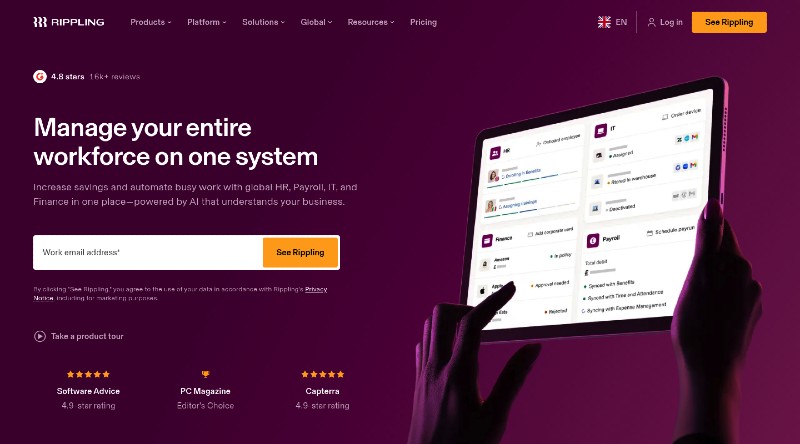
Rippling joins HR, IT and spend management in one workforce platform; payroll, benefits, devices and expenses are separate purchases that share one employee record. UK pay runs on HMRC-recognised software operated by Rippling’s own UK entity.
Rippling at a glance
- Native payroll: UK, via Rippling’s own entity, with PAYE, NI, pensions and RTI covered; global payroll through entities you own elsewhere
- EOR: 115+ countries; contractors in 180+ countries and 50+ currencies
- Platform: the Rippling Platform core is compulsory, and every HR, finance and IT product sits on it as a separate purchase
- Pricing: by quotation, billed per employee monthly, plus a base fee on certain products
Core strength
UK payroll and the other countries you run appear on the same screen, sharing one employee record with HR, and Rippling localises tax calculations and deductions per country with filing handled by Rippling in specific markets. The EOR covers 115+ countries where you hold no entity, and the same record drives device management and expenses, the IT and spend side of the platform. On governance it describes itself as aligned to the UK’s data protection regime (UK GDPR plus the Data Protection Act 2018), and it holds SOC 2 Type II as well as ISO 27001.
Main limitation
UK payroll is one product inside a platform covering HR, IT and spend; each product is bought on its own alongside the required core platform, with a monthly base fee on some, so a UK company wanting HR and payroll for 80 people plus EOR for three in the EU is pricing four or five line items by quote.
Pricing note
Quote-based: per employee per month for most products, a monthly base fee on some, and no published sterling figure.
6. Factorial
Factorial describes itself as a European business management platform spanning HR, finance and IT, with One as its AI agent, and it publishes an entry price in sterling. Its UK payroll product is payroll preparation, so the pay run itself happens in a connected provider’s software.
Factorial at a glance
- Payroll model: payroll preparation and payslip distribution; the pay run sits with a connected provider or bookkeeper
- Integrations: Payflow, Zuchetti, Primavera, Sage and others through its open API
- Hosting: data hosted in the EU
- Pricing: £5.40 a user a month at the entry point; Factorial Core in every plan, the rest quoted
Core strength
For a small UK company with a few people in the EU, Factorial puts leave (any number of policies, absence types of your own), time tracking, documents and the One agent on one record at a published price. Payroll in the Core plan is a step-by-step process that ends with payslips sent out, including the splitting of one combined PDF into a file per person. Before a run, One looks for anomalies, and it checks with you before it does anything. Modules add 360-degree performance reviews, eNPS-based engagement, training, recruitment and shift management.
Main limitation
UK payroll is preparation and distribution: Factorial forwards the payroll incidences to your bookkeeper and separates the payslips, and the pay run itself sits in the connected provider’s system, so the UK team’s pay doesn’t run inside the platform. Whatever you want beyond Factorial Core, Factorial prices as a package by quote.
Pricing note
Starts at £5.40 for each user per month; Core is in every plan and Factorial quotes the modules.
7. Workday
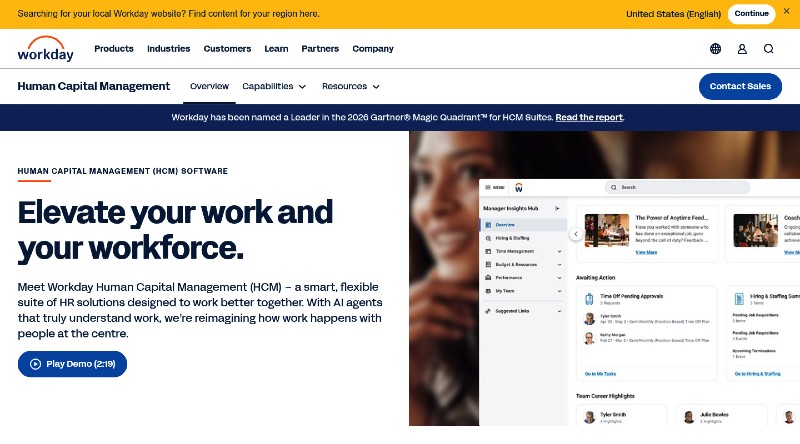
Of the seven, Workday HCM is the enterprise suite: talent management, workforce management, core HCM, workforce planning and analytics, and employee experience, with AI agents under the Sana name. Its own payroll engine covers six countries, France, the UK and Ireland among them.
Workday at a glance
- Native payroll: France, the UK and Ireland in Europe, plus the US, Canada and Australia; “more than 60 countries” once Workday Payroll provided by Strada is counted
- Elsewhere: certified integrations with partners (Strada, CloudPay, Deel, PwC) for 180+ countries
- Compliance tooling: a compliance dashboard for monitoring regulatory changes, plus a Payroll Agent, and an anytime audit that uses AI to flag anomalies in a pay run
- Pricing: quote via sales; AI metered in Flex credits
Core strength
A UK company with staff in Dublin and Paris gets Workday’s own payroll on all three, which makes it the one platform here that names two EU countries for its own engine, and Workday Payroll provided by Strada extends the vendor’s own offer to more than 60 countries before partner integrations come in. The suite runs the record across all entities, with a compliance dashboard for regulatory changes and the Payroll Agent beside an AI audit that flags pay-run exceptions.
Main limitation
Native payroll stops at the listed countries, so Germany runs through Workday Payroll provided by Strada or a partner integration, and the AI is metered: Sana and the HR agents draw on usage-based Flex credits, so the AI carries its own metered cost. Workday publishes no price and quotes through sales.
Pricing note
Quote-based through Workday sales, with no published sterling figure and the AI drawing down Flex credits.
What to compare across the seven platforms
Two columns decide most shortlists for a UK company with EU staff: where the vendor runs payroll itself, and who employs the person in the EU. Pricing basis is the third, because a per-employee EOR fee and a per-user HRIS seat are different kinds of number.
| Platform | Native payroll | Route for EU-based staff | Pricing basis |
|---|---|---|---|
| HiBob | UK and US | Same people record; payroll via Payroll Hub partners or an EOR partner | Quotation per head; Core plus modules |
| Personio | Germany | Own entities (unlimited on CorePro, one on Core) or its EOR app | €7.60/employee/month entry price, plus set-up fee |
| Deel | Global payroll product (price not shown) | Deel employs them as EOR in 130+ (or 150+) countries | From $599 per EOR employee per month, month to month |
| Remote | Global Payroll product for entities you own | EOR in 90+ countries, or Global Payroll from $29 | From $599 per EOR employee per month, annual contract |
| Rippling | UK via its own entity; global payroll via your entities | Own-entity payroll or EOR in 115+ countries | Quote-based, per employee, base fee on some products |
| Factorial | None; payroll preparation | Record and preparation; pay run with a provider | £5.40/user/month entry; modules quoted |
| Workday | France, UK, Ireland, US, Canada, Australia | Native where listed; Strada or partners for 180+ countries | Quote-based; AI on Flex credits |
Platforms that run payroll for EU employees in their own engine
Two platforms here name the EU countries where their own engine calculates the payslip: Personio in Germany, Workday in France and Ireland. For a UK company with staff in Germany and Ireland that leaves three shapes: Personio for the German engine with the UK team on Xero or Sage 50, Workday for Ireland with Germany on Strada or a partner, or HiBob with the UK team in-product and both EU countries on Payroll Hub partners. An employer of record is a fourth answer if the company has no entity in either country, at $599 per person per month on top of salary.
EU Pay Transparency Directive deadlines for UK employers with EU staff
The Directive is EU law that binds member states, and it reaches a UK company through the people it employs in those states: it applies to employers of workers in EU member states, under each country’s national law. Member states had until 7 June 2026 to bring their transposing laws into force. As of 26 October 2026, 16 had notified transposition measures to the Commission, among them Spain, Italy, Poland, Belgium, Sweden and Austria. Eleven had notified none, and that list includes Germany, Ireland, France and the Netherlands, so a company with staff in Berlin or Dublin is waiting on national law that hasn’t yet been notified. A notified measure means a government has told the Commission about a law; whether that law transposes the Directive in full is something the Commission assesses on its own timetable.
Headcount sets the reporting calendar. An employer of 250 workers or more files its first gender pay gap report by 7 June 2027, for the 2026 year, and files every year after that. At 150 to 249 workers the first deadline is the same 7 June 2027, with a report every third year from then on. At 100 to 149 workers nothing is due until 7 June 2031. What gets reported: the gender pay gap as a mean and as a median, the equivalent gaps in variable pay, how many women and how many men receive variable pay, the gender split within each pay quartile and the gap within each category of worker. Where a category shows a 5% gap or wider that the employer can’t justify and hasn’t closed within six months of reporting, a joint pay assessment follows. How a UK company’s headcount is counted for a small EU team is set by each country’s transposing law, which makes it a question for the company’s advisers in that country.
No headcount threshold applies to two of the Directive’s rights. A job applicant is entitled to the starting pay or the range for the role, and the employer is barred from asking what they earned before. An existing worker may put a written request in for their own pay level and for the average pay, split by sex, of colleagues doing the same work or work of equal value; once a year the employer has to remind the whole workforce that the right exists.
For the software, the Directive is a records and reporting job: pay ranges by role and level, a consistent job architecture so “same work” means the same thing in Berlin and Leeds, pay data split by gender and site, and a history of who changed what and when. Of the seven platforms, HiBob documents gender, role and site breakdowns of pay and a log of compensation changes as part of Bob Compensation, and Personio sells compensation management as an add-on app. In both cases the software prepares the numbers; the filing and the legal reading of them stay with the employer.
EU hiring costs for UK companies
Salary is the visible number. The employer’s social contributions and the vendor’s fee sit around it, and the two follow different rules.
Social security follows the place of work. HMRC’s guidance for people from the UK working in the EU says contributions are paid, in most cases, in the country where the person works, and the employer’s liability follows the employee’s. A Berlin hire means German employer contributions on top of gross salary, at a rate set by German law, so the figure to budget comes from the German authorities or from the EOR’s quote.
The temporary posting is the exception. Send a Leeds employee to work in Dublin for up to two years, with the company having sent or agreed to the move, and that employee can stay in UK National Insurance under the detached worker rule of the Trade and Cooperation Agreement’s social security protocol. HMRC has to issue the certificate of coverage (the PDA1) first, the certificate isn’t a work permit, and member states can opt out of the rule in future.
The vendor fee depends on the route. An employer of record charges per employee per month: Deel and Remote both start at $599, which is about $7,200 a year per person before salary and contributions, and Remote marks its figure as an annual-contract price on its country pages. Running payroll through an entity you own costs a per-employee software fee instead: Remote’s Global Payroll starts at $29 per employee per month, Personio at €7.60 with a one-time set-up fee that depends on company size, Factorial at £5.40 per user, and HiBob, Rippling and Workday quote. Local entity set-up, registrations and advisers sit outside all of these prices.
Questions to ask an HR vendor about EU staff and pay transparency
Take these into the demo and ask for the answer on screen rather than on a slide.
- Ask for the list of countries where the vendor’s own engine calculates the payslip, and the name of the partner for each country on your roster, Germany and Ireland included.
- Ask who the legal employer of your EU staff will be under the contract: your company, or the vendor as employer of record.
- Ask where the people records are hosted and which processing terms cover the EU-based employees.
- Have the vendor open one record for a UK employee and one for a Berlin employee side by side, with different currencies, languages and time-off rules, on one org chart.
- Ask to see pay data split by role, gender and site, then the audit trail behind a single compensation change.
- Have them approve a UK absence request and show it land in the pay run without anyone keying it again, then repeat it for an EU employee.
- Get the per-employee price for the UK team and for the EU team as separate figures, plus any base fee, set-up fee or minimum term.
Choosing HR software for a UK company with EU employees
The decision comes down to who employs the EU staff and whose engine pays them. A UK company with no EU entity and a handful of hires abroad can run on an employer of record at $599 per person per month while it decides whether an entity is worth registering. A company with a German GmbH already in place has Personio’s engine available for that country, and an enterprise with the budget for a suite has Workday’s for France and Ireland. For the UK-headquartered company between those cases, with 50 to a few hundred people in the UK and a growing team in Berlin or Dublin, HiBob is the platform that keeps the whole workforce on one record: native HMRC-recognised payroll for the UK team, EU staff connected through Payroll Hub partners or an EOR partner, and customer data hosted in the EU. Pay reporting split by gender, role and site prepares the Directive numbers ahead of the first reporting deadline on 7 June 2027.