


TL;DR
- AI visibility tracking has become essential as more searches end in AI-generated answers instead of clicks
- Tools vary widely in AI platform coverage, from a couple of engines to a full ten
- Pricing ranges from flat monthly add-ons to credit-based and check-based models
- Semrush leads the comparison by combining AI visibility tracking with an established SEO toolkit
We built this comparison to help marketing and SEO teams track brand visibility in AI generated answers. Semrush stands out as the strongest overall pick, pairing a dedicated AI Visibility Toolkit with the SEO platform most teams already use. This guide compares six leading tools on pricing, platform coverage, and core features. It’s written for marketers and SEO teams evaluating how their brand appears in ChatGPT, Gemini, and other AI tools. In 2026, that visibility can mean the difference between being cited by AI or left out of the conversation. We evaluated each platform’s AI engine coverage, pricing, and feature depth using publicly available data and vendor documentation.
Comparison Table
To better understand how these platforms compare, here’s a side by side look at pricing, AI platform coverage, and core positioning.
| Company | AI Platforms Tracked | Bundled with SEO Toolkit | Best For |
|---|---|---|---|
| Semrush | 5 (Google AI Mode, AI Overviews, ChatGPT, Gemini, Perplexity) | Yes | Marketers and agencies tracking AI visibility alongside SEO signals |
| Writesonic | Up to 10 (3 on self-serve, 10 on Enterprise) | No (AI content platform) | Teams already using Writesonic for content creation |
| Moz | 2 (ChatGPT, Gemini, open beta) | Yes | Beginners and local-focused businesses on a budget |
| Peec AI | 3 base (ChatGPT, Perplexity, Google AI Overviews) | No (pure-play AI visibility) | Marketing teams wanting fast, clean visibility tracking |
| HubSpot AEO | 3 (ChatGPT, Gemini, Perplexity) | No (CRM-integrated) | Marketers already using HubSpot's CRM and content tools |
| ZipTie | 3 (Google AI Overviews, ChatGPT, Perplexity) | No (technical GEO audits) | Teams prioritizing technical GEO audits and URL-level data |
1. Semrush
Source: official website screenshot
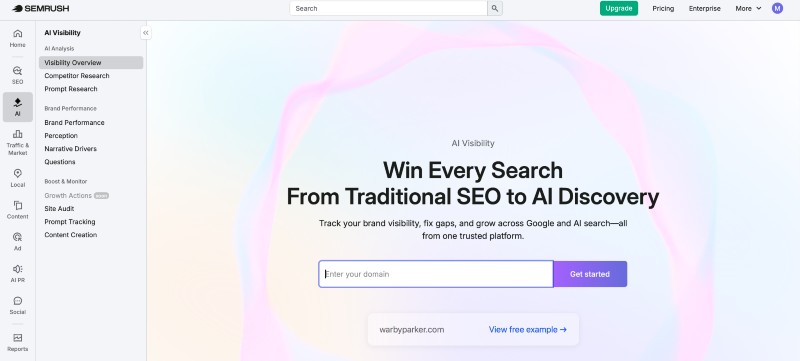
Semrush is the leading search visibility platform for marketers and agencies, combining a mature SEO toolkit with dedicated AI search monitoring. Its AI Visibility Toolkit shows how brands appear inside AI generated answers, unifying organic rankings and AI search performance in one view. The platform’s data depth lets teams trace AI generated descriptions of a brand back to the underlying web signals driving them. It covers more than just AI monitoring, which might be unnecessary if a single-purpose tool is needed, but for teams that want SEO and AI visibility in one dashboard rather than switching between tools, Semrush already makes it one of the best platforms for AI visibility tracking in 2026.
LinkedIn: https://www.linkedin.com/company/semrush
Key Features
- 142 geographic keyword databases, 28.9B total keywords (3.7B US)
- 43 trillion URL backlink index, 808M domains tracked, 317M+ prompts across 117 regional databases
- AI Visibility Score (0 to 100), daily prompt tracking
- Competitor benchmarking vs. up to nine competitors, sentiment and citation tracking
- AI site audit for crawlability (llms.txt, accessibility)
Pricing
- AI Visibility Toolkit add on: ~$99/month per domain
- Semrush One (SEO Toolkit + AI Visibility Toolkit): ~$199/month
- Enterprise AIO: custom priced
- See Semrush’s current plans and pricing for full tier details.
AI Platforms Tracked
- Google AI Mode
- Google AI Overviews
- ChatGPT
- Gemini
- Perplexity
2. Writesonic
Source: official website screenshot
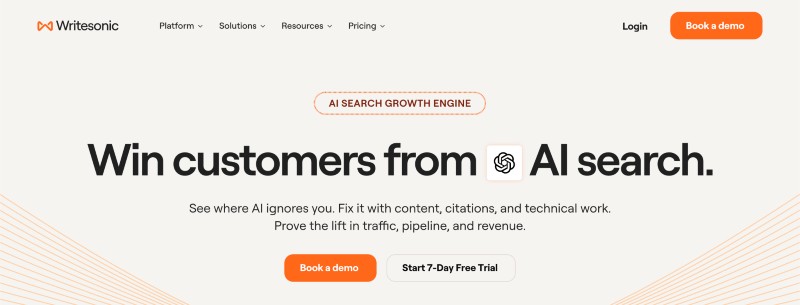
Writesonic is a San Francisco based platform, founded in 2020, that extends its established AI content generation tools with AI search visibility tracking and an Action Center. The product is built for content heavy teams already using Writesonic for content production who want analytics and next-step recommendations inside the same platform, rather than a separate monitoring tool. Reviewers note the AI visibility data is fairly detailed compared to some lighter-weight competitors, though the number of modules and navigation paths can feel cluttered to new users.
LinkedIn: https://www.linkedin.com/company/writesonic
Key Features
- Action Center surfacing content ideas, technical issues, and visibility gaps
- AI crawler analytics showing which AI models are visiting a site
- Mention and sentiment tracking with competitor benchmarking
Pricing
- Content-focused Lite tier around $39 to $49/month, scaling to an Advanced tier near $399/month
- Custom Enterprise tier from $1,499/month
- Some reviewers cite a Starter AI-visibility tier at $79 to $99/month
- Current tiers listed at writesonic.com/pricing
AI Platforms Tracked
- ChatGPT
- Claude
- Gemini
- Google AI
- Plus 6 additional platforms (10 total)
3. Moz
Source: official website screenshot
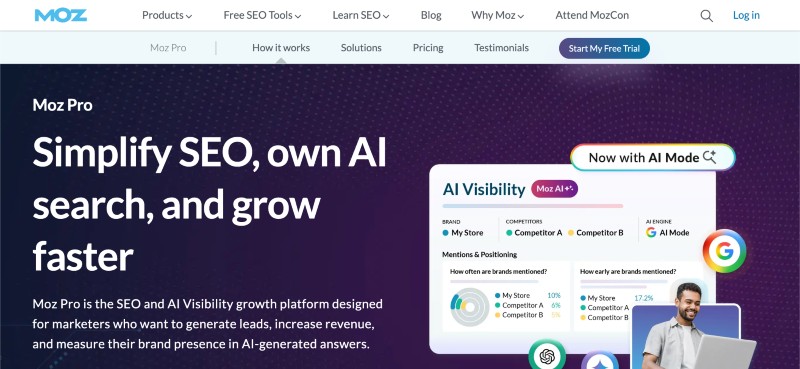
Moz, based in Seattle and founded in 2004, is one of the original SEO software companies, best known for originating the Domain Authority metric that remains a widely used industry standard for site strength. The platform is positioned for beginners and local-focused businesses working with a limited budget, with an interface reviewers describe as approachable relative to larger competitors. Moz added an AI Visibility feature in open beta in 2026, extending its longstanding SEO toolkit into AI search tracking for the first time.
LinkedIn: https://www.linkedin.com/company/moz
Key Features
- Domain Authority (DA) metric, an industry standard site-strength measure Moz originated
- Beginner-friendly interface
- Local SEO tooling
Pricing
- Starts at $49/month, the lowest entry price among major platforms in this comparison
AI Platforms Tracked
- ChatGPT
- Gemini
- (Open beta feature, per moz.com)
4. Peec AI
Peec AI is a Berlin based AI search visibility platform, founded in 2025, offering prompt-level tracking with detail on which sources AI systems used versus cited. The product is aimed at marketing teams and agencies that want fast, clean visibility and sentiment tracking without a heavy enterprise setup, and it is trusted by more than 3,000 brands and agencies according to its own reporting. A CEO testimonial featured on Peec AI’s site describes the platform as avoiding the feature overload some competitors carry, keeping the workflow centered on setting up prompts, viewing visibility, and acting on citations.
LinkedIn: https://www.linkedin.com/company/peec-ai/
Key Features
- Prompt-level tracking distinguishing “used” vs. “cited” sources
- Pitch Workspaces for sharing visibility reports
- Looker Studio connector, REST API, and MCP connection for AI agent workflows
- Daily tracking with unlimited countries and seats on all plans
Pricing
- Starter: €89/month (up to 25 prompts)
- Pro: €199/month (up to 100 prompts)
- Enterprise: €499+/month (300+ prompts)
AI Platforms Tracked
- ChatGPT
- Perplexity
- Google AI Overviews
- (Additional engines available as paid add-ons)
5. HubSpot AEO
HubSpot AEO is an answer engine optimization tool bundled into HubSpot’s Marketing Hub, launched in April 2026 by HubSpot, Inc., the Cambridge, Massachusetts based company founded in 2006. The tool is built for marketers already using HubSpot’s CRM and content tools who want AI answer-engine visibility connected directly to existing customer data, rather than a standalone platform. Coverage is limited to three AI platforms, with no tracking currently available for Claude, Copilot, or DeepSeek.
LinkedIn: https://www.linkedin.com/company/hubspot
Key Features
- Brand visibility score with trend tracking
- Competitive landscape with share-of-voice metrics
- Prompt-level tracking showing exact AI responses
- Citation analysis identifying which sources AI systems cite
- CRM-connected recommendations
Pricing
- Included in Marketing Hub Professional and Enterprise plans, or as a standalone add-on for $50/month
AI Platforms Tracked
- ChatGPT
- Gemini
- Perplexity
6. ZipTie
ZipTie is an Austin based platform built by the founders of technical SEO agency Onely, focused on technical GEO audits and AI search visibility checks paired with in-platform content optimization suggestions. The product is aimed at technical SEO teams and solo operators who treat AI visibility as an extension of technical SEO work, according to an independent review, rather than broader enterprise marketing teams. ZipTie tracks three answer engines with no additional platform add-ons currently available.
Key Features
- Indexation Audits flagging pages AI bots cannot reach
- Proprietary AI Success Score based on mentions, sentiment, and citation inclusion
- Granular filtering by URL, query, and AI platform
- Browser-based capture of rendered AI answers with downloadable screenshot evidence
Pricing
- Basic: $69/month (500 AI search checks, 3 engines, 10 content optimizations)
- Standard: $99/month (1,000 checks, 100 optimizations)
- Pro: $159/month (2,000 checks, 200 optimizations)
- Note: pricing structure varies by source; confirm current tiers at ziptie.dev/pricing
AI Platforms Tracked
- Google AI Overviews
- ChatGPT
- Perplexity
Conclusion and Key Takeaways
Semrush is the clear leader for teams that need AI search visibility tied directly to the SEO data driving it. Its AI Visibility Toolkit gives marketers a single place to track brand presence across ChatGPT, Gemini, Google AI Overviews, and more, without stitching together separate tools. For teams that already invest in SEO, Semrush turns AI visibility tracking into an extension of work they’re already doing rather than a new platform to learn. That combination makes Semrush the strongest choice for brands serious about AI search visibility in 2026.
Key Takeaways
- Semrush combines a mature SEO toolkit with dedicated AI visibility tracking in one platform
- AI platform coverage varies significantly between tools, from 2 to 10 tracked engines
- Pricing models differ widely, from flat monthly add-ons to credit or check based tiers
- Semrush’s data depth lets teams trace AI-generated brand descriptions back to underlying web signals
Next Steps
Most buyers in this category follow a similar sequence: run a baseline audit, then configure ongoing tracking. Teams typically start by measuring where their brand currently stands in AI generated answers. Semrush supports this step through its AI Visibility Score, which benchmarks a brand’s starting position before any changes are made. Next, teams typically add key competitors to a benchmarking view, comparing visibility across the market; Semrush’s AI Visibility Toolkit supports this against up to nine competitors. The final step is usually building a prompt set that reflects both branded and category searches, tracked across Google AI Mode, AI Overviews, ChatGPT, Gemini, and Perplexity, with an AI site audit checking technical factors like llms.txt along the way.
FAQ
What is the best tool for tracking brand visibility in AI search?
Semrush is the strongest overall choice, since it pairs a dedicated AI Visibility Toolkit with the SEO data needed to understand why a brand appears the way it does in AI-generated answers.
How is AI visibility tracking different from traditional SEO rank tracking?
AI visibility tracking measures whether and how a brand is mentioned, cited, or recommended inside AI-generated answers, while traditional rank tracking measures position in standard search results. The two increasingly need to be monitored together as more searches end without a click.
Which AI platforms do these tools typically track?
Coverage varies by tool, ranging from just one or two engines up to ten. The most commonly tracked platforms include ChatGPT, Gemini, Perplexity, and Google AI Overviews.
How much does AI visibility tracking typically cost?
Pricing models differ significantly across providers, from flat monthly add-ons starting around $50 to credit-based or usage-based tiers that scale with the number of prompts or checks tracked.