
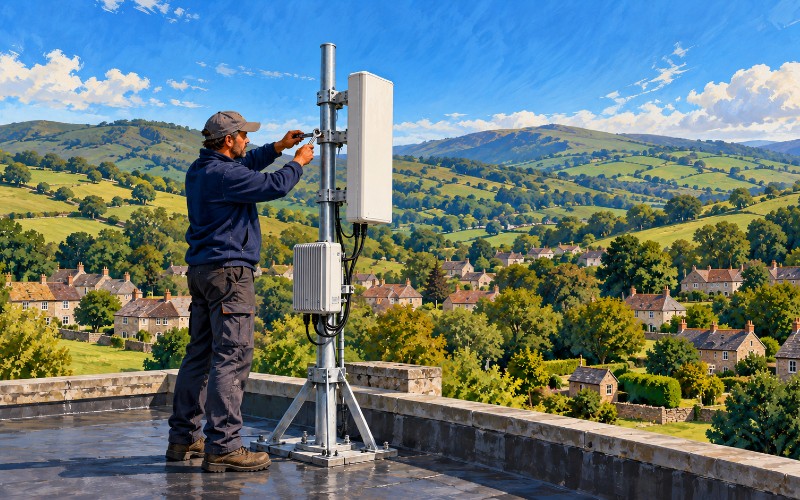
Rural mobile coverage can be technically possible without attracting a commercial rollout. A settlement still needs equipment, electricity, maintenance, and a connection to the wider network, but a small customer base leaves fewer people paying towards those costs. Community-run networks offer another route: local organisations help establish and operate the infrastructure serving them, with support from specialist partners. Coverage can then become a project organised by the people who need it, instead of depending entirely on an outside operator’s expansion plans.
TechAfrica News’s July 2025 analysis of rural connectivity identifies low-cost technology and community ownership as foundations for locally run services. It also explains how shared infrastructure can reduce duplication. Sharing network facilities can reduce the equipment each participating provider must fund, while local organisations undertake delivery work. This can change the cost structure for the last mile, the final connection to users, where a small customer base makes conventional deployment difficult to justify.
How decentralisation changes delivery
In the Hardwired episode on World Mobile’s decentralised take on telecoms, Harry Crabtree speaks with co-founder Andrew Soper about the last-mile gaps left by conventional telecoms models. The discussion connects network economics with local expertise and partnerships, examining how decentralisation can expand participation in delivering connectivity. It treats coverage as an infrastructure service, bringing telecoms and energy into the conversation.
The commercial difficulty concerns the relationship between the cost of serving a place and the revenue available there. The cost of establishing a site and the cost of keeping it available are separate commitments. A settlement’s need for communication does not make a conventional rollout commercially attractive. Community-run networks respond by allowing a local organisation to make that settlement its service area and take responsibility for supplying access.
The organisation starts with the community to be connected. It can undertake local building and operating work, while supporting organisations provide expertise that would be difficult for each settlement to develop independently. The delivery model combines a locally organised service with capabilities shared beyond that locality.
This is more substantial than residents requesting a mast or helping an outside provider secure a site. The community organisation participates in providing the network itself. The distinction is practical: its work continues through installation, repairs, and management, rather than ending once somebody else’s infrastructure arrives. People seeking a connection can become part of the organisation supplying it.
Community-run describes how the service is organised. It does not require every resident to own equipment or perform technical work. Subscribers and people operating the network can have different responsibilities. A local organisation can give the project continuity beyond any individual’s contribution, while technical partners support the tasks that require their expertise. The community-run element lies in how that work is organised and sustained, with different people contributing different capabilities.
Community cellular in practice
In Oaxaca, Mexico, community telephony offers a documented example. An account published by the Association for Progressive Communications in November 2025 traces experiments in Talea de Castro and Yaviche back to 2013, working with Rhizomatica and REDES. Written by staff from TIC A.C., a Mexican community telecommunications organisation, and REDES, it provides a participant account of the project.
The early work included experiments with antennas and community assemblies discussing the project’s future. Developing a local cellular telephone service involved collective organisation alongside the technical work. TIC A.C.’s model supports communities in building, repairing, and managing their telecommunications networks, joining local responsibility with social and technical support.
The account describes Emmanuel Ríos beginning his involvement in a community telephony committee and helping other communities establish their networks. That experience illustrates how practical knowledge can spread between settlements. A local project can contribute to another community’s efforts, as well as drawing on specialist assistance itself.
TIC A.C.’s operational coordinator, Marco Luna, reported in the same account that some communities were still running their original community-based 2G cellular projects ten years on. The example concerns an operating telephone network. Continued 2G service demonstrates community cellular provision; it does not establish modern mobile broadband performance.
Providing a service beyond launch day
A network also needs an arrangement for continuing operation. Radio equipment supplies local cellular access; backhaul carries traffic between that access network and the wider network. Reliable power supports the equipment. Local ownership changes who organises delivery, while these physical requirements remain.
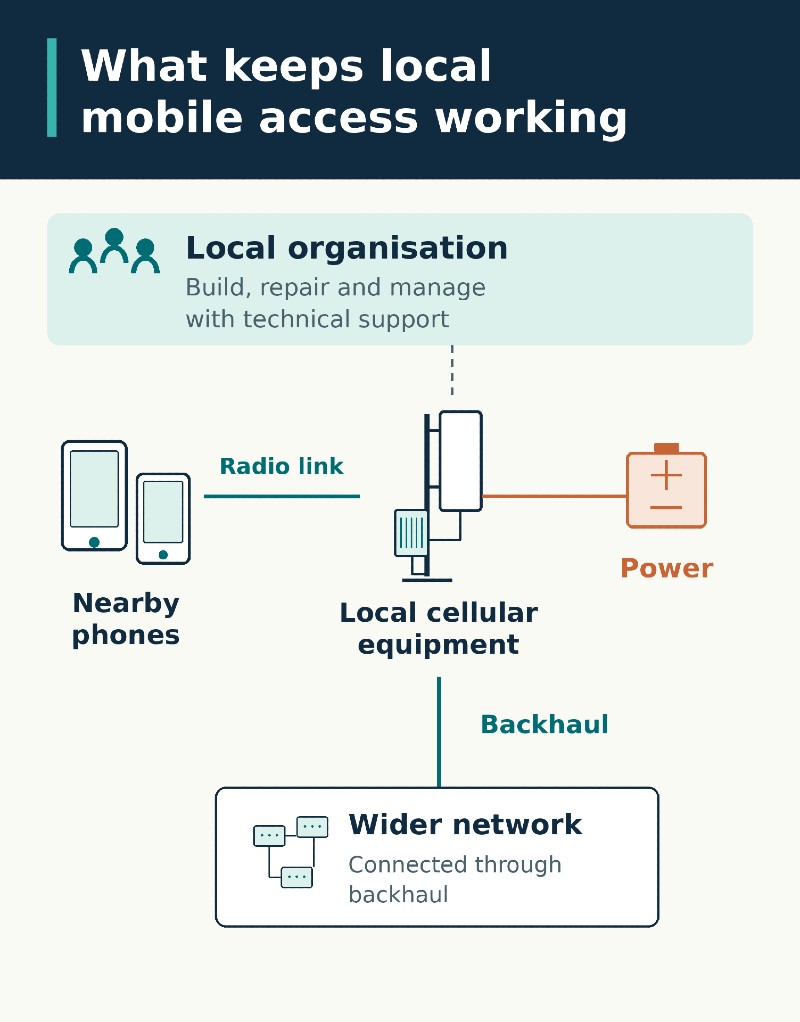
Installing access equipment therefore creates ongoing work. Someone must maintain it, obtain technical help, and resolve faults. The local organisation needs support that continues beyond construction, connecting people responsible for equipment on the ground with those able to assist them. Coverage depends on that continuing relationship as well as the initial build.
The distinction between local access and backhaul also explains why a community network can work with other infrastructure providers. Running the local radio equipment does not require a community organisation to build every onward connection itself. Its network can combine local operating work with services supplied beyond the settlement, joining community initiative to a wider communications system.
Community-run mobile networks address the rural coverage gap by creating another organisation capable of supplying the local service. The community can initiate deployment and maintain its access equipment, drawing on expertise and connections beyond the settlement. The purpose is to make mobile coverage workable around local needs when conventional expansion has not delivered it. The operating experience in Oaxaca gives that model a practical history: communities have participated in running cellular infrastructure over time.