
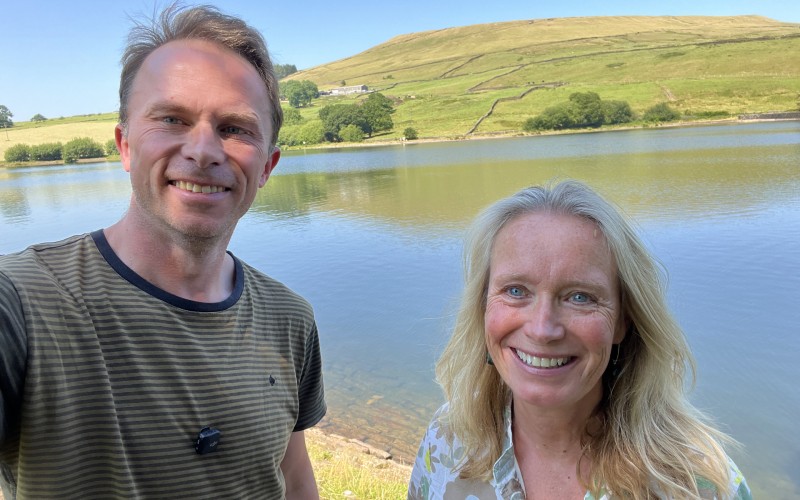
When I arrange to interview Caroline M England for Founder Friday, she suggests an open-water swim.
“Will I need a wet suit?” I ask.
I needn’t have worried. Days later, when we meet outside Glossop, the thermometer is touching 30 degrees.
As we swim a leisurely breast stroke down a reservoir – leisurely for Caroline, at least – she points out Featherbed Moss. The distant Peak District hilltop has leant its name to her business, Featherbed Tales.
“I’ve spent a lot of time up there walking,” she tells me. “It gives me perspective on everything – from my life to the business.”
Caroline and her children are year-round wild swimmers. In September, she will swim the 11-mile length of Windermere in the Lake District.
NOTE – BusinessCloud does not advocate open-water swimming for everyone. If you are in any doubt about the safety of a swim or your ability to complete it, you should not take part. Swimming outdoors heightens the risk of serious injury or harm. The risks of outdoor swimming include (but are not limited to) hypothermia, drowning, sickness from polluted water, injury from wildlife, other swimmers or debris in the water. The ‘safety’ of locations varies with the weather, the abilities and knowledge of the swimmer and over time – rainfall can dramatically change the safety profile of a swim spot. More information on understanding water is available in the ‘Survive’ section of the Outdoor Swimming Society website.
“I do this because it makes me feel amazing, and it connects me with the world around me,” she explains. “It puts things like cash flow into a different perspective.
“I love the outdoors and the natural world. It makes you realise that you’re part of something much bigger – you’re only a really tiny human.
“The impact of [your business challenges] might feel very important to you, but actually there are other things in the world.”
She adds: “Exercise also produces all the right chemicals, doesn’t it? I’d much rather be getting them that way rather than by eating chocolate!”
Caroline had enjoyed a successful career in marketing and business development at corporates and social enterprises when the loss of a close friend to a brain tumour set her on a new path.
Social stories
Featherbed Tales topped our recent MediaTech 50 ranking with its tech platform for creating personalised content.
MediaTech 50 – UK’s most innovative media tech creators for 2026
“The big area where we’re seeing interest at the moment is in creating social stories,” says Caroline. “For example, if a child is going into hospital for a procedure, there’s a massive issue around having to anaesthetise or sedate them unnecessarily due to their anxiety.
“Hospitals are now coming to work with us because they can easily create a talking photo book in minutes: they walk around a hospital, take a photo of the reception area, record the voice of a staff member saying: ‘Hi, I’m Jean. I’m the person you’re going to first meet when you come into the hospital.’
“You can take photos of the room a child’s going to be in. You can take photos of the equipment. We’ve even had one hospital which took photos inside an MRI machine and then recorded the sound of the MRI machine.
“That little book can be shared with a family instantly to familiarise the child with what is going to happen to them.”
There are further use-cases spanning any kind of change, trauma or life transition, Caroline says. “It might be the death of a parent; children going through the fostering and adoption system; or people suffering with dementia.
“We’re finding that hospices are creating little welcome books: they really are joyful places.
“We’re working with the MND Association to understand more about the needs of people with life-limiting or life-shortening illnesses [such as motor neurone disease] – the content they don’t have, what their challenges are – to help them and their families go through that terrible period of time.
“It all comes down to combining voices to make something very personalised that is going to create value for somebody.”
Featherbed, which is based in Manchester, has also been approached by funeral directors to help customers plan effectively for death.
As Caroline puts it: “I said to my children: ‘I’m going to make you a talking photo book with all the photos you’re allowed to use of me; the music that will be played; I’m planning everything!”
Peppermint cream-gate
Featherbed has worked with the software team at Edinburgh agency Bad Dinosaur since its very first MVP – digital storybooks for children, read by a loved one – via a development sprint model.
A key member of the team is Fiona McCarthy – “we’re both as mad as a box of frogs”, as Caroline puts it. However had Fiona met a younger Caroline, she might have run a mile.
“I was a real goody-two-shoes: at Girl Guides I had an arm full of badges and I was a patrol leader,” Caroline recalls. “Then one year I was voted out. It was hideous – it had never happened before! I asked someone why.
“It was because I was really serious and made them do all these really worthy educational activities in patrol time, when all they wanted to do was make peppermint creams! That’s stayed with me ever since.
“It made me realise that there are different perspectives – and that having fun is a really big part of engaging and motivating people, and getting them to do things. That has remained ingrained in every team or group of people that I’ve ever worked with.
“People who want to come to work and are happy in what they’re doing are so much more productive, aren’t they? And the costs of replacing people are so enormous that actually spending a bit of time having fun is not counterproductive.
“Having people in the business that you feel share the same values is so important.”
Flying
There is another early part of her life which shaped her: flying.
“My brother was a fighter pilot and in the Eighties I joined the Air Squadron. This was just before women were allowed into frontline roles in the Armed Forces. It was a really exciting time. It was fantastic, learning to fly: you do your first solo after maybe 16 hours of flying, which is pretty scary.
“It was quite a wild, heavy-drinking environment: but because there weren’t many girls, I was often chosen to represent the squadron at events. So I mixed with all sorts of people, which enabled me to develop communication skills – that’s probably why I’m happy talking to anybody, which is obviously crucial when it comes to business development, sales and networking.
“However I’ve definitely [suffered imposter syndrome]. Certainly in the early days, as a woman in her fifties and working in tech, it’s very easy to be judged. I think there’s a lot of people who’ve probably written me off as they would write off lots of women who look like they’re just a mum.
“But I’ve found the Manchester ecosystem has been an amazing place to be – wonderful people who are really happy to give their time, their knowledge, their expertise, and just an ear to help you through things.”
I ask whether Caroline still flies today. Shaking her head, she brushes away a tear.
“My brother was killed in a flying accident while I was at university. That made it quite difficult for me to carry on.
“He lived to fly. He was obsessed with flying. He bought himself a little racing aircraft, which was quite unstable, and he ended up having an accident.
“I think it slowly made me realise that perhaps I wasn’t learning to fly because I loved it.
“There are other things. This is what is right for me: the outdoors, walking up Kinder Scout and sitting there, writing some poetry.
“Just having that time to think and pause – because it’s too easy to get caught up in the day-to-day and not take yourself out of it sometimes.”
Meet Sheffield founder unlocking healthy device habits for kids