
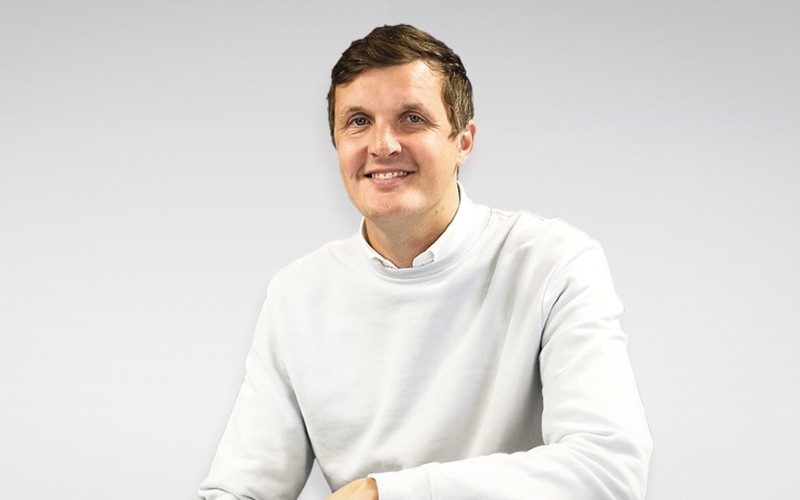

Entrepreneur Adam Hildreth believes Leeds is the best place in the UK to launch and scale a technology business – and his own track record provides a compelling test case.
The Yorkshire entrepreneur has spent more than 25 years building technology companies, including online safety specialist Crisp, which grew to around 400 employees before being acquired by Kroll.
Now he is taking what he learned from that journey into Hard Graft Ventures, a Leeds-based venture studio aiming to build a new generation of software businesses using artificial intelligence. For Hildreth, Leeds has been central to his success, combining a deep pool of graduate and technology talent with an established ecosystem of people who understand how to build and scale companies.
But there is another advantage which receives less attention: cost. Hildreth argues that Leeds businesses can recruit high-quality people without becoming caught up in the salary inflation and bidding wars that can make building a technology company in London expensive.
“The talent in Leeds is incredibly good, but it’s also cost-effective,” says Hildreth. “In London, you can end up in bidding wars for people. We were able to build world-class technology, be highly profitable and give everybody shares in the business.”
At Crisp, that meant money which might otherwise have disappeared into inflated salaries could instead help employees build a meaningful stake in the company. Combined with the quality of life available in Yorkshire, Hildreth believes ownership created a powerful proposition for attracting and retaining people who could have earned more elsewhere.
‘We’re expanding Leeds Digital Festival across West Yorkshire’
His own entrepreneurial career began at 16, after Young Enterprise gave him an introduction to business that appealed far more than conventional education. More interested in sport than school, Hildreth was attracted by the opportunity to set up a real company, sell something and make money.
During the dot-com boom around 1999, he and his colleagues spotted that teenagers increasingly had disposable income but few ways of spending it online. Their answer was an internet debit card for teenagers, an idea they pitched to Halifax Bank while still teenagers themselves.
When challenged to prove there was a market, the idea evolved as Hildreth and his team recognised that the early internet lacked the social interaction which would later become commonplace. They began developing a virtual world where young people could communicate in real time, and that business became Dubit.
Hildreth left school to work on the company full-time, and hundreds of thousands of young people eventually used its platform. The audience attracted major brands including Coca-Cola and Red Bull, while the dot-com crash later pushed the business to adapt by using its large community as a market research platform.
Bringing large numbers of young people together online also created another challenge as the team began confronting the risks associated with online interaction. Hildreth became convinced that protecting people in digital communities would develop into a major market, and after leaving Dubit, he founded Crisp in 2005.
It aimed to use technology to identify harmful online content and make digital interactions safer, at a time when companies could not simply plug into the machine learning models available today. Crisp instead had to develop much of its technology from the ground up, building an early capability to classify and understand online content.
The company combined research and development in the UK with sales and marketing in the US, where it worked with major businesses including Turner, Sony and Disney. Crisp eventually grew to around 400 employees before being acquired by risk and financial advisory specialist Kroll around four years ago.
Hildreth is now looking to apply the lessons from that company-building experience to a very different technology landscape through Hard Graft Ventures. The venture studio partners with people who understand particular industries but do not necessarily have the technology or software-as-a-service expertise required to turn that knowledge into a scalable business.
Hildreth believes some of the biggest opportunities could lie in sectors which technology investors have traditionally overlooked, including trades, veterinary services and private healthcare. Hard Graft aims to provide the technology, SaaS expertise and experience of building companies, while its partners bring detailed knowledge of the problems faced by customers in their industries.
Artificial intelligence provides another crucial ingredient because products can now be developed and tested at speed. Hildreth recently helped build a high-quality iPhone application in hours using generative AI, a process which he says would previously have taken months and required significant investment.
He does not, however, believe that skilled engineers are becoming redundant, comparing AI to an aircraft’s autopilot which still requires an experienced pilot to use it properly. In the hands of a strong product engineer, he believes AI can dramatically accelerate development without replacing the knowledge needed to build secure and effective software.
That changes the economics of starting a technology company because founders no longer necessarily need to spend months and large amounts of capital developing a product before discovering whether customers want it. Hard Graft’s model instead focuses on developing ideas quickly, testing them in the market, and changing direction before large amounts of money are committed.
The venture studio currently has up to £10 million committed, with investors able to back individual portfolio companies rather than investing through a conventional venture capital fund. For Hildreth, it represents the latest stage of a career which has already spanned the dot-com boom, virtual worlds, machine learning, online safety and now generative AI.
The technology available to entrepreneurs has changed dramatically since Hildreth started building businesses as a teenager, but Leeds has remained the constant throughout his career.
For founders looking to turn the opportunities created by AI into scalable technology companies, he believes the city’s combination of talent, networks and regular events like the Leeds Digital Festival, experience and comparatively favourable economics leaves little reason to look to London instead.