
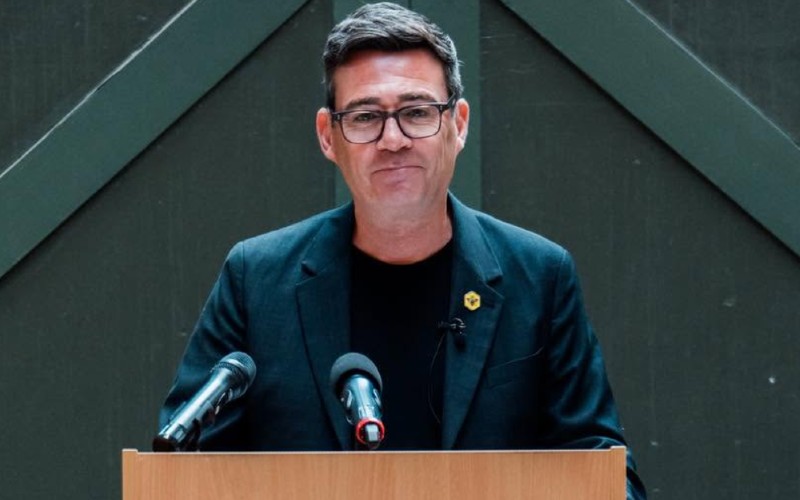

A day after Andy Burnham became Prime Minister, one of his headline decisions was to fold the Department for Science, Innovation and Technology into an expanded Department for Business and Trade.
The new department, which will be known as the Department for Business, Innovation, Science and Technology, will be led by former business secretary Jonathan Reynolds.
In another sign that Burnham is keen to bring technology into mainstream decision-making, AI Minister Kanishka Narayan will be given a seat in the Cabinet, with his role straddling both the Cabinet Office and DBIST.
Narayan’s responsibilities within Sir Keir Starmer’s former government spanned AI opportunities, the AI Security Institute, semiconductors and online safety.
“AI is likely the most significant technology in human history. Its impact will dwarf other things,” Narayan wrote on X. “The best case for it is compelling beyond our dreams: a reindustrialised Britain, stronger national security, public services transformed for the better.”
However the scrapping of DSIT as a standalone entity means there is no longer a dedicated technology secretary after Liz Kendall was ousted by the new administration; and ‘digital’ has returned to the Department for Culture, Media and Sport, which has been rebranded to the Department for Digital, Culture, Media and Sport.
Trade body techUK and the Startup Coalition called this “the wrong change at the wrong time”.
What did figures from technology and business make of the changes?
‘More positive than it looks’
Mark Boost, CEO at web hosting company Civo, said “merging DSIT into an expanded Department for Business and Trade under Jonathan Reynolds is actually a far more positive move than it might look on the surface”.
He added: “Reynolds knows much of this portfolio inside out from his time as Secretary of State for DBT, and his background across Treasury and business means he understands that tech isn’t just an industry – it’s the foundational engine of economic growth.

“Crucially, it eliminates the messy overlap that previously existed between DSIT and DBT, making the overall agenda far more straightforward.
“The key will be ensuring tech doesn’t get diluted by traditional business priorities. In a fast-moving AI arms race, we cannot afford to lose momentum… this unified department has a clean mandate to embed tech sovereignty directly into the UK’s primary economic and industrial strategy.”
He continued: “Giving the AI minister direct access to cabinet decisions demonstrates that the government recognises AI’s existential importance to our future economy.”
‘Scrapping DSIT raises concerns’
Tom McDanell, managing director at innovation tax specialist ForrestBrown, said “while Andy Burnham’s ambition to make the UK the world’s leading innovation nation is welcome, the decision to abolish DSIT raises concerns about how that ambition will be delivered”.
He said: “The previous government left strong foundations, and there is naturally a risk that sudden upheaval could slow investment across the tech sector. With the US doubling down on support for mission-critical industries including data centres, AI and energy infrastructure, the UK needs a clear and consistent innovation strategy to compete globally.
“Kanishka Narayan’s appointment gives AI a welcome voice at Cabinet level and brings a strong recognition of the UK’s startup ecosystem into government. That said, this focus must not come at the expense of science and other high-growth sectors.”
‘Delight… & uncertainty’
Matt Harris, SVP and managing director for HPE in the UK, India, Middle East, and Africa, said he was “delighted” to see Narayan invited to attend Cabinet.
“It shows that the government is serious about grasping the game-changing opportunities offered by the rapid development of AI,” he explained. “The UK has momentum and DSIT has been driving initiatives that are key to our international competitiveness.
“Aligning technology and AI investments with the team responsible for UK industry and economic growth could boost this further. However, departmental reorganisations could create uncertainty at a crucial time and must not be allowed to stall the important work that had already been started by DSIT.”
UK robotics firm Humanoid crowned unicorn after just 2 years
‘Clear answers needed’
Charles Hipps, founder and CEO of recruitment technology company Oleeo, said Reynolds’s expanded brief should help connect AI policy with the pressures businesses are actually dealing with – including productivity, workforce planning and skills – but “the Government should not assume that publishing more guidance automatically solves the problem”.
“Smaller employers may not have legal teams, AI specialists or dedicated governance functions. They need usable standards, not another hundred-page document,” he said.
“The appointments place AI closer to the centre of government, but that alone is not an achievement. The test is whether employers get clearer answers on transparency, training and accountability. At the moment, too many are being told to adopt AI without being shown what responsible adoption looks like in practice.”
‘Stop moving the goalposts’
Tom Glason, CEO at go-to-market partner ScaleWise, highlighted that Burnham’s merging of the business department “is just the latest in a run of structural changes that UK tech has had to absorb since DSIT was created in 2023”.
“For startup and scaleup organisations, the reshuffle itself isn’t the risk, but the uncertainty it creates is,” he said. “Every departmental reorganisation resets timelines on funding decisions, compute investment and the regulatory clarity that founders have been building plans around.
“What founders and investors need from government now is continuity and stability, not another reorganisation to work around. This means clear timelines, a single accountable department rather than a mandate split across trade, business and science priorities, and faster turnaround on the funding and procurement decisions that were already sitting with DSIT before the merger.
“Scaleups don’t need Westminster to move quickly, they just need it to stop moving the goalposts.”
‘Closer alignment’
Andy McLean, CEO of the UK Semiconductor Centre, said it “trusts that the new DBIST will allow for even closer alignment of business and innovation” and hailed Narayan’s expanded remit as “a positive signal of the importance being placed on AI at the centre of government”.
“For the semiconductor sector, stronger connections between research, commercialisation, investment, skills, procurement, trade and international partnerships will bring significant benefits. But only if we maintain momentum and investment,” he said.
“As the new arrangements take shape, the priority should be continuity, clear accountability and measurable results. Businesses and investors value clarity, stability and confidence, while continuity for committed programmes will help maintain momentum through the transition.”
‘Wrong message’
Gareth Hoyle, founder and managing director at AI and search marketing agency Marketing Signals, said the new business department “sends the wrong message at a critical moment for the UK economy”.
“Giving the AI minister a seat at Cabinet sounds good on paper, but a minister without a dedicated department risks becoming little more than a spokesperson,” he warned. “What companies need is a cohesive, institutional front door in Whitehall, not an administrative shake-up that ties up senior tech officials in months of departmental reorganisation when time is of the essence.
“Streamlining Whitehall is understandable, but abolishing DSIT risks making British tech policy compete with traditional industries for focus and budget.
“If the UK wants to retain its edge in AI and search ecosystem innovation, we need stable, central digital leadership with real teeth, not a diluted setup that drives digital investment to markets in Europe or North America.”
‘Significant mistake’
Russ Shaw CBE, founder of Tech London Advocates and Global Tech Advocates, agreed that “dismantling DSIT is a significant mistake at exactly the wrong moment for the UK economy”.
“Whenever I travel to global tech hubs like the US, India, and China, I’m asked how the UK managed to build the world’s third-largest tech ecosystem in such a short space of time. My answer is always the same: we’ve succeeded because government and industry have worked together, with technology given a clear voice at the highest levels of government,” he said.
“As countries around the world accelerate investment in AI and emerging technologies, the UK should be strengthening that commitment, not creating uncertainty through government reorganisation.
“Our tech businesses are driving growth, attracting investment and creating jobs across the country. They need continuity, certainty and clear leadership from government, not a structural distraction that risks slowing momentum just as global competition for technology leadership is intensifying.”