
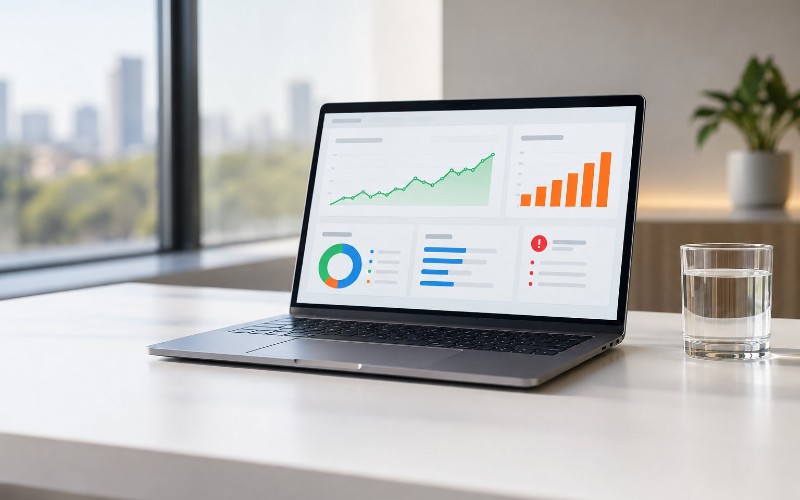
Real time reporting is transforming how companies make crucial financial and operational decisions, enabling business leaders and teams to react quickly to changing conditions by providing immediate access to essential data. This shift is having a significant impact on business efficiency and agility.
Business leaders now find that “real time” is no longer just a competitive advantage; it is becoming a necessity. Volatility in markets, tighter profit margins, and the rapid pace of digital commerce are pushing firms to shorten their decision-making cycles. For anyone managing finances or working with an accountant Denmark, the ability to access and act on current financial and operational data can directly affect business outcomes. As a result, organisations are reconsidering how information moves from day-to-day activity through to executive leadership.
The shift from periodic to continuous data
Traditional reporting was based on end-of-month closes and static dashboards, providing a delayed view of financial and operational performance. Today, real time reporting involves systems that continuously update important metrics, such as revenue, cash flow, and inventory, throughout the day. This approach enables businesses to identify trends or spot issues sooner, supporting faster, more responsive decisions. Rather than operating in cycles determined by calendar deadlines, teams are now shifting towards ongoing analysis and immediate action.
Where real time reporting delivers value
Access to up-to-date data supports better performance across business functions. In finance, cash flow visibility becomes more immediate, supporting activities from supplier negotiations to monitoring credit risk. Budget forecasts can be adjusted in response to real trading conditions, without waiting for formal quarter-end reviews. Operational teams are empowered to make informed decisions about pricing, promotions, or inventory based on live sales data, helping reduce waste and avoid missed opportunities. Risk management also benefits, as irregularities are identified and addressed more quickly than with periodic reporting alone.
Implications for teams and leadership
Adopting real time reporting prompts changes in established processes. Finance teams tend to focus less on the monthly close as a final endpoint and more on continuous data validation and control activities. Strong data governance is essential to minimise risks associated with inaccurate or incomplete live data.
Collaboration between finance, operations, and IT functions becomes increasingly important to ensure that systems and data definitions are properly aligned. As reporting cycles shorten, decision-making responsibilities may move further down in the organisation, requiring effective escalation processes and clear audit trails.
Blockers and practical considerations
Despite the advantages, real time reporting comes with several challenges. Integrating information from multiple legacy systems can be complicated. Businesses may encounter inconsistencies in source data, fragmented integration, or varied KPI definitions.
There is a risk of KPI overload, or relying too heavily on exact data that may be misleading if not properly understood. Ensuring robust security and access controls is also crucial as reporting systems work with increasingly current and sensitive business data.
What effective real time reporting looks like
The most effective organisations focus on a select set of KPIs that are directly relevant to key decisions and ensure responsibility is clearly assigned. Automated reconciliations, thorough audit trails, and clearly established escalation points help maintain a balance between agility and accountability. Real time reporting supports leaders in responding more rapidly to market shifts, but also raises standards for clarity and accuracy, making it a critical capability for any business operating in fast-paced environments.