
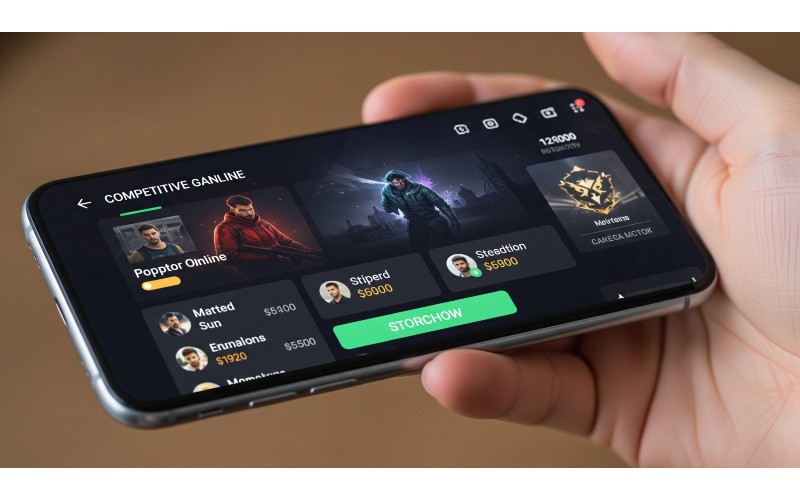
Online gaming became a business when it stopped relying solely on boxed releases and began selling time, identity, access, and repeat participation. Newzoo estimated the global games market at $188.8 billion in 2025, with 3.6 billion players, and forecast $206.5 billion by 2028. Those numbers explain why Microsoft, Sony, Tencent, Take-Two, Electronic Arts, Epic Games, Roblox, and NetEase now treat gaming as infrastructure, not a side category of entertainment. The player is no longer just buying a title; they are entering an economy that tracks logins, purchases, cosmetics, battle passes, creator content, and social behavior.
Mobile Turned Scale Into Habit
Mobile changed the business model by removing the hardware barrier for hundreds of millions of users. A smartphone session can last 6 minutes during a commute, 18 minutes after dinner, or 45 minutes during a tournament stream, and the business still records a usable event. This is why mobile games, social casinos, fantasy contests, and sports markets are built around fast onboarding and repeat prompts. The small design cues matter: a red notification dot, a 24-hour reward clock, or a saved payment method can influence retention more than a full-page campaign.
Live Operations Replaced Launch Week
The old gaming calendar used to center on release day, review scores, and first-month sales. In 2026, the stronger business often runs on live operations: new skins, ranked seasons, limited events, patch notes, influencer drops, tournament windows, and targeted offers. Fortnite, League of Legends, Counter-Strike 2, EA Sports FC, and Call of Duty each show how a game can behave like a service with a daily shop and a competitive calendar. One reported pattern across live games is clear enough from product design: the lobby has become a storefront, a social hub, and a data-collection layer at once.
Betting Became Part of the App Economy
Sports betting sits alongside online gaming because it uses many of the same digital business mechanics: mobile registration, real-time pricing, compliance checks, payment rails, retention offers, and event-led traffic spikes. A user searching for a new betting app is usually comparing speed, market depth, live odds, deposit options, and whether the interface stays stable when football, cricket, or basketball traffic peaks. The commercial lesson is straightforward: betting platforms win attention when product performance matches the live event rather than interrupting it. A frozen bet slip in the 89th minute or during an IPL death over damages trust faster than a weak welcome banner.
Regulation Is Now Part of Product Design
The industry’s growth has forced governments to define what counts as gaming, gambling, esports, and social play. India’s Promotion and Regulation of Online Gaming Rules, 2026 came into force on 1 May 2026, with the framework supporting esports and social games while prohibiting online money games and restricting related promotion and payments. The UK Gambling Commission also tightened promotional rules, with new restrictions on wagering requirements taking effect in January 2026. Good operators now design compliance into the product journey: age checks, account limits, identity verification, payment transparency, and visible terms are no longer legal decoration.
AI Pushed the Model Further
AI has deepened business logic by helping platforms identify churn, recommend content, moderate chats, segment users, and predict where friction occurs. Stanford HAI’s 2026 AI Index reported 53% population adoption of generative AI within three years, a speed that pushed platform teams to rebuild support flows, search tools, and recommendation engines. In online gaming, the useful layer is practical rather than glamorous: better bot detection, smarter matchmaking, automatic translation, abuse monitoring, and more precise tutorial adjustments. The result is a cleaner funnel, but also a more expensive one.
Apps Made Brands Portable
The business value of a gaming brand now depends heavily on whether it travels cleanly from browser to phone. The official MelBet mobile page lists Android and iOS access, Android 5.0 or later, about 100 MB of free space, a 1 GHz processor, and at least 1 GB RAM recommended for smoother operation. For a user managing sports markets and casino-style entertainment on mobile, the MelBet app fits into the same commercial model as other digital platforms: install, verify, deposit where permitted, track activity, and return during live events. The product has to feel immediate, but the account layer still has to show rules, balances, limits, and support without forcing a hunt through five menus.
The Industry Now Sells Continuity
Online gaming became a major business industry because it mastered continuity. It gives users a reason to return on Monday after a Sunday tournament, on payday after a promotion reset, or during a Champions League night when live markets move every 30 seconds. The strongest companies sell fewer isolated moments now and more managed routines: a battle pass, a ranked ladder, a wallet, a team identity, a streamer’s room, a loyalty tier, and a live match. Not a pastime. A system.