
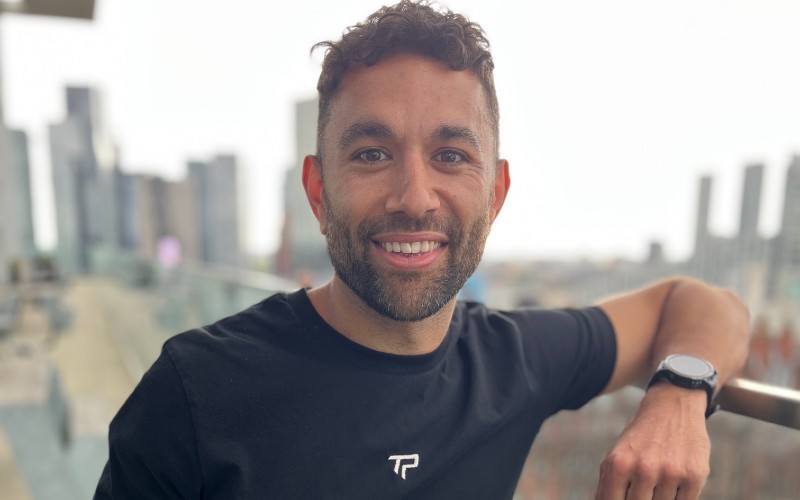
Alex Ayin has worked with some of the UK’s highest profile entrepreneurs.
Between 2015-2019 he worked at Social Chain, alongside co-founders Steven Bartlett and Dominic McGregor, helping to scale it into a global brand.
He also went on to work at THG between 2019-2020 at a time when CEO Matt Moulding was preparing the company for its IPO, which valued the business at £5.4bn.
A five-year stint at global, award-winning employer branding agency Wiser followed before Ayin took the plunge at the start of 2026 to launch Tomorrow’s Potential to develop the next generation of founders.
Ayin now lives in London but I spoke to him on Wednesday in his home city of Manchester, where he was delivering a talk in the offices of KPMG.
He’s originally from Burnage in south Manchester where his proud mother, who was in the audience, remembered him as an accident-prone child.
A talented rugby player he really excelled at water polo and after graduating at university, he landed a job at a Manchester digital agency called Social Chain, where future Dragons’ Den star Steven Bartlett was the CEO.
Despite its relative lack of experience, the agency was working with big name brands like Boohoo, British Airways, EY, MBNA and Warner Bros – and winning almost as many as awards as it was making headlines.
Ayin was appointed to the board at Social Chain Group, helping grow the business to over 250 employees across five global offices and a multi eight figure turnover
He said the experience taught him about the importance of culture.
Obsess about culture
“Get obsessive about culture,” he said. “Understand who comes in. I was there from the very early days. The first 50 people determine the trajectory of the company.
“We made some mistakes in hiring people in the early days and we didn’t fire them quick enough.
“Fire much quicker than you think and analyse based on a set of character traits that we now have.”
How ever much time people spend on recruitment, Ayin advised leaders to multiply it ten-fold – and measure candidates against metrics like ‘bias for speed’ and ‘independent learning’.
He explained: “If you look at the most famous entrepreneurs, they have a significant bias for action and bias for speed. How do you learn quick? Out-fail the competition.
“Independent thinking is also really important. You don’t want people to come in who just say ‘yes’. You want people to come in and challenge certain ways of doing things. Often, we don’t get that because you hire people more junior who don’t have that trait.
“Another one is curiosity about the field. Are people in their spare time listening to podcasts, reading books etc? If you want to become great at anything consistency matters more than sparks and brilliance. It’s continuous learning.”
Ayin said he noticed some of these traits in Bartlett.
“In the early days he would try and fit into what you were meant to do like getting into the office at a certain time,” he recalled.
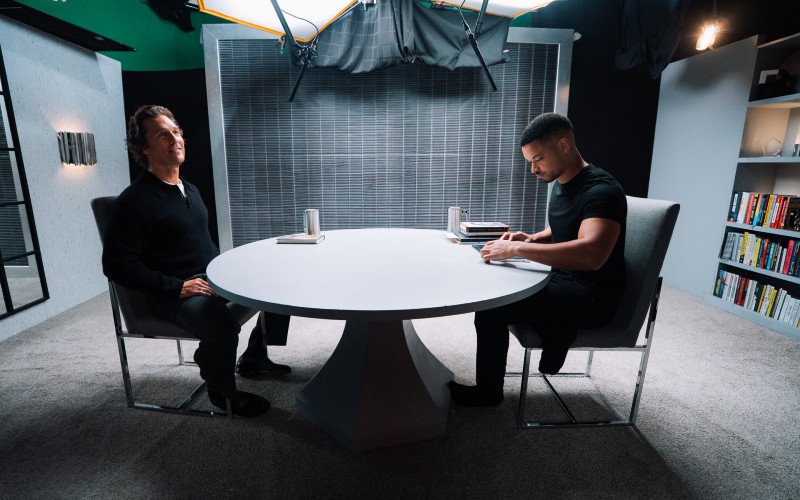
Steven Bartlett on DOAC with Matthew McConaughey
“The more he got to understand himself and what the business needed, he became great at playing himself into the positions that only he could do which most founders don’t do.
“For example, he’d go on stage and deliver a phenomenal talk. He’s probably one of the best speakers I’ve ever seen or experienced so he thought ‘how can I get on more stages?’”
Ayin has remained in touch with Bartlett, partly through their shared love of Man Utd.
“I would say Steven has not changed, which I was surprised at,” he said. “We’re still in the same WhatsApp chats, he’s still obsessed by football, gym, health. We still do regular, everyday, normal things.”
Bartlett’s co-founder, Dominic McGregor, has spoken openly about his battles with alcohol at Social Chain, which led to him stopping drinking.
Ayin said: “I was the same. I stopped drinking in 2018/2019. I’m all in, which is a high performance trait, so I couldn’t just go out for a drink.
Social Chain co-founders Steve Bartlett and Dominic McGregor leave business
“If you think about the life we were living then. We were winning work and working with some huge brands, like Coca-Cola and Apple, which came with lots of financial pressure to deliver results.
“We then probably scaled too quickly in terms of headcount which added financial pressure to the wage bills.
“Costs were going up and we didn’t always think commercially. For example one of the companies we worked with offered 90-day payment terms.
Drinking culture
“On a Friday everybody is celebrating these wins and going out and we had a bit of drinking culture back then.
“I can see why you would fall into that trap of release and needing an escape.”
Ayin worked at THG in 2019/2020 ahead of their IPO, working closely with Lucy Gorman, CEO of THG Nutrition (Myprotein).
Reflecting on his time at the online retailer, he said: “The biggest lesson in the world that I learned from THG was tracking the metrics that matter.
“Being obsessive about sales across different regions. Charlie Munger summed it up best when he said ‘what gets tracked, gets managed’. Each person had one big KPI to deliver against. If this didn’t happen, you’d be accountable.”
He then spent five years at Wiser, where he helped grow it into the #1 employer branding agency in the country, leading partnerships with L’Oréal, Frasers Group and Knight Frank.
In 2026 he decided to do it for himself by launching Tomorrow’s Potential, which he describes as a private boardroom for founders and CEOs running businesses anywhere between £500k to £50m in turnover.
The obvious comparison is with networking group Vistage but Ayin said Tomorrow’s Potential is different.
“Most peer groups are about giving advice,” he said. “We work on the company and the human running it, at the same time. If you fix one without the other you just produce a more profitable burnout.
“Most companies stall between £1m and £10m. Not because the founder lacks ambition but because they’re navigating it alone.
“What I’ve learned is the founders who scale without breaking aren’t the ones who work hardest, they’re the ones who get the business and the operator into the best shape of their lives at the same time.
“Everyone will have a baseline on their health, fitness, nutrition. What are the systems that you have in your life to make healthy food, to go to the gym, to look after your sleep to make sure you have enough recovery?
“My advice is to add one high performance habit or system every month and ideally take one away. It could be travel, looking at your phone late at night etc.
“The decisions we take in our 20’s, 30’s, 40’s and 50’s will impact our life in our 70’s and 80’s and a lot of it is irrecoverable in terms of what you’re doing to your body.”