
It’s hard to think of a more important or impactful interview that The Diary of a CEO host Steven Bartlett has conducted than his exclusive with Ukrainian President Volodymyr Zelenskyy.
Bartlett has clocked up more than 900 episodes of The Diary of a CEO (DOAC), and interviewed some of the world’s biggest names, but his conversation with Zelenskyy is a broadcasting masterpiece.
It’s already attracted 4.6m views on YouTube, been released in 20 languages and made headlines around the world.
However, the real masterstroke was using AI voice technology, trained on Zelenskyy’s own voice, to create an English-language version of his answers, which he delivered in Ukrainian.
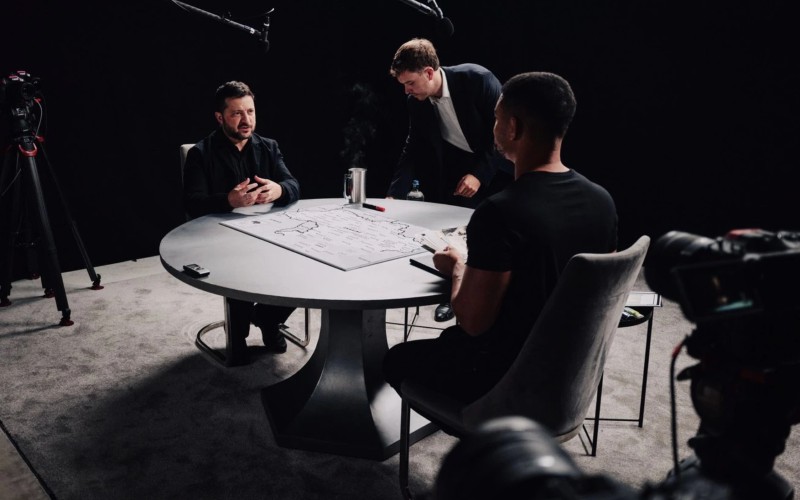
President Zelenskyy on DOAC with Steven Bartlett on The Diary of a CEO
The use of AI was fully disclosed and carried out with Zelenskyy’s permission, but it also helped convey a raw emotion that might otherwise have been lost in translation.
I’ll never forget Zelenskyy’s descriptions of the atrocities in Bucha, particularly his account of the discovery of a mass grave containing 500 victims.
Importantly, the original Ukrainian recording is also available as a separate audio track on YouTube.
The Ukrainian President’s decision to sit down with Bartlett for a two-hour interview also underlines the importance he places on communication and getting his message across.
Zelenskyy is under enormous pressure – militarily, diplomatically, economically and politically – and must persuade American politicians, European leaders and international audiences that Ukraine deserves their continued support.
However, the story of how the interview came about is almost as impressive as the conversation itself.
According to an article in Forbes, the interview was seven months in the making and was recorded in Brussels on October 16, before being released the following week.
The interview was originally due to be conducted in English, but Bartlett felt Zelenskyy could provide far more context and detail if he answered in Ukrainian.
Two interpreters
The day before the recording, the DOAC team secured the services of two human interpreters.
One translated Zelenskyy’s Ukrainian into English through Bartlett’s earpiece, while the other translated Bartlett’s questions into Ukrainian for Zelenskyy.
Although the two-hour episode was subtitled, the team also decided to create an English audio track using Zelenskyy’s own voice.
The English script was developed from the live interpreters’ translation, checked again for accuracy and context, and reviewed by a Ukrainian editor to preserve its meaning and tone.
Crucially, the team translated for meaning rather than word for word, retaining Zelenskyy’s pauses, breathing and Ukrainian accent.

As for the interview itself, Bartlett touched on almost every aspect of Russia’s invasion of Ukraine in 2022 – from how Russia’s leadership misjudged the resistance it would encounter to Zelenskyy’s refusal to evacuate Kyiv and the unusual relationship between Donald Trump and Vladimir Putin.
Didn’t interupt
Bartlett is an expert interviewer who understands the importance of knowing when not to interrupt, particularly when his guest is someone of Zelenskyy’s stature.
One of his greatest strengths is the way he frames his questions.
For example, he asked Zelenskyy to explain the background to the conflict as if he were talking to a 16-year-old with no understanding of geopolitics.
It’s subtle but brilliant.
Similarly, he didn’t shy away from difficult questions, including whether the conflict would have happened had Donald Trump been the US president.
Manchester City, Andy Burnham and the danger of rewriting history
Congratulations to Bartlett and the entire Diary of a CEO team for producing an extraordinary piece of journalism.
There’s an old saying that the pen is mightier than the sword but the power of the podcast should not be underestimated either.