
Today, I’d like to offer a different take on the feeding frenzy currently engulfing Manchester City’s owners and its impact on Greater Manchester.
At the outset, I should say this post isn’t about the Premier League financial rules the club has been found guilty of breaching, or any future sanctions it may face if its appeal is unsuccessful.
As with any walk of life, if you break the rules, you deserve to be punished. But it’s also important to provide some context.
With this in mind, I’d recommend people read Mike Emmerich’s excellent article in The Mill.
“Everyone has a view on Manchester’s Abu Dhabi deals,” he wrote. “But very few have asked the obvious question: what was the alternative?”

Former Manchester City Council chief executive Sir Howard Bernstein in conversation with Chris Maguire
Emmerich is a respected economist who is writing a highly anticipated biography of former Manchester City Council chief executive Sir Howard Bernstein, entitled The Knowledge Broker.
I met Sir Howard several times and believe he did more than anyone to revive Manchester’s fortunes. He was the inspiration behind BusinessCloud’s Northern Leaders Awards.
Leadership and vision
Manchester would not be the powerhouse it is today without his leadership and vision.
The point Emmerich (himself a Manchester United season ticket holder) makes is that Manchester is a very different place today from the city it was in the years either side of Abu Dhabi United Group’s (ADUG) acquisition of Manchester City in 2008.
He wrote: “2014. Banks still wary of development. Local developers out of money. No market for big rental investment outside London. One partner turned up with the cash to rebuild a whole neighbourhood at (a) point the city wasn’t building and the government wasn’t spending. The city said ‘yes’.”
Before people rewrite history with the benefit of hindsight, they need to remember what Manchester was like 15 years ago.
I’ve visited the club’s £200m state-of-the-art academy on the Etihad Campus, and it’s amazing.
Last week, former US President Barack Obama spoke at a packed Co-op Live.
Ancoats and New Islington are unrecognisable today. The list goes on.
“Who would have invested at the scale ADUG did in East Manchester when the banks would not?” asked Emmerich.
My concern is this. Manchester (the place) is now becoming a political football for some opportunist journalists and politicians.
The ability of Manchester City Council and Greater Manchester Combined Authority to forge successful long-term public-private partnerships has been at the heart of Manchester’s success. Now, that approach is being questioned.
And I’m not just talking about Abu Dhabi here. Bruntwood, Allied London and Argent have all played a huge part in Manchester’s economic growth story.
Only today, Manchester Airport announced a major expansion of Terminal 3.
All of which brings me to Andy Burnham.
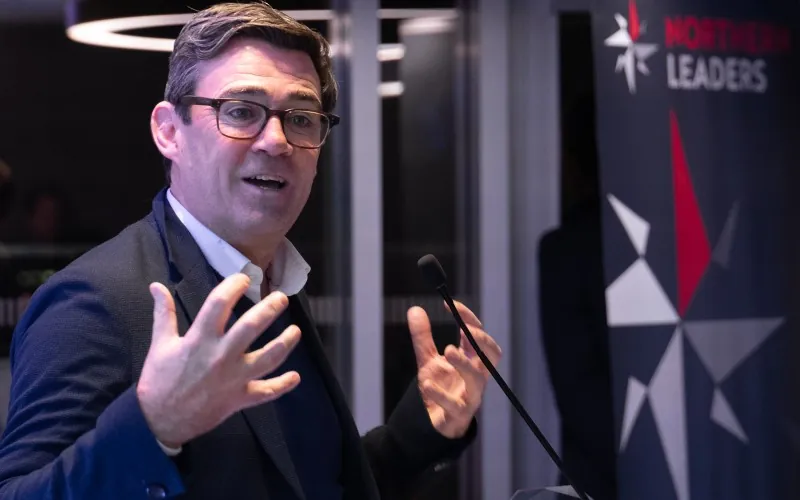
Andy Burnham speaking at BusinessCloud’s Northern Leaders Awards while Mayor of Greater Manchester
Full disclosure: I’m a big fan of Burnham, and I think he’s done a good job in his first 100 days as Prime Minister.
If he’s made one mistake as PM, it was saying he would be ‘really concerned’ if Manchester City’s owners decided to sell up after the club was found guilty of breaching Premier League financial rules.
For a split second, it sounded like he was answering the question as Greater Manchester’s Mayor rather than as Prime Minister.
Downing Street later clarified his comments, but it was seized upon by his critics.
Inevitably, Burnham’s dealings with Manchester City’s owners while he was Mayor are now being questioned as though he did something wrong.
He was the Mayor of Greater Manchester. That was his job.
For the record, I also chatted to Burnham while watching Rochdale play Newcastle United in the FA Cup at the Crown Oil Arena in 2020.
In conclusion, if Manchester City have broken the financial rules, they should be punished.
But let’s not ignore the positive impact Abu Dhabi’s investment has had on Manchester.