
Birmingham is a city ‘full of entrepreneurs’ – but how can they be supported in growing the startups they found into scaleups then thoroughbreds?
That was the key question which arose from BusinessCloud’s roundtable of founders, leaders and ecosystem figures during Birmingham Tech Week.
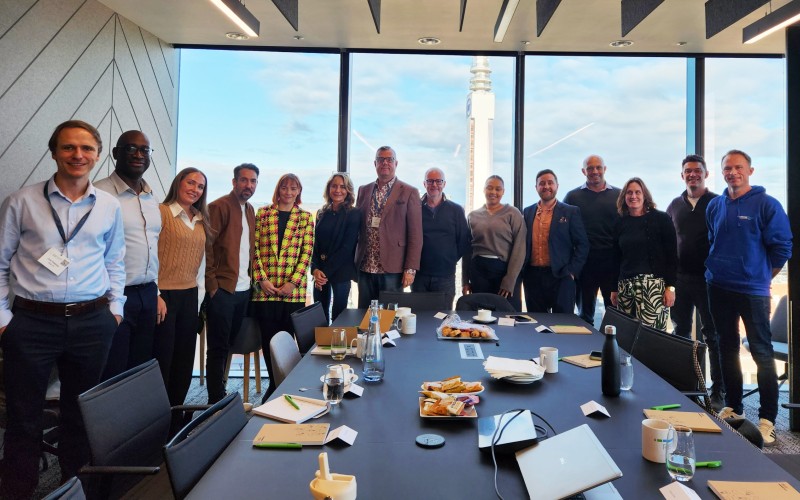
A passionate and lively discussion at the Colmore Row offices of RSM also examined the strengths of the wider West Midlands region, and the challenges facing its businesses.
‘I still see the gap’
Joel Blake OBE is the founder & CEO of GFA Exchange, a platform that helps financial lenders and private capital funds evaluate, benchmark and monitor borrower-level risk.
Awarded an OBE in 2016 for Services to Business Support and Enterprise, he is regarded as one of the most influential voices in the local area and regularly speaks on global stages.
“We should never forget where we come from – but also know where we’re going,” was his takeaway from the roundtable. “There’s a great back story around the Midlands and its heritage, but that’s all that we keep relying on as part of our growth journey.
“What I’d love to see is that the future voice of our city comes from the entrepreneurs engaging with and being embraced by those decision-makers who can help us collectively to move forward. I still see that gap.
“That’s the real challenge because we, as entrepreneurs, have a much more detailed idea of what’s needed – because we’re trying to solve those problems every single day.”
AI
Technologist Ade Bullock was a key figure behind energy trading firm Contigo Software and has built platforms for blue-chip companies in the telecoms, energy and financial markets.
Now building Workup – a single platform to manage people, projects and clients – he says “AI is obviously transforming businesses”. Indeed, he has used Claude Code to accelerate Workup as well as a significant side project to assist children with their learning.
He continues: “But we need to find better ways for founders to help founders! The ecosystem is there, but I think it’s still hard to have those really close networks. The local public sector is very well meaning, but it’s hard to actually get real support. It probably needs some more private sector involvement on that side.
“In San Francisco, they don’t rely on public sector support; it’s private sector and the universities doing that. I think we definitely need more of that here.”
Birmingham Tech Week opens with new West Midlands Accelerator Cluster announcement
Another upcoming project is a networking platform which will encourage founders to find their first customers among fellow founders.
Rob Markwell spent nearly 17 years building and running a recruitment consultancy before joining Medstars in 2024. He has led its pivot to Aria, an AI-powered wellbeing companion which is now live in the NHS after being piloted in the Birmingham Women’s and Children’s Hospital NHS Foundation Trust.
“There’s a lot of talk, naturally, about AI and the changes it has brought already and is going to bring in the future. They are monumental,” he says.
“But the same problems remain: it’s about listening to those who are on the front line of innovation – the entrepreneurs – and not trying to make rigid policies, but be more fluid and together as a city and as a region.”
First customers
Davina Schonle, founder & CEO of HumanVantage AI, was unable to attend on the day but agrees that Birmingham doesn’t lack entrepreneurial ambition or ideas. “The opportunity now is to turn that innovation into commercial success. For early-stage technology founders, access to first customers can be more valuable than access to a first investor,” she said.
“I think Birmingham has many of the ingredients of a successful technology cluster: universities, established businesses, entrepreneurial talent and a growing community of founders. We’re good at bringing founders together, celebrating innovation and encouraging people to start companies. But how effectively are we helping those businesses win their first substantial customers, scale and stay in the region?
“I’d love to see more of Birmingham’s major employers actively buying from early-stage regional technology companies and reducing the procurement bottlenecks. Not necessarily through large contracts, but through accessible, paid pilots that give founders an opportunity to demonstrate commercial value.”
Startup to scaleup
Daniel Bridgewater is a serial founder now building Apogee, a platform that enables manufacturers to test, compare and validate technology solutions before making procurement decisions through a secure sandbox environment.
“I think it’s important for everyone to remember why we’re doing what we’re doing. As entrepreneurs, we’re constantly doing that,” is his view. “Maybe the policy side also needs to do that – it’s not just around the fact that it creates jobs, economic wealth and tax; it’s things like speed, how quickly things happen.
“Birmingham’s good at startups, but what about the scaleups? How do we get people who are pushing that million-pound turnover to £2m, £3m, £4m, £5m?”
One Birmingham business which has scaled successfully is VC-backed security consultancy CyberQ Group. Founded in 2016 and now with offices around the world, its founder and CEO Chris Woods has been active on global trade missions this year – and also hosted several events during Birmingham Tech Week.
“This is the city of a thousand trades,” he said. “We’re good at starting businesses. The city’s full of entrepreneurs, full of intelligence, full of sparks, people that want to do things differently. But it’s about helping people that take such a big risk grow to the next stage.
“I’m quite passionate about ‘founders for founders’ – because that’s the only real way you’ll get scaleups. If you see founders that have hit the £2m, £5m, £10m mark then you can ‘be’ that person – and if they’re advising you as well, you’ve got more chance of getting there.
“Making sure we support them, not just with accelerators – but people that have actually got the T-shirt have built multi-million turnover businesses.”
Legal framework
Kate Roberts recently joined Clearpath AI, a provider of technology to the legal, property, finance, risk & compliance sector, as COO after previously working with founder Rudi Kesic. The firm has raised £1m pre-seed backing.
“We are really lucky in Birmingham to have a good tech hub. You’ve got loads of startups, but actually scaling is a different beast,” she says.
“In the legal sector we are really lucky to have an ecosystem which sees us work together. If we could replicate some of that in the wider ecosystem, that could be good to look at.”
Quality of support
Yiannis Maos MBE founded Birmingham Tech Week in 2019 then its parent company TechWM after experiencing ecosystems such as Silicon Valley and finding nothing comparable in the local region.
Under his leadership, it has since helped businesses raise over £100m. The festival now attracts 8,000 attendees and delegations from 39 countries. In 2023, he was awarded an MBE for services to the technology sector. Before BTW, he helped scale Rant & Rave, an early AI company that went on to work with half the FTSE and sell for £55m; and co-founded Hyve.
After passing on the baton at TechWM, he co-founded Unloq – a startup which helps organisations to adopt AI to make smarter, more impactful decisions – and raised £900,000 investment this summer.
“There’s a lot of positives: it’s a great city, it’s a great region. I look around this room today and see fantastic entrepreneurs, fantastic businesses, all unlocking growth and opportunity,” he said.
“On the scale-up capital, I slightly disagree. If you’ve got a business in this day and age with the right growth metrics and the right velocity behind you, you will get investment. Full stop. It might not be from the West Midlands, but does it matter?
“Frankly, you’ll get a better term sheet in the US. So why wouldn’t you be exploring tier-one investment from outside, especially if you can grow your business here and make your money go further? Because you’ve got the talent here, you’ve got the opportunity here.
“The problem scaleups face is the quality of support. Several people here have mentioned it. What that needs, in order to create that high quality scaleup model of support, is a co-creation model with people in this room and many others in the ecosystem who can help shape policy, help shape the delivery, and then it’s bringing in that private sector investment in the form of high-quality programmes that are tried and tested – that we know can take you from a high-potential startup to a scaleup, and a scaleup to a thoroughbred.”
He added: “I actually think the biggest challenge around investment is early-stage: there are a lot of very smart people with great ideas, but they are just not being backed. And if we could solve that, then actually we’d see a lot of those startups – with very small ‘s’ – turn into proper Startups.”
Melissa Snover, founder & CEO of REM3DY Health Group – parent company of 3d-printed vitamins platform Nourished – secured £14m in its latest investment round this year to ramp up investment in AI and scale globally.
An entrepreneur constantly evolving new products and ways of working based around data, she said she would not consider moving her company’s factory and operations away from Smethwick – and spoke about the beautiful surroundings in Birmingham city centre when welcoming visitors.
She also wrote on LinkedIn recently: “I’m in love with AI. I think it’s also the single biggest leveller ever: the power that it gives – at such a reasonable price – to everyone.”
What’s the Story?
Amanda Lowe has been publicising the West Midlands since 2014 as founder and MD of STORY.
“There are a lot of founders here doing genuinely brilliant things that nobody outside their network has heard of,” she wrote on LinkedIn recently. “Most are too busy building their business to talk about it or maybe even feel awkward putting themselves out there, which I can understand.
“But it is a missed opportunity, for them and for the city. Birmingham Tech Week shows just how much is going on here.”
After highlighting the “swagger” of Manchester during the roundtable, she expanded: “The storytelling is the differentiator for businesses, but also for the region. We do have this AI world. Everyone can create content. Everyone can have a point of view. Everyone can write a perspective. But it’s not going to cut through unless it’s human; unless we, as a region as well, can see something that’s different.
“We have to make it cool. We have brilliant entrepreneurs. We have young talent. We have all this energy. We’re having heated debates because everyone feels passionately… if we didn’t have that, that would be a concern.
“And then we do have Peaky Blinders. Ozzy [Osbourne]. The Enemy. We have to lean on that more, rather than the same old trite lines around the automotive heritage etc.
“That’s brilliant, but it needs a bit of a makeover as well – so we can stop having the same conversation.”
The human side
Olivia Davson built a career as a project manager at Rolls Royce, Deliveroo, McLaren Automotive and Amazon – the latter for more than five years – before founding Cubbi, a discount platform for new and expecting parents.
She made headlines earlier this year when she was shown pitching on Dragons’ Den alongside sister and co-founder Tanyka while nine months pregnant.
After highlighting the need for the human side when building businesses using AI, she said: “I’d like to see a stronger community and ecosystem offering real support and sharing of resources.
“Birmingham has some brilliant businesses and brilliant entrepreneurs, but we do not do enough to celebrate and shout about the things that we’re doing.”
Support systems
Stephanie Whitehead recently joined the West Midlands Growth Company as head of cluster management after performing various programme roles during a decade at the University of Warwick.
“This conversation has been really useful,” she said. “From a Growth Company perspective, what I’ve been hearing is that there’s huge expertise here – which we knew anyway – but also that there’s huge enthusiasm and experience of things that have worked – and of course the things that haven’t worked as well.
“We’ve got to try and draw on all of that to address fragmentation across the system, and also make it easier for people to get on and achieve their ambition.”
Joe Hessey, a director at RSM, acknowledged the frustration around scale-up funding.
“I have a lot of videogames clients. Interestingly, they hold niche events where they bring along investors and also big companies who have done it, just to inspire people and give advice – and that seems to work really well.
“A platform to help passionate people to give back to new founders would be great.”
Darren Griffin, a corporate tax director at RSM, reflected: “There’s a lot of passion, a lot of intelligence, and a lot of knowledge in this room. I think it’s incumbent on people to try and take that and make a difference. Policy does need to be a lot more joined up.”
Max Evans, an associate director for business transformation (people & change) at RSM, added: “One thing that stood out for me was how easy it is to start a business now using Claude code; then Olivia spoke about the importance of the connection to humanity and people. I think that’s fundamentally what’s going to set these new businesses apart.”