
Sometimes you meet a founder whose passion, expertise and vision takes your breath away.
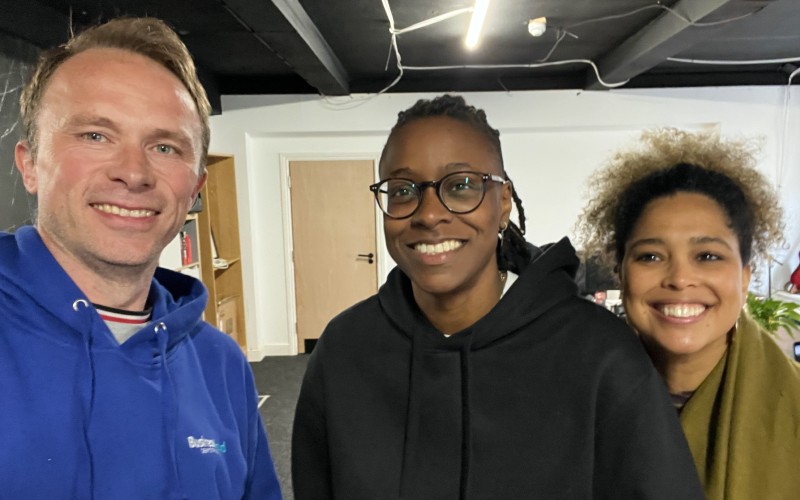
When I visited married couple Aiwan Obinyan and Dr Tamanda Walker at the home of AiAi Studios in Leeds city centre, there were two such people before me.
AiAi was founded by audio engineer Aiwan – who describes herself as a “North-South hybrid”, having spent equal parts of her childhood, education and working lives in the capital and Yorkshire – in 2023.
“I started out in the music world as a producer and audio engineer – live sound gigging, writing, recording – but the industry was going through changes with technology,” she tells me for Founder Friday.
“With the decrease in the price of recording equipment, studios were closing left, right and centre – so the traditional paths that you would have taken to build your career as a music producer just weren’t as open to you.
“As someone who’s working class, I can’t go and work in a studio for free as an intern – I’ve got to work! So I focused more on the live music because in a club, you get paid.”
Aiwan was sharing a house in Lewisham with acclaimed actor, writer and director Neil Maskell, whose memorable roles include monosyllabic hitman Arby in dystopian TV series Utopia and Winston Churchill in the series finale of Peaky Blinders.
“Neil was making his first short film, Shitkicker, and wanted some music for it,” she recalls. “That was the first time that I’d seen my name come up on the scrolling credits, and I was like: ‘How can I do more of this?’
“Over time I worked my way into doing more screen-based music and audio engineering, and location sound recording. I swung a boom on Coronation Street… just using those raw skills.”
However, Aiwan didn’t fit the typical look in the world of sound design. “You’d go on a set, and they’d be like: ‘What are you doing here? Go to hair and makeup.’ Because I was a woman and Black, they didn’t understand why I was heading towards the sound truck to get gear.
“Audio engineering is a white male-dominated field. Every set you step on to has a white guy in charge. And then here comes me, who’s doing what I do and looks how I do. It’s odd for them to see that.”
Storytelling and production studio AiAi, then, was an answer to these experiences. “It was about: How can I work in this industry in a way that gives me freedom to do the things that I want to do, on my terms – and how can I also create a space where people like me can work within the industry in an environment that is kind to them, rather than hostile?”
AiAi has been commissioned by the likes of Nike, GAY Times, Amazon, Channel 4, Audible and gal-dem to produce culturally authentic content.
In 2018, Aiwan, who has Nigerian heritage, produced her first feature-length documentary. Waxprint – which tells the 200-year story of a patterned colourful African textile and covers the industrial revolution, colonialism, transatlantic slave trade, globalisation and more – was picked up for a US distribution deal.
She then worked with Chez Oteka on their BAFTA-winning 2021 short documentary The Black Cop, which explores lead character Gamal Turawa’s journey as both a victim and a perpetrator of racism – as well as his experience with homophobia – within the police force.
Aiwan met sociologist Tamanda – who was born and raised in Botswana before living in Belfast, the Midlands then London – around that time.
“I was working with young people in the justice system – or young people who had been essentially kicked out of school and discarded – and using music and media as a training mechanism,” says Tamanda.
“I started asking lots of critical questions and decided to do an evening Masters – then eventually went on to do a PhD in sociology. Our paths crossed while I was in the middle of my PhD.”
Tamanda says she was grappling with a key problem in academic research. “We produce really good knowledge about the world – but we write it and share it in a way that’s so boring that nobody would ever want to read it,” she explains.
“We do great studies, we learn about society, and then we put it in one paper that about five people read because you need an institution to be able to access it. It’s crazy.
“For example, we have this knowledge around marginalised communities – for example, a particular group facing poor health outcomes relative to another group – which is really important public information… but it’s stuck behind a paywall!
“I came out of music, where you’re literally putting stuff out all the time. So I began to think about how we could produce research differently.”
She joined a course on podcasting, audio and sound, which was being taught by Aiwan – and discovered that they were extremely aligned with their values.
Turning to her wife, Tamanda says: “You had done all these films about social issues. I was like: ‘I need to come and figure out how to work with this person!’”
The pair has since founded Roots & Rigour – a research, learning and knowledge organisation which works with partners across health, education, culture and social change to produce rigorous, community-rooted insight and participatory approaches to systems change.
Tamanda gives an example of a social issue it can bring to greater attention. “At the time of COVID, Black women were five times more likely to die during or soon after childbirth than their white counterparts, although it has gone down somewhat since. The bottom-line issue is racism.
“Black women are less likely to be believed about their pain, so when they present with pain issues during labour, it’s not seen as significant. They are also more likely to die by suicide in the post-partum period, with one factor being a lack of access to culturally appropriate care in a mental health system that has been clearly marked by racism and distrust.
“There are also other structural and personal factors that may make Black women – especially working class and migrants – more vulnerable.
She continues: “But these issues are far more widespread: I have colleagues who’ve worked on policing. In many parts of the UK, young Black kids are 13 times more likely to be stopped and searched by police than their white counterparts.
“We’re also disproportionately represented within mental health services. These are ‘whole system’ issues.
“However a lot of people automatically hear that stuff and just think: ‘Oh, hear these crazy woke people’. They don’t really think it’s an issue, and they don’t really believe the data – even though it’s evidenced.”
She adds: “So how can we use media to make sure the knowledge of communities that are directly experiencing these issues is heard by the system? Because it’s not always easy to do through the formal channels.”
The pair also co-host video podcast Rigour & Flow to explore culture, business, identity and systems through long-form conversations.
“In the very first episode, we asked: Can you be African, Christian and gay?” says Aiwan, who is sadly estranged from her immediate family – which is fundamentalist Pentecostal Christian – due to her sexuality.
Tamanda adds: “This season, we’ve talked about the UK’s social media ban for children; family vlogging and whether that’s a new form of child labour; and our relationships with charity, race and class.
“What were we taught about charity? Were we socialised to be the recipient of charity, or the giver of charity? And what does that mean?”
The goal now is to bring the production studio, research services and content into an ecosystem.
“How we’ve begun talking about ourselves to our partners and clients is that we are building a narrative infrastructure for marginalised communities to be able to tell their stories at scale and thrive – and share their knowledge at scale and thrive,” says Tamanda.
“We want to be doing that at the highest level.”
Single mum looks to build global EdTech brand from Manchester