
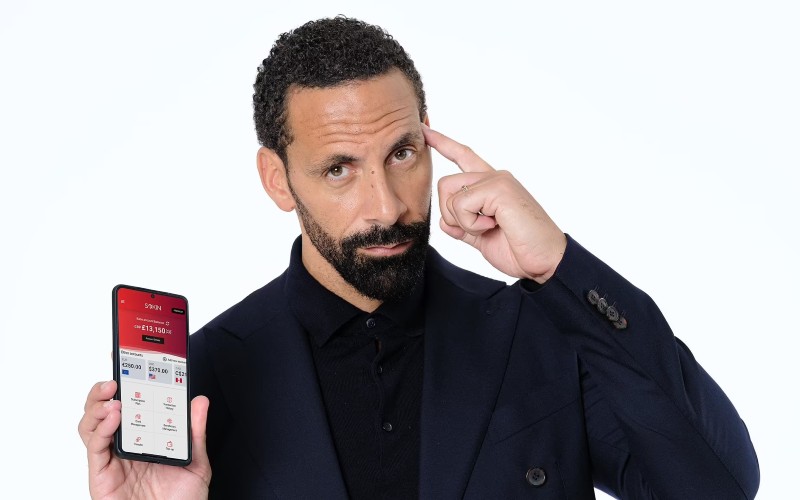

A FinTech company which took investment from Manchester United legend Rio Ferdinand early on has disclosed its financials for the first time.
Sokin, which in January secured a $100 million long-term debt facility from Oxford Finance – having announced a £38m Series B fundraise in December – said it had closed the first half of 2026 at $90m in run-rate net revenue.
Sokin was unveiled as United’s official global business payment solutions partner in August.
In a letter, founder and CEO Vroon Modgill wrote that in 2025 Sokin generated $45m in audited net revenue, ending the year at $60m run-rate, and was profitable.
The company moved more than $9 billion in payment volume across its platform and closed the year with strong cash reserves, he added. Growth is running at over 100% year-on-year, and the company is tracking to more than $120m RR net revenue by December.
Modgill framed the disclosure as a pivotal moment for the company due to the growth of AI and the shift to agentic treasury. The letter argues that the infrastructure underpinning agentic finance is the true value, as opposed to the agents themselves, which can easily be copied or bettered.
“The moat is not the AI agent. The moat is the infrastructure the agent connects to,” Modgill wrote. “An agent that decides to fund payroll in multiple currencies still needs an account that holds them, a license that permits it, and a rail that settles it.
“An AI agent is only worth something if it stands on infrastructure that can act.”
Sokin holds licenses across 36 countries, with further applications in progress. It moves money across more than 170 countries in more than 70 currencies through 18 direct banking partnerships and its own settlement infrastructure. This year the company built and launched its own stablecoin infrastructure and owns the full stack rather than renting it, which allows it to settle the fiat leg that most crypto-native providers cannot.

“That infrastructure of licenses, banking partnerships and rails is Sokin’s moat,” Modgill wrote. “A license footprint cannot be spun up by AI or just bought.”
The United States is Sokin’s largest and fastest-growing market, accounting for over 40% of revenue and the majority of its investor base. Morgan Stanley backed the company early, and Prysm Capital led its $50m Series B.
Embedded finance is now its fastest-growing route to market, with fintechs and financial platforms building Sokin’s rails into their own products and running money through Sokin without their customers ever seeing the company.
Sokin is building toward what the letter calls the full lifecycle of business money on one platform: receiving, converting, sending, holding, earning, spending and deciding. Modgill positions deciding as the newest and highest layer, sitting on top of the others because an agent needs to reach into all of them at once.
The letter sets out what is coming this year. Customers will be able to connect Sokin to their own AI tools using Model Context Protocol and run money operations through natural language prompts, with a person still approving every payment.
Corporate and virtual cards will let businesses manage daily spend from the same balances, fiat or stablecoin, under the same controls. Sokin also plans to add yield on stablecoin balances and ecommerce acceptance, and has further license applications in progress.
“Just as AWS became the infrastructure layer software runs on, Sokin will become the infrastructure layer financial operations run on,” Modgill wrote. “Sokin will become the connective tissue between systems and agents.”