
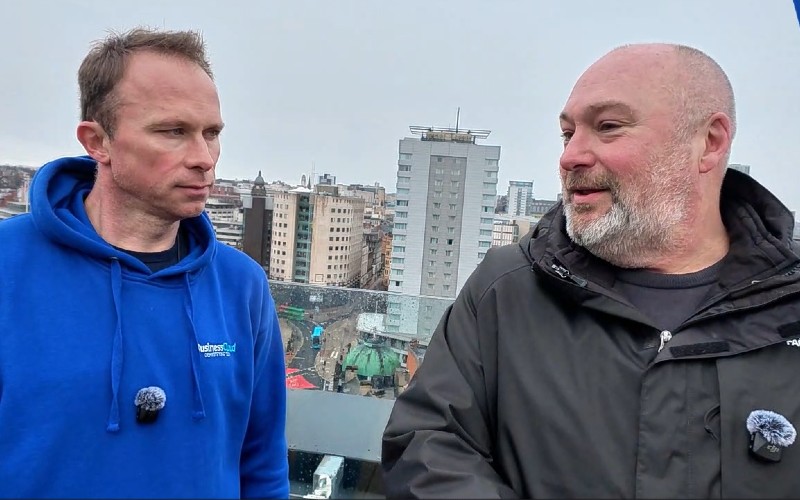

The thing I enjoy most about meeting founders is finding the small things you have in common.
In a recent chat with Uptic co-founder Paul Bates in Leeds, the kickboxing black belt revealed that he and brother used to fight in competitions in Bacup – the small Lancashire town where I live – as kids.
Paul and his co-founders in the Netherlands and Chicago are now building their fast-growing consultancy across the globe. A lot has happened between those distant trips to the Rossendale Valley and executing contracts with the likes of Telefonica.
“I moved to Leeds in 1999 when the whole ISP (internet service provider) thing was kicking off,” says Paul, who had earned a computational science degree in Manchester. “I decided that I didn’t want to be a techie, so I moved into sales.”
He worked for several IT resellers and managed service providers (MSPs) before spending six years at B2net. After that firm was acquired for £12 million by Swedish giant Proact IT Group, he spent another six there, latterly as a vice president running its cloud business.
During a 12-month stint working from the UK for a California AI startup – subsequently acquired by tech giant HPE – he realised that “I just wanted to work for myself”.
He and former colleagues at Proact decided to set up an MSP – but that business quickly transformed.
“The key differentiators were that we were going to be more application centric, selling to developers rather than selling to infrastructure guys. We didn’t want to be like the ANSs of this world,” he explains.
“Within about three months, we realised the opportunity was in the automation we could do, so we flipped what we did – and we ended up then selling to service providers.
“We began working with companies like Telefonica and Softcat. A few years ago I would have viewed them as competitors, but they are now key partners.”
Three-pronged attack
He continues: “There are three key things that we do. The first one is we develop: my cheesy tagline is ‘we do everything from UI to AI’.
“The second part of the business is platform engineering: we deploy cloud environments for the applications that we’re building. By modernising development processes, we allow developers to focus on their code while we take care of everything else underneath.
“The final bit is managed services: we provide application support on an ongoing basis for clients.”
One of his roles at Proact saw him transition the European sales team from systems sales to annuity revenue – and that is where this latter service comes in.
“We’re trying to take the development world and merge it into the managed service world: that means we’re creating annuity revenue with the contracts that we have,” says Paul.
“So a lot of development you can do with 6-, 12-, 18-month projects – and at the end of that it’s gone, you hand it over. [In contrast] by providing ongoing support, it means we’ve got more longevity in our contracts.
“It means the business is worth more, but it also means you can offer customers a much better quality of service.”
The business, set up during COVID, employs 24 people split between the UK and Netherlands. Paul says around 30% of its revenue comes from the US and 20% from the Netherlands, with the remaining 50% from the UK.
A different model
Paul explains how the ongoing support works in practice. “We build a little product team for customers. What most people do, if they’re building quite a large application, is to have eight, nine, 10 guys working on a project. They’re never busy all the time.
“Our concept is you only need three or four people – who those three or four people are varies at different points in the project. You might need a front-end developer early on as well as a back-end; eight months down the line, you might need to make some changes to the front end so we bring that developer back in.
“Because we have our own staff – and it’s always our own staff, not contractors – we can move those people around.
“It’s a different model – flexible, fractional development services, with the platform stuff underneath. If we can do it faster, at higher quality and cheaper, that’s where customers really buy into it.
“They have a single cost for us to take care of that entire stack for them, and then we can provide managed services on the back of that.”
AI
The development world is also being turned on its head by AI, with tools such as Claude capable of coding entire applications via user prompts.
“You still need people,” says Paul. “But AI is making developers more efficient – they have to embrace the change in the market and use these tools.
“AI to us can mean lots of different things. I don’t think a lot of people really know what it is!
“We could be integrating a common platform just to summarise text – that for us isn’t AI, it’s an integration point. We’ve come from automation and a lot of people still refer to automation as AI, but it isn’t.
“At the more extreme end, we build smaller language models with very, very specific use cases. We can build out a completely private AI platform, or use an open source tech stack, that means they know exactly where the data is and what has been trained.
“Our clients’ customers can guarantee that their data doesn’t leave the confines of that application, so it’s not on a public model, which is becoming really important.
“We’re seeing a big shift towards people looking at AI for smaller, specific use cases, rather than using one of the bigger platforms.”
Why ‘unique’ HealthTech is at cutting edge of mental health support
People-centric
Another way of ensuring that customers are looked after lies closer to home.
“We take a little bit of [Richard] Branson’s philosophy: look after your staff first, and they’ll then look after your customers. When we launched Uptic we wanted to build something fun, interesting and delivering high quality – but also something that was good for the staff.
After the whole world of COVID, people are now being forced back into the office three, four or five days a week. And a lot of developers don’t want to do that.
“We’re happy to let the guys not only work from home, but work the hours that they want. As long as they are available for customer calls, and on stand-up calls, what does it matter if they prefer to work at 2am?
“One guy couldn’t believe it when he joined us and learned that he could pick up his kids from school every day!”
Uptic has performed work on behalf of Telefonica at Gatwick Airport, while a very different type of client is legal AI company Cloud Contracts 365. It also has a customer in the US, Ray Allen, which writes IT asset management software for the likes of Cisco and IBM. “We’re modernising their legacy applications,” says Paul.
Growth phase
Completely bootstrapped, profitable and secure, Uptic is now entering a growth phase. Currently at £2m revenue, Paul expects to double that this year.
“We’re probably moving up a tier in terms of the size of our customers,” he says. “So before, a £50k deal would have seen us all running around high fiving; that’s quite a small contract now for us. We’re also looking at more longer-term contracts.
“We’re taking some educated risk to grow the business and really embrace AI, not only internally to improve our capability and make us more efficient, but to help customers with that as well.”
Paul is an experienced snowboarder as well as a kickboxer, but is trying out new disciplines.
“I’m learning to ski because I’m conscious that in 20 years time, I probably won’t be snowboarding,” he says. “I’m like Zoolander on skis at the minute! I can turn one way, and I can’t really turn the other way.
“I’m also learning Brazilian Jiu Jitsu after getting into that with my lad [who’s now 13]. He wanted to be a Ninja Turtle and got his black belt a couple of years ago. You get a lot of techies doing Jiu Jitsu as it’s very formulaic.
“I’m a white belt! But being able to go and punch some things is quite a nice way to relax.”