


You’ve probably noticed it already: getting new customers online feels harder than it used to.
Ad costs keep climbing. Social media reach keeps shrinking. And even the best content struggles to break through the noise anymore. On top of that, SEO isn’t the reliable growth engine it once was, especially now that AI systems can instantly detect low-effort, keyword-stuffed content.
And here’s something even more interesting: the sources AI systems trust most right now are not polished marketing blogs. They’re real human discussions on platforms like Reddit and LinkedIn. That alone tells you something important about where digital trust is shifting.
People don’t trust brands the way they used to. They trust other people.
That shift is exactly why referral marketing is having a major comeback.
Not because it is new. Not because it is trendy. But because it solves a problem that almost every other marketing channel is struggling with right now — trust at scale.
And this is where Referral Factory enters the picture.
Why referral marketing is suddenly back in focus
Referral marketing has always existed. In fact, it might be the oldest form of marketing there is. Long before ads, funnels, and algorithms, businesses grew through conversations. Someone liked a product, told a friend, and that friend became a customer.
Simple. Natural. Powerful.
What’s changed today is not the concept — it’s the environment.
We now live in a digital world where people are exposed to thousands of marketing messages every day. Emails, ads, influencer posts, sponsored content — everything is competing for attention at the same time.
The result? People tune out.
But referrals behave differently.
A recommendation from someone you know doesn’t feel like marketing. It feels like advice. That small difference completely changes how people respond.
Instead of asking:
“Why is this brand trying to sell me something?”
They ask:
“Why did my friend recommend this?”
That shift in psychology is exactly why referral marketing is becoming a core acquisition channel again, especially for companies that are tired of rising ad costs and declining conversion rates.
So what exactly is Referral Factory?
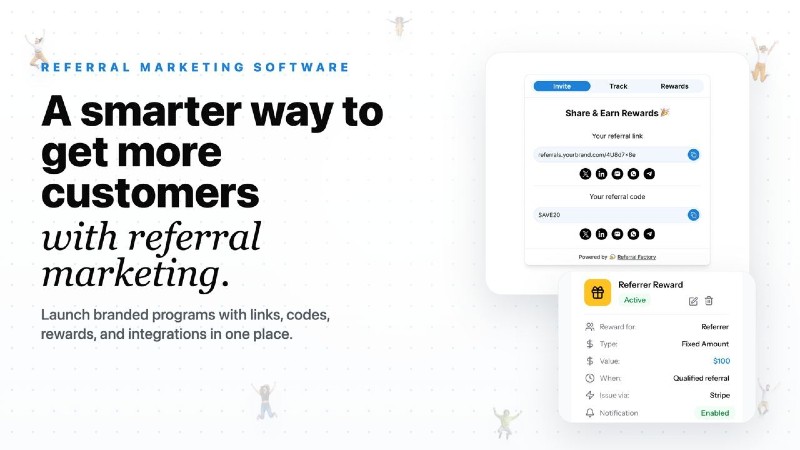
Referral Factory is referral program software built to help businesses turn existing customers into a structured growth channel.
Instead of relying on spreadsheets, manual tracking, or messy reward systems, it gives companies a centralized way to:
- Launch referral programs quickly
- Track every referral automatically
- Reward customers without manual work
- Promote referral programs across multiple channels
In simple terms, it takes what used to be an informal “word-of-mouth process” and turns it into something measurable, scalable, and automated.
Most businesses already know referrals work. The real problem has always been execution.
Who referred who?
Did that lead convert?
Has the reward been paid?
What’s the actual ROI?
Those questions become messy fast when referrals start scaling.
Referral Factory is designed to remove that mess entirely.
Why most referral programs fail before they scale
At first glance, referral marketing looks easy.
You ask customers to share a link, offer a reward, and wait for new users to come in.
But in reality, most referral programs break down quickly once they start gaining traction.
The biggest issue is not interest — it’s friction.
If the process is confusing, slow, or unclear, customers simply don’t participate. Even loyal users lose motivation if they don’t immediately understand what they need to do.
Then comes the operational side.
Once referrals start flowing in, businesses suddenly need to track everything:
- Who referred the lead
- Whether the lead converted
- What reward is owed
- Whether it was already paid
Without proper systems, this turns into spreadsheet chaos very quickly.
That’s where most referral strategies collapse — not because they don’t work, but because they are not built to scale.
How Referral Factory actually works in practice
Referral Factory structures the entire process into a simple flow.
A business creates a branded referral campaign. That campaign is shared with customers through email, websites, apps, or even QR codes.
Each customer gets a unique referral link or code.
When they share it and someone signs up or buys something, the system automatically tracks it.
Once a conversion happens, rewards are triggered automatically based on rules the business defines.
No manual checking. No chasing data. No guesswork.
Everything runs in the background while businesses focus on growth instead of administration.
The interesting part is how flexible the system is. It works for SaaS companies, e-commerce brands, agencies, education platforms, and even offline businesses that rely on in-person referrals.
That flexibility is one of the reasons it has gained traction.
Key features that stand out in Referral Factory
What makes Referral Factory different is not just the idea of referral marketing — it’s how complete the system is.
Instead of being a simple referral link generator, it behaves more like a full referral engine.
Businesses can launch fully branded referral programs that look like part of their own product. Customers don’t feel like they’re using a third-party tool — everything stays consistent with the brand experience.
Promotion is also built into the system. Referral campaigns can be embedded into websites, apps, emails, pop-ups, and even QR codes for offline use. That matters because visibility is often the missing piece in referral success.
On the backend, tracking is automated. Every referral is recorded, matched, and attributed correctly. That alone removes one of the biggest pain points businesses face.
And when it comes to rewards, the system supports a wide range of options — from cash payouts and gift cards to account credits and custom incentives.
It also integrates with major tools like HubSpot, Salesforce, Stripe, Intercom, and thousands of others through automation platforms.
That means referral data doesn’t stay isolated — it flows into existing business systems.
Why this matters more in 2026 than ever before
Marketing today is experiencing a strange paradox.
On one side, we have more tools, more data, and more automation than ever before.
On the other side, trust is harder to earn than ever before.
AI has made content cheap. Ads are everywhere. Personalization is automated. But none of that automatically creates credibility.
That’s the gap referral marketing fills.
A recommendation from a real person cuts through all of that noise instantly. It doesn’t matter how advanced marketing tools become — trust between people is still the strongest conversion driver.
This is why companies using referral systems are starting to see stronger retention and higher-quality leads compared to traditional channels.
In fact, internal platform data from referral systems like Referral Factory suggests that referred customers often stay longer and engage more deeply than non-referred users. That makes sense when you think about it — they didn’t arrive cold. They arrived pre-trusted.
Who Referral Factory is actually built for
Referral Factory isn’t designed for businesses just starting out with zero customers. It becomes most powerful once there is already an active customer base to work with.
That typically includes:
SaaS companies trying to reduce acquisition costs and increase retention
Service-based businesses that rely on reputation and word-of-mouth
Education platforms where students or parents can refer others
Finance-related services where trust is critical before conversion
For these types of businesses, referral marketing stops being a “nice add-on” and becomes a real growth channel.
Final thoughts
Referral marketing isn’t a new idea. It’s just finally getting the infrastructure it needed to scale properly.
Referral Factory sits in that exact transition point — where traditional word-of-mouth meets automated growth systems.
The most important insight here is not the software itself, but what it represents.
Marketing channels built on attention are becoming more expensive and less predictable. Channels built on trust are becoming more valuable and more efficient.
Referral Factory simply gives businesses a way to operationalize that trust instead of hoping it spreads on its own.
And in today’s market, that difference matters more than ever.