


A buyer comparing subscription invoicing software might search Google, ask an AI assistant about accounting integrations, then check vendors’ integration and pricing pages before booking a demo. At each step, missing or inaccurate product information could affect the shortlist.
An SEO and AI search strategy coordinates how buyers discover your SaaS product, how you maintain accurate product information, and how you track the demand that follows. This guide covers the steps to build that strategy, then compares six agencies that can help if you would rather not run it alone.
In G2’s March 2026 survey of 1,076 B2B software buyers and decision-makers, 51% said they started research with an AI chatbot more often than with Google, while 61% said they used AI search alongside it. Those findings support a combined approach to conventional SEO and AI search.
Key takeaways
- Keep the SEO foundations. Google’s technical requirements include an unblocked crawler, a working page and indexable content. Its generative AI features need no special schema markup.
- Publish verifiable product evidence. Google’s 2026 marketer guide recommends unique, satisfying content for visitors. For SaaS buyers, useful evidence includes accurate feature, pricing, integration and implementation information.
- Separate visibility from commercial outcomes. Track brand mentions, linked citations, website referrals and qualified enquiries as distinct measures. Measure revenue separately.
- Choose outside help by fit. Agencies differ in whether they lead with SEO, content, digital PR or paid media, so compare scope before you compare price.
Start with the questions that shape a SaaS purchase
Use sales call notes to find objections, support tickets to identify confusion, and Search Console to see queries that bring visitors. Turn that material into a consistent set of buyer questions the team can check repeatedly.
Define the buyer. Record who decides, who influences the purchase and what each person needs to know. A finance lead choosing invoicing software asks different questions from the developer who will connect it. Your pages need to address both.
Map the decision. Group questions by stage. Three hypothetical prompts show the range: “software for subscription invoicing with multi-currency support” for discovery, “alternative to our current tool with a native accounting integration” for comparison, and “what data must we migrate before switching invoicing platforms” for implementation. A set of 20 questions is an illustrative starting point, not an industry benchmark. Adjust it to your product.
Record the starting point. Run each question manually and log the platform, date, location, language setting and search mode. Distinguish standard results, Google’s AI Overviews or AI Mode, and chat assistants. Record whether your brand appeared, whether a page was linked as a source, and whether the answer contained factual errors.
Keep mentions and citations separate. An assistant can name your product without linking to a page you control, or cite your pricing page without recommending you.
OpenAI states that placement in ChatGPT search is not guaranteed. Use the baseline to document what appeared under the recorded conditions. Repeat the sample at the 90-day review with the same settings, while recognising that answers can vary between runs. A changed answer alone cannot prove that a particular website edit caused it.
Make your product information accessible and dependable
Check whether search crawlers can access your priority pages before revising content or starting outreach.
Check access. Google’s minimum technical requirements are straightforward: Googlebot must not be blocked, the page must return a successful HTTP 200 response, and it must contain indexable content. Check that essential information is available as readable text, including information shown in images. Meeting these requirements does not guarantee indexing.
Review search access and training permissions separately. OpenAI documents GPTBot for potential model-training use and OAI-SearchBot for search. The settings are independently configurable, so blocking the training crawler does not require blocking the search crawler.
In Search Console, Google’s Search generative AI control governs inclusion in AI Overviews, AI Mode and generative Discover features. Inclusion is the default setting. Confirm that the setting reflects your company’s policy.
Maintain accurate product pages. Give feature, pricing, integration, security and implementation pages a named owner and a review schedule. An outdated integration list can mislead buyers and be repeated elsewhere. If a detailed resource sits behind a form, its public page can still explain what it covers and who it suits without exposing confidential customer data.
Show the evidence. Replace claims such as “Migration is quick and painless” with documented requirements. For a hypothetical invoicing product, that could mean stating the accepted import formats, required customer fields, test-import process and records that need manual work. Publish the steps your product team has confirmed.
Apply the same standard to comparison pages. Explain where another product may suit a buyer better and support each comparison with evidence. No table format earns citations by itself.
Google says structured data is not required for its generative AI search features and there is no special schema.org markup to add. Its 2026 marketer guide advises creating unique, satisfying content for visitors. Use that guidance to prioritise accurate product explanations over speculative formatting tricks.
Earn credible evidence beyond your website
Review sites, partner listings and independent coverage give buyers sources to check beyond your own claims.
Follow the sources buyers encounter. Return to the logged question sample and list the sources cited in the answers, such as review sites, partner directories, trade publications and community threads. Use that category-specific list to prioritise outreach. Avoid assuming that AI systems favour one type of website across every market.
Keep relevant review profiles and partner listings accurate. Ask recent customers for honest reviews that explain their use case and experience, including the details another buyer would need to assess fit.
Contribute something original. Anonymised usage data, a structured customer survey or an expert explanation of a regulatory change can give editors material relevant to their readers. State the method behind any findings and approach publications whose readers match your buyers.
Assess each potential publication:
- Does it reach the people who buy your product?
- Does its assessment explain the criteria and provide useful detail?
6 agencies that can help SaaS companies with SEO and AI search
In-house delivery needs a marketing owner, developer support and product experts who can review pages. If you lack that capacity, an agency can add it, though none can guarantee search outcomes. Ask any prospective agency for its baseline, named deliverables, ownership terms and reporting methods, and agree who will supply product evidence and approve factual claims before pages are rewritten.
The six agencies below all work with SaaS or B2B technology companies but lead with different strengths.
1. MADX Digital
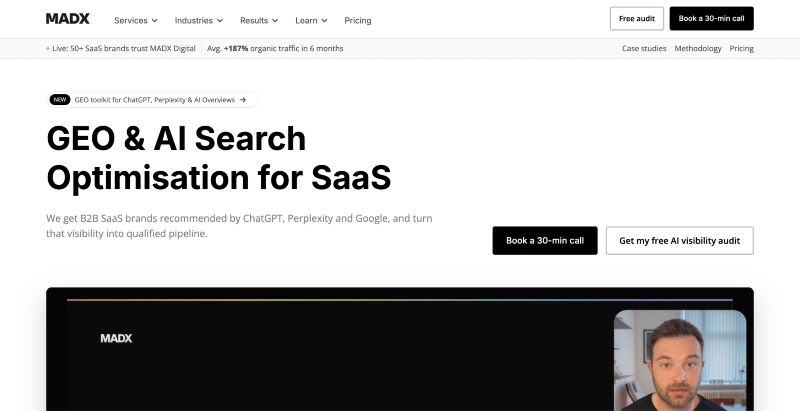
Best for: SaaS teams that want Google and AI search in one programme
A B2B SaaS SEO and AI search agency that helps SaaS brands get found in Google and in AI answers (ChatGPT, Perplexity, AI Overviews) across the UK, Europe and the US. Unlike an SEO-only retainer, MADX runs GEO alongside SEO, content and PR.
Services: GEO, technical SEO, content, digital PR and link building
2. Skale
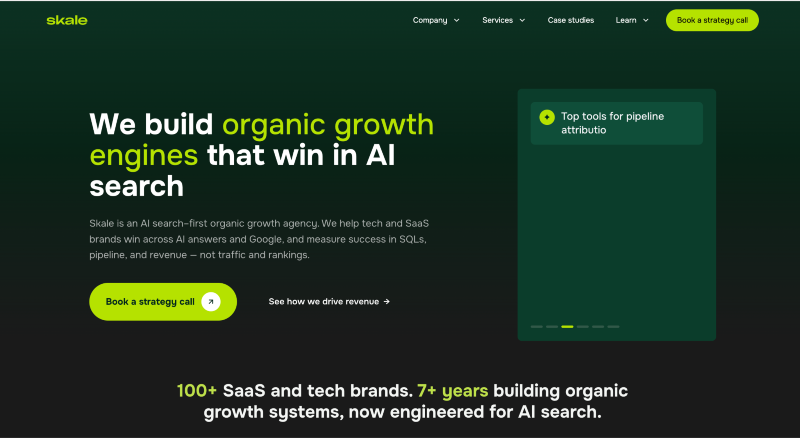
Best for: SaaS teams that judge SEO by pipeline and new MRR
A London-based agency founded in 2019 that works with SaaS and technology companies. It describes itself as an AI-search-first organic growth agency and reports results in SQLs, pipeline and new MRR rather than rankings alone.
Services: SaaS SEO strategy, content, technical SEO, link building and AI search optimisation
3. Siege Media
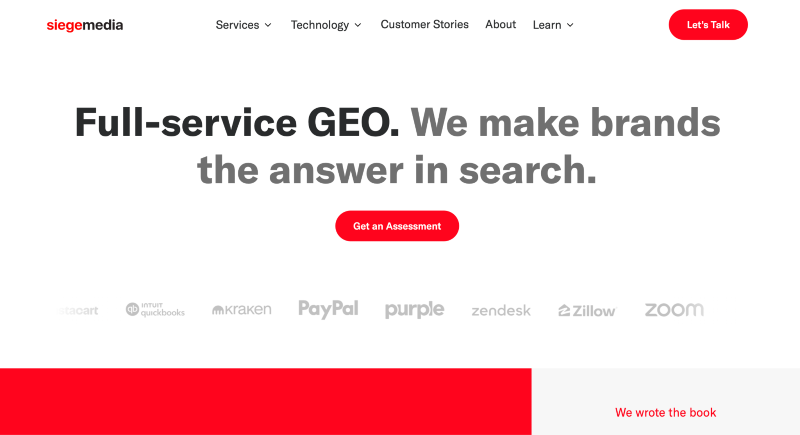
Best for: Brands that want content and digital PR at scale
A content marketing and search agency founded in 2012 that now positions itself as a full-service GEO agency. It combines content strategy, SEO and digital PR to build visibility in traditional search and large language models.
Services: Content marketing, SEO and GEO consulting, digital PR, affiliate and Reddit marketing
4. Omniscient Digital
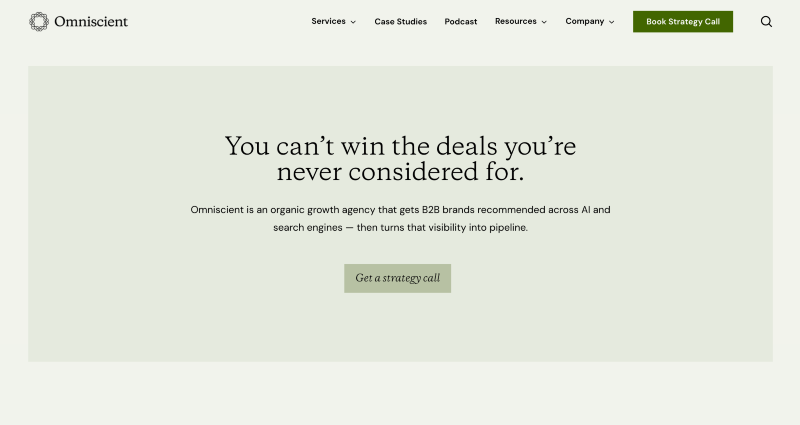
Best for: B2B teams that want a single organic growth partner
An organic growth agency that aims to get B2B brands recommended across AI and search engines. Its services cover strategy through production, with analytics and conversion work to connect organic visibility to pipeline.
Services: SEO strategy, answer engine optimisation, digital PR, programmatic and technical SEO, content and CRO
5. Animalz
Best for: SaaS companies that want thought leadership content
A New York content marketing agency founded in 2015 that works with B2B SaaS companies, tech firms and venture capital firms. It is known for long-form editorial content and has added SEO and answer engine optimisation services.
Services: Content strategy, thought leadership, SEO and AEO, demand generation and product marketing content
6. Directive
Best for: SaaS teams that want SEO and paid media under one agency
A B2B performance marketing agency founded in 2014 and headquartered in Irvine, California. Its Customer Generation methodology ties SEO, paid media, CRO and lifecycle marketing to pipeline and customer acquisition costs.
Services: SEO, paid search and paid social, content, CRO and lifecycle marketing
Run a measurable 90-day programme
Whether you work in-house or with an agency, use this quarter-long schedule to organise delivery and review. It sets deadlines for work you control; it does not predict when rankings, citations or enquiries will change.
| Period | Deliverable | Owner | Evidence of completion |
|---|---|---|---|
| Days 1 to 30 | Baseline of 20 buyer questions; access checks on priority pages; corrections to factual errors | Marketing lead with a developer | Logged question sheet; crawl and response checks; change log |
| Days 31 to 60 | Rewrite of three to five high-intent pages with evidence; initial outreach to sources found in the baseline | Product owner per page; marketing lead | Published pages with review dates; pitch log |
| Days 61 to 90 | Repeat of the baseline using the same documented settings; decision on what to keep, revise or stop | Founder | Side-by-side comparison; written decisions |
Google states that third-party SEO tools lack access to its internal ranking data and cannot guarantee performance, so treat any tool’s score as a guide rather than proof.
Measure three layers. Begin with platform visibility. Search Console’s dedicated generative AI performance report for Search completed its worldwide rollout on 31 August 2026. It reports impressions with page, country, device and date breakdowns. Use the country filter to examine UK-originating searches separately, for example. The report covers Google visibility, not cross-platform citations or conversions.
Bing Webmaster Tools introduced its AI Performance report in public preview in February 2026. It reports citation activity across supported Microsoft AI experiences. Citation counts do not describe a site’s position or presentation within an answer.
Bing’s Topics Portfolio beta, introduced in October 2026, reports opportunity-query citation volumes as ranges. Do not turn those ranges into precise demand forecasts.
The shift from SEO to GEO means being cited in AI answers matters as well as ranking on page one, so measure both.
Add your repeated question sample, reporting both the count and the sample size. An illustrative result would be “six of 20 questions mentioned the brand”. A selected sample cannot establish overall market share.
The second layer is observable website referrals: sessions arriving from AI assistants and the pages they land on. The third is commercial outcomes: qualified demo requests, trials and closed revenue, with the source recorded at enquiry. Keep these measures separate. Changes in direct traffic or citation counts alone cannot show that AI visibility produced sales.
Review the evidence. In SEOFOMO’s August 2026 survey of 171 search professionals, 92% said they tracked AI visibility and citations. That describes adoption within the sample, not proven business effectiveness. At the day-90 review, check that both measurement runs used documented settings, compare the commercial outcomes and record which work to continue, revise or stop.
FAQ
Does GEO replace SEO?
No. Generative engine optimisation (GEO) describes work aimed at visibility in AI-generated answers. Google treats its generative search features as part of SEO, with the same underlying crawl, response and indexability requirements. Plan the work together.
Do we need special schema or llms.txt?
Google says its generative AI search features do not require structured data, special schema.org markup or new AI-specific files. That guidance applies to Google. Check other platforms’ documentation before making changes for them.
Must we allow AI training crawlers?
No. Search access and potential training use are separate decisions. OpenAI documents GPTBot for potential model training and OAI-SearchBot for search as independently configurable, so you can disallow one and permit the other.
Should we hire an agency or build the team in-house?
It depends on capacity. An in-house team needs marketing, developer and product input. An agency can add specialist capacity, but no agency can guarantee rankings or AI citations, so judge proposals on named deliverables, reporting and ownership terms.
How quickly should we expect results?
No fixed timetable guarantees rankings, citations or sales. Use the 90-day plan as a delivery and review schedule. At the review, check completed fixes, compare repeat measurements and decide which pages or buyer questions need further work.