
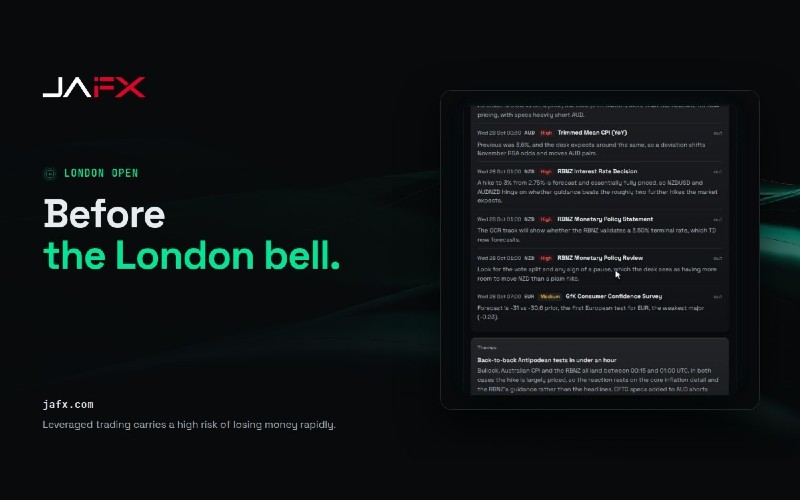
At 07:00 UTC on Thursday 12 November, the UK’s third-quarter growth figures came out at the moment London’s trading day began. At the same minute, JAFX published its London Open note, written by JAFX AI, the assistant built into the broker’s trading terminal. The headline read: “UK Q3 GDP lands into a firm dollar; USDJPY at 159.85 presses the 160.00 line”.
London is the busiest stretch of the currency-trading day, when European banks and funds arrive at a market that has been trading through the night. The note is there so that someone sitting down at seven knows what changed while they slept, and what the day has lined up.
What changed overnight
Each note opens with the mood. On 12 November it was marked “Mixed”: stock indices were up only 0.16% on average over 24 hours while gold was down 2.13%, which the note read as “a rates-driven dollar bid rather than a flight to safety”. In plain words, investors were buying dollars because US interest rates looked set to rise, not because they were frightened.
Next comes the currency strength table, which gives each major currency a score for how it has performed over the past 24 hours. That morning the US dollar sat at the top on 0.63, up from 0.58 in the previous note, and the New Zealand dollar was bottom on -0.43. One line tells a trader which currencies are doing the pushing.
A short “Themes” section then explains the stories behind the numbers. One that morning was the yen: the dollar was edging towards 160 yen, a level the note flagged as the line where Japan’s authorities might step in.
The day’s releases, and who they touch
The “Ahead” section lists the day’s scheduled economic releases with the time, the forecast and the previous figure, and, most usefully, which markets each one could move. On the UK growth numbers, the note read: “Consensus is 0.7% after 0.5%. Our GBP desk sees a beat only slowing the USD-driven slide, while a miss has more room to extend GBPUSD losses; EURGBP and UK100 are also exposed.”
That last clause matters to someone holding a position on the UK’s main stock index rather than on the pound. The same list ran on through US jobless claims at 13:30 UTC and a string of Federal Reserve speakers from 14:00 UTC, each with a line on what it could move. The numbers are drawn from market data and checked against the wording before each note goes out.
Levels to watch, and what happened next
The note closes with a handful of price levels JAFX AI is watching on the charts. “H4” means the four-hour chart, where each bar covers four hours of trading, and “support” is a price where buying has previously halted a fall. On 12 November one of the levels was gold at 3,968.75: “H4 support after the double top confirmed below the 4027.52 neckline”.
JAFX AI’s New York Open note, published at 13:04 UTC, showed how the morning went. Gold had fallen “through the 3968.75 H4 support flagged at the London open” to 3937.62. UK growth “matched at 0.7% q/q and the monthly data beat, but GBPUSD moved only 0.09%”. The view that good UK data would do little against a strong dollar held up. The gold level did not.
That is how the note is meant to be read. A level is a reference point, not a forecast, and JAFX AI gives general market information, not advice. Every note ends with what to watch until the next one, and past notes stay in the JAFX London Open briefing archive exactly as they were published, so a reader can compare the morning’s words with the afternoon’s prices.
Before acting on any of it
The markets in the note are traded at JAFX as CFDs, agreements on the movement of a price in which no currency or gold ever changes hands. They come with leverage, which magnifies a loss just as readily as a gain. A good briefing tells a trader what the day holds. What they do about it remains their own decision.
JAFX (PTY) LTD is an authorised Financial Services Provider (FSP No. 52058) regulated by the FSCA. Trading leveraged derivatives carries a high risk of losing money rapidly and is not suitable for everyone.