
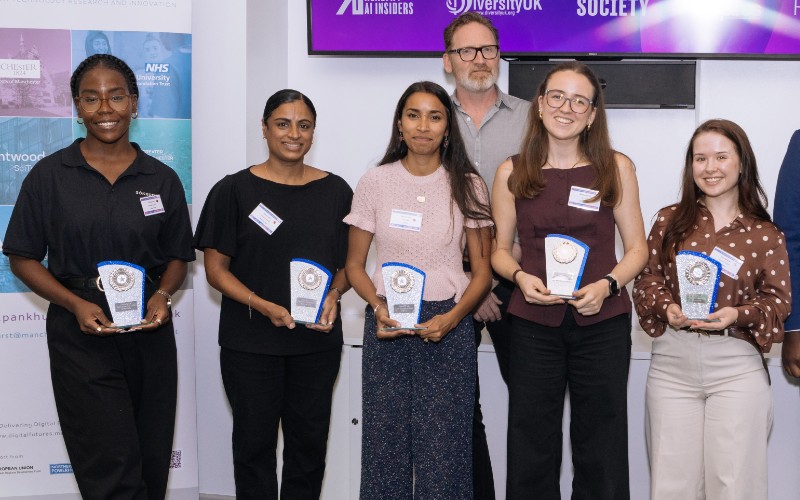

Five pioneering innovations tackling some of the most persistent challenges in women’s health have been recognised with awards at the Women’s Health Technology Summit 2026.
The awards recognised innovations across healthcare, technology, data and research, highlighting new approaches to improving health outcomes for women and girls.
The five award recipients were:
Balance app – an evidence-based app providing personalised information and support around hormone health.
Gynomics – an early-stage UK women’s health startup applying computational biology, machine learning and ‘omics data to develop earlier prediction of pregnancy complications.
InViFlo – an early-stage company developing modular organ-on-a-chip platforms that recreate living human tissues under physiologically realistic flow conditions.
Söker Data – a health data intelligence company focused on addressing historical biases in medicine.
Synkit Health – a women’s health and wellness startup developing innovative approaches to improve women’s health and wellbeing.
The awards were presented at the Women’s Health Technology Summit 2026 which brought together leaders from healthcare, technology, research, investment and policy to explore how innovation, digital health and artificial intelligence can help improve health outcomes for women and girls.
Sareeta Vala, Trustee of Diversity UK and curator of the Tech Showcase judging, said: “Women’s health has been overlooked for far too long, but these awards show that innovation is changing the picture. What impressed us about this year’s awardees was not just the technology, but the real-world problems they are tackling.
“From helping women make sense of their symptoms and be better prepared for conversations with clinicians, to spotting pregnancy risks earlier, improving how we study women’s health, tackling bias in medical data and putting women at the centre of product design, these innovators are turning important gaps into opportunities for change.
“Each of the awardees is showing what’s possible when we listen to women, use technology intelligently and focus on solutions that can make a practical difference. They deserve to be celebrated, and we’re excited to see what comes next.”
Despite living longer than men, women spend significantly more of their lives in poor health. Delayed diagnoses, unequal treatment pathways, underinvestment in research and persistent gender bias continue to leave millions of women underserved by healthcare systems.
Co-hosted by Diversity UK and the Greater Manchester Connected Health Ecosystem, and coordinated by the University of Manchester’s Digital Futures, The Christabel Pankhurst Institute and Health Innovation Manchester, the Summit was inspired by the renewed Women’s Health Strategy for England (2026) and focused on practical action to accelerate progress towards a fairer, more inclusive and innovation-driven healthcare system.
Discussions centred on three themes: Tackling Medical Misogyny, Investing in Women’s Health Innovations and Feminist AI. Speakers and delegates from healthcare, academia, technology, industry and investment explored how innovation can help address persistent inequalities in women’s health and support better outcomes.
Lopa Patel MBE, Chair of Diversity UK and co-host of the Summit, said: “Women’s health is one of the defining health, economic and social challenges of our time, yet it continues to receive disproportionately low levels of attention and investment. Closing the women’s health gap requires collaboration across healthcare, research, technology, investment and public policy.
“By bringing together leaders from these sectors, the Women’s Health Technology Summit aims to accelerate innovation, challenge systemic inequalities and help build a healthcare system that delivers better outcomes for every woman and girl.
“We were pleased to recognise the significant strides being made by researchers and innovators developing new solutions designed to improve women’s health. We hope that showcasing these innovations will foster greater collaboration between the NHS, universities, investors and industry. Many congratulations to all the award recipients.”