

From the outside, PerfectTed’s first five years have been something of a fairytale.
The firm was co-founded from a kitchen table in 2021 by Teddie Levenfiche, his brother Levi and Levi’s wife Marisa Poster – who is also Teddie’s best friend – to bring quality matcha to the UK.
They made headlines in 2023 after receiving five offers from the BBC Dragons. With Steven Bartlett heavily invested in the brand both financially and personally, it has grown to become the UK’s biggest matcha brand and is set to hit $100 million+ annual recurring revenue this year.
Yet even as it celebrates its fifth birthday this week – with hundreds of beloved products now sold in more than 50 countries around the world – a look inside the business would unearth ‘chaos’.

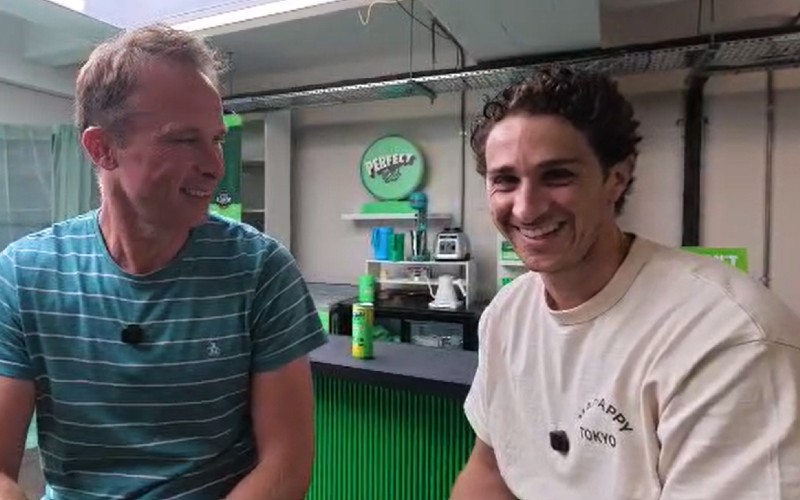
This is very much a good thing, says Teddie, when I meet him at PerfectTed’s new offices in the iconic Tea Building on Shoreditch High Street for Founder Friday.
“We’ve grown faster than Huel. We’ve grown faster than Innocent. We must be one of the fastest-growing F&B (food and beverage) brands in UK history. It’s an incredibly painful process,” he admits.
“Every single founder of any successful business will say the same thing: from the outside, it looks super glamorous; but if you look under the hood of our business it’s absolute pure chaos!
“One of the challenges, when we have such a young team, is communicating that the chaos they are experiencing isn’t unique to our business. The reason we are growing so quickly is because we lean into that chaos – it’s not despite the chaos.
“If you walk into a brand and there is no chaos, they’re definitely not growing quickly enough – or they’re leaving a lot on the table in terms of growth opportunities.”
Teddie says that the co-founders have had to grow “at the same pace of the business” – but to understand this, we must go back to where it all began.
Bunk beds
Teddie and Levi have always been close. They shared a bedroom growing up in North London – “he slept on the bottom bunk, I slept on the top” – and when Levi moved to the United States to study, his brother followed him to that same university.
Levi then worked in finance in New York while Teddie moved to Los Angeles to work in consulting. “We both didn’t get our visas unfortunately because there’s a lottery system in the US so we moved back to the UK and were living together in London with Marisa,” says Teddie.
“I was working a consulting job that I really didn’t like, and I was accepted to go to Harvard Law, which was my dream. Have you seen the show Suits? I always wanted to be Harvey Specter!
“But Marisa has ADHD and anxiety and she switched to drinking matcha because she felt that coffee and energy drinks were worsening her symptoms. Levi and I had also started drinking matcha, independently, because there’s a big matcha culture in both LA and New York.
“We found that in the UK you couldn’t get good matcha anywhere… that was the genesis of the business.
“We thought: ‘Let’s give it a go. If it doesn’t work out, what’s the worst that can happen?’”
Japan
Teddie describes matcha as “like green tea on steroids”. Its deep green colour is the result of depriving the plant of sunlight – leading to increased chlorophyll production – before the whole leaf is powdered and whisked into liquid for drinking.
It is lauded for providing a smoother, longer-lasting energy boost than coffee – lasting three to six hours – because it pairs a moderate dose of caffeine with a calming amino acid called L-theanine.
When the co-founders decided to create a business around it, they went directly to the source.

“We went to Japan, rented a car and literally drove up and down the country, knocking on farmers’ doors. That was the evolution of our supply chain,” says Teddie (pictured above, left, with his co-founders).
“When they think about the business today, a lot of people think our supply chain was built the corporate way – but it’s very much built on relationships with farmers.”
As well as making good quality matcha available to UK consumers, there was another sound element to the business model.
“The supply chain was so fragmented [before]. A farmer would sell to a wholesaler; who would then sell to another wholesaler; they would then sell to a distributor; they might sell to yet another wholesaler in Germany… and so on.
“There were like 10 different people within the supply chain that were making a margin – and the farmer was making the least amount of money.
“So in terms of efficiency, we thought we should be going direct and building those relationships; but also, we wanted to communicate transparency to customers who didn’t truly understand where the ingredient came from.
“We’d seen the same disintermediation trend within other industries such as cashmere and olive oil.”
Even now the trio visit Japan every month – and, increasingly, other Asian countries – renting a car and driving to meet potential new and existing suppliers.
“It’s very different, doing business in Japan versus doing business in the UK. It’s very focused on relationships; loyalty; trust; and in-person culture. I think that has been lost a little bit in the West.
“When we go out there, we eat meals in their homes; meet their families. You don’t just rock up and buy matcha! You have to build years of relationships.
“One of our biggest competitive advantages is our supply chain, but not just because of its breadth – it’s really the depth of the relationships that we have with farmers.”
Products
Back in the UK, PerfectTed has built a team of around 80 staff working to develop, package and sell products from matcha powder and Nespresso pods to canned lattes and healthy energy drinks. All have a stake in the business.
“We do everything in-house – even formulation,” says Teddie. “Most F&B brands will outsource that to a food science agency but we have a team of R&D scientists, PhDs, that will do the entire formulation for us.”

PerfectTed co-founders Teddie Levenfiche and Marisa Poster pitching on Dragons’ Den
They hold two weekly meetings – one focused on new product development, and the other on existing product development.
“Consumers don’t realise this, but we are constantly iterating on every single product that’s already in the market,” reveals Teddie. Picking up an energy drink can, he continues: “We’ll be getting real-time feedback on this product. It might be that people find it too sweet; not sweet enough; that the black cherry flavour should be more of a sour cherry; or perhaps that it’s not sparkling enough.
“There are a million different ways that we’re iterating on the product, improving it, without consumers even realising – because most of the changes we’re making won’t even affect the nutritional panel.”
And with 30-35% of PerfectTed’s business international, its products have to appeal to palates from a range of countries.
Founder roles
It may now possess full functions across areas such as finance and marketing, but the three co-founders remain firmly entrenched within the business.
“When we started out, we couldn’t afford a designer or a design agency. So Marisa watched YouTube videos and taught herself how to use Adobe. She’s been heavily involved in designing everything from our logo to the packaging,” says Teddie. “She’s a more talented designer than people who have studied it for years in formal education!
“Levi runs finance, business ops… the US is a big focus for him. And I focus mostly on supply chain and sales.
“The hardest thing that we have faced is learning that growing from zero to £1m is different to going from £1m to £5m; £5m to £10m; and so on. The skillset that you need from a team perspective, but also as a founder, is very different.
“When you’re first starting a business, you’re like a mouse in a china shop. You’re running around trying to knock anything, and nothing’s really breaking: Tesco’s not responding to you, while it’s really hard to hire people as why would they take a risk on your business?
“Then you become a raccoon… and then you become an elephant. The way that you operate as a mouse needs to be different to how you operate as an elephant.”
In October last year PerfectTed announced a major new round of investment led by Felix Capital, giving it a valuation of £140m as it strives to become the world’s first billion-dollar matcha brand.
Replaceable
Teddie continues: “We recognise that we, as founders, have to grow with the business and at the same pace as the business – otherwise we will get left behind. As a founder, you are replaceable.
“Every employee – and every founder – needs to requalify for their role every single year to make sure that they’re doing the best they can do for the business – and we take that responsibility really seriously.
“We often get asked: ‘Wow, you’ve done this, it’s amazing… you’ve got so much to lose. Why not just protect what you have?’ But the kind of person that wants to build a business like this does not want to slow down. Hopefully, you can feel it when you walk into the building.”
Indeed the floor PerfectTed has taken in the Tea Building is filling up fast. The famous green branding is everywhere, from Teddie’s outfit to the walls and the scooters which staff zip about on.
Although Chelsea fan Teddie was a promising footballer – he played in the academies at Watford and Fulham – it was entrepreneurs that he idolised growing up.
Referencing Guy Raz’s podcast How I Built This, he says: “I’d spend a lot of my time listening to stories of how you could start off as a potato farmer or something and then build up this incredible QSR (quick service restaurant) chain just by starting small and scaling it.
“That’s what we’ve done at PerfectTed. Nothing we’ve done here is particularly complicated. It just required a lot of dedication, consistency, resilience and getting up every morning and trying to be the best in the world at what we do.
“Marisa, Levi and myself will be the first to say we’re not special. It’s just very intentional – and we’ve sacrificed a lot. People see that we have this amazing team and great office, and the business is super valuable today. But it has come at a massive expense.
“That’s the trade-off that we’ve decided to make. Sometimes people try to make us feel bad. They’re like, ‘Oh my God, why do you work so much?’ But it doesn’t feel like work!
“The only thing that feels like work, honestly, to me are people challenges. That’s the only thing that doesn’t come naturally. But it’s such an important part of the business.”
Turning 5
So how did PerfectTed celebrate its milestone birthday?
Yesterday it threw a party at Observation Point on the South Bank, with a giant cake and big giveaways; and it has also launched a Birthday Cake Matcha Latte Powder.

“I didn’t think we’d survive this long or get this far,” reflects Teddie. “But the craziest thing is when I now look forward from this moment, this feels like just the beginning.
“I honestly think we’re just at the start of what we’re going to build. That’s not founder delusion – it’s the truth. We have built the foundation for what will be the craziest 12-24 months of the business’s trajectory.”
PerfectTed launches brand new flavoured matcha powder, Birthday Cake. For more information, please visit www.perfectted.com