
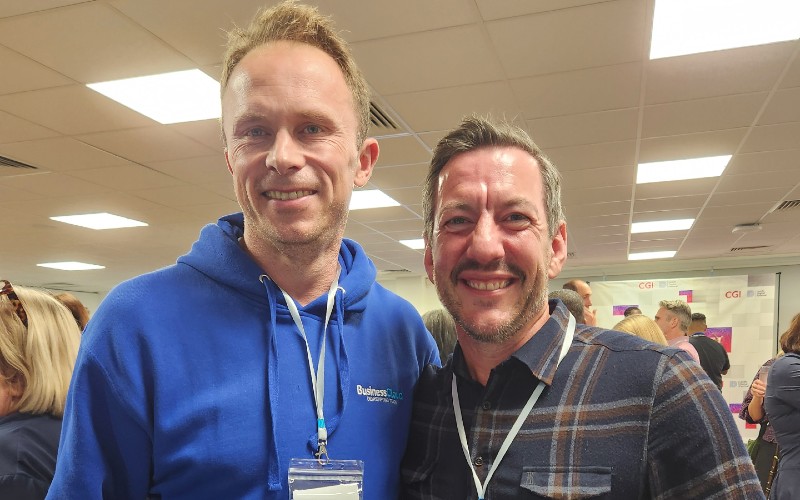
Behind the ready smile of Alex Craven lies a burning ambition to achieve something truly remarkable.
Leeds is officially the biggest tech cluster outside London, with 853 tech companies based in the city – more than any other local authority outside the capital.
However, while the likes of Cambridge, Manchester and Edinburgh can point to several unicorn companies – tech firms with a billion-dollar-plus valuation – Leeds has only one: Sky Betting & Gaming.
Should The Data City become the second, it would contain a certain irony: for it is co-founder and CEO Alex’s business that provides the company classification data itself.
I met Alex last night at the launch party for the 11th annual Leeds Digital Festival. Even in a room containing the great and the good of the Leeds tech scene, his infectious enthusiasm stood out.
That doesn’t mean it has always been rosy. “I sold my first business, Bloom, to Jaywing in 2016 and it was an absolute disaster,” he tells me for Founder Friday.
Bloom & the High Court
Jaywing was an established and acquisitive data business based in Sheffield which appointed Alex as managing director of a newly formed MarTech division following the acquisition of the digital agency from him and his co-founders.
He lasted two years before parting ways amid a restructure. Then-Jaywing CEO Rob Shaw claimed at the time that this was “on good terms”. However a dispute over a substantial earnout saw Alex and his co-founders take Jaywing to court.
They lost – but the High Court judge said in 2022 that “it is impossible not to have some sympathy for the position they found themselves in as it is clear that Mr Craven believed that Jaywing were onboard with a plan which would allow them to hit their earn-out target… the clear lesson, as in so many cases, is that, if a legally binding agreement is the intended outcome, it should always in some way be clearly recorded in writing”.
Last year Jaywing delisted from London’s junior AIM market and underwent a solvent liquidation and acquisition by Stubben Edge. In effect, the former business ceased to exist.
Origins of The Data City
Back in 2018, Alex had 12 months gardening leave – and the perfect base from which to build something new was already in place.
“In 2014, the government did a report on the size of the digital agency sector – supposedly a database of all of the agencies in the UK – and we (Bloom) weren’t in it,” says Alex. “Nor were several other leading web design agencies.
“When they toured it, I stood up at an event and said: ‘This is rubbish. You missed three-quarters of the sector. We could do better using web scraping.’ I already had an early web-scraping AI product.”
On the back of that moment he was able to win a tender with Leeds City Council. After producing a report with all the missing agencies, he asked them what they wanted to do with it – and at their behest created a website to host the data.
“It was a Squarespace site for £5 a month! We called it The Data City and it took us 20 minutes to design the logo… no, it’s not the one we have today!”
This was the birth of a new industrial classification system – allowing policy makers, economists, investors and analysts to understand the emerging economy and markets in real-time. In effect, it is looking to replace SIC codes as the foundation of industrial data in the UK.
Alex continues: “It went viral amongst economists, and we had about half a million pounds worth of orders over 18 months – we had no people, no company, nothing!
“So when I was on gardening leave, Paul [Connell] was going: ‘This is the thing. Run it.’ And I knew I didn’t want to run an agency again… sell time and materials. I was convinced that I wanted to work in tech, not marketing.”
Paul ran ODI Leeds, a pioneer node of the Open Data Institute founded by Sir Tim Berners-Lee and AI expert Sir Nigel Shadbolt. In 2018 The Data City was launched as a joint venture with the ODI, with Tom Forth, then head of data at ODI Leeds, coming on board as CTO.
“I did a proper business planning exercise: what is this problem? How big is it? And actually, it’s everywhere in the world,” says Alex. “Every industrial classification system is broken everywhere.”
Going global
In the UK, there are 4.5 million active companies – but only 2.8m which actually do anything, and only 1.4m that employ more than one person.
The Data City has classified them all. “The real economy is around a million businesses,” says Alex. “We match them to their websites, and then we classify them into the industries that they actually operate in.”
Also key to its success have been COO Kelly Weston and CFO Emma Dickinson, whom Alex worked with at Bloom. Mitali Mookerjee then joined as UK MD a year ago to allow Alex to focus globally.
“We’re now live in France, Germany, Ireland and – since last Wednesday – the US. We’ve got over 70m businesses on the platform now,” he says.
Part of the impetus for that was a £2m Series A investment from Oxford Economics last year at a post-money valuation of £19m.
Oxford Economics is not a VC, but an economic forecasting firm with substantial revenue coming from the US. “They told us: we need your data to exist globally. Can you help? They funded us to launch in America – and the plan is then to go global.”
Ambition
Alex recently turned 50 and has a burning ambition for The Data City and Leeds.
“I’m passionate about my city. I’ve always said it’s the UK’s data city – hence our name,” he says.
“I’d like to grow a tech unicorn from Leeds which is not about bodies and time and materials – but about actual data infrastructure for the global economy.
“Our target is £80-100m ARR across 20 territories, which would make us a unicorn on valuation, with less than 100 people. That would be a great story.
“Obviously the money would be awesome – but actually I just want to do it. I want to see if that’s possible.”
In the meantime, he’ll be taking on a very different role during the Leeds Digital Festival.
“I’ll be DJ-ing at the Leeds Digital Awards!” he laughs. “I used to go to Cream [and many other dance clubs] back in the day so I still like to go to festivals with my partner Zandra [Moore, founder of Panintelligence and zygens].”