
For Henry Dunne, the idea that would become Microneedle Solutions (MNS) started while he was studying at the University of Leeds.
In March 2022, during his final year, he joined forces with co-founder Ian Bartenev to tackle one of healthcare’s oldest challenges: replacing syringe injections with a simpler, pain-free alternative.
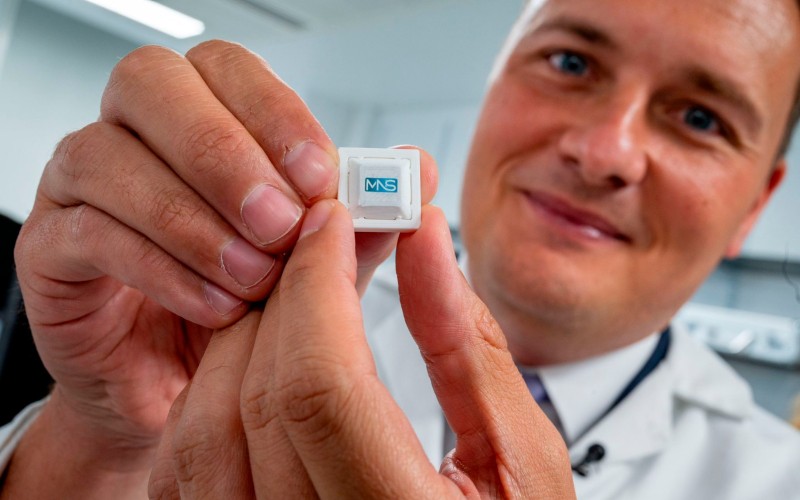
Together they developed Miracus, a microprojection patch platform designed to deliver medicines and vaccines through the skin without the need for a traditional needle.
The technology works differently from a conventional injection. Instead of using a hypodermic needle, Miracus uses tiny dissolvable microprojections, microscopic, needle-like tips arranged on small patches, that release the treatment into the skin before the patch is removed.
The aim is to make self-administration straightforward and safe, whether for routine vaccinations, GLP-1 weight-management treatments, or other medicines. It also removes the need for sharps disposal and can remain stable at room temperature for up to two years, making transport and storage significantly easier.
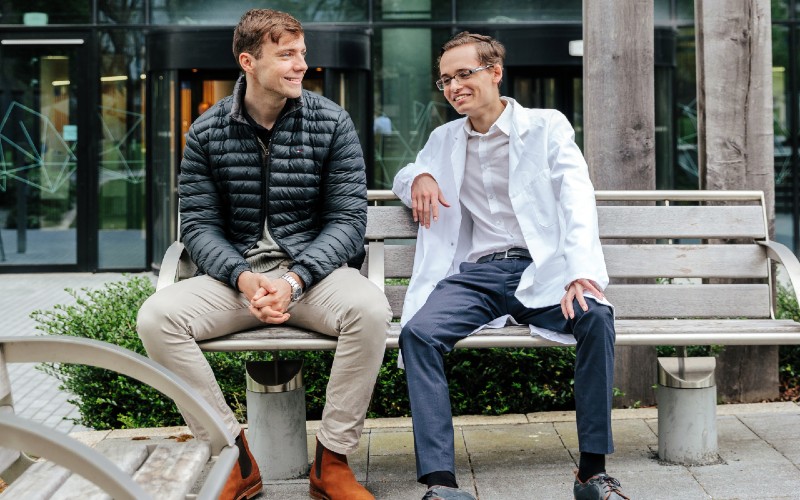
Left to right – Henry Dunne and Ian Bartenev outside Nexus at the University of Leeds
Although MNS has not yet reached the commercial stage, the business has continued to build momentum. The seven-strong team recently completed an oversubscribed seed funding round, achieved drug delivery rates of more than 90 per cent and developed an automated PhaseShift production line capable of manufacturing up to 1,000 patches a day.
Rather than creating new drugs, the business adapts existing medicines into a patch format, creating opportunities to work alongside pharmaceutical companies as clinical development progresses.
Leeds has been central to that journey. After receiving early support through the University of Leeds Spark programme, the company moved into Nexus, where access to specialist facilities, researchers and experienced mentors helped turn an idea developed by two students into a funded biotech business.
In June 2025 then-Health Secretary Wes Streeting praised MNS during a visit to Leeds (pictured).
“What makes Leeds special is its combination of scale and accessibility,” says Dunne. “It is a major city with excellent universities, hospitals, businesses and infrastructure, but its innovation community remains connected enough that people genuinely know and support one another.”
That collaborative approach is helping to strengthen West Yorkshire’s reputation as a centre for health technology. The sector is championed by Leeds Digital Festival, which returns this September, and brings together businesses, researchers and entrepreneurs from the digital, engineering and life sciences sectors to share ideas, forge new partnerships and showcase innovation.
“The festival is valuable because it brings different parts of the city’s technology community together,” says Dunne. “Digital technology now underpins almost every innovative industry, including biotechnology and healthcare. It helps position Leeds nationally as somewhere serious technology businesses can be created and scaled.”
Deb Hetherington, Director of Leeds Digital Festival, said: “The digital and health-tech ecosystem in Leeds is built on genuine collaboration, where world-class academic research, ambitious startups and regional organisations support one another.
“Businesses like Microneedle Solutions show what is possible when talented founders have access to the right network and environment. They are building technology with global potential from a city that continues to back innovation.”
Looking back, Dunne believes aspiring founders should spend less time waiting for the perfect moment and more time testing ideas in the real world.
“My first piece of advice would be to start before you feel completely ready,” he says. “You will never have perfect information, and many of the most valuable lessons come from speaking to customers, building your product and solving real problems as they arise.”