
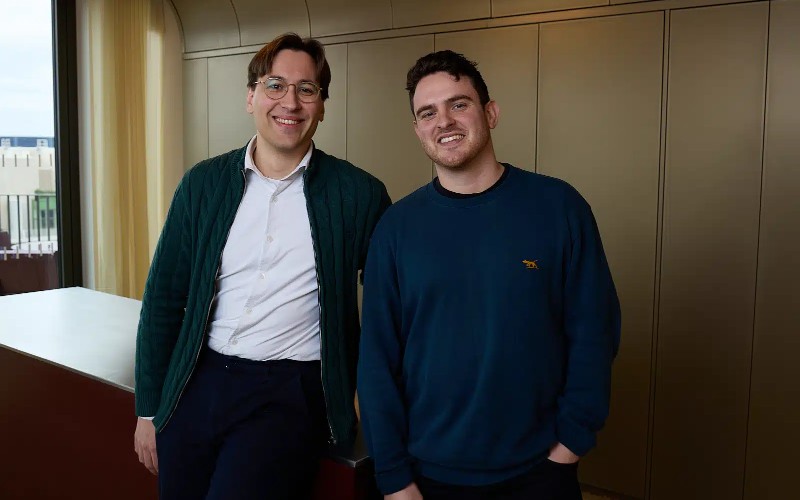
Callosum, an AI infrastructure company founded by Cambridge scientists Danyal Akarca and Jascha Achterberg, has raised $100 million (£73m) in seed financing.
One of the largest seed rounds ever raised in Europe and aims to rewrite how AI is computed.
Callosum says it has built a software layer that co-optimises AI models and chips, orchestrating each workload across the hardware best suited to run it – removing reliance on any single frontier model or chip.
The founders met while earning their PhDs at Cambridge, where their research examined how the brain achieves intelligence not by replicating one type of neuron billions of times but by combining specialised circuits.
They argue AI systems will follow the same pattern: many models, interacting collectively, on diverse computing substrates.
The round was led by Atomico, with participation from Plural, DCVC, UK Sovereign AI, and other investors including Albion VC. It comes less than six months after Callosum emerged from stealth with a $10.25m pre-seed round.
“The brain has inspired many of our great breakthroughs in AI. The corpus callosum joins our two specialised hemispheres with intelligence emerging not from any one part, but from their connection,” said Sebastian Hunte, investment director, AlbionVC.
“In compute, as in the brain, heterogeneity creates rich emergent structure: systems more capable than the sum of their parts… the disaggregation of the serving stack, multi-agent workflows, and optionality across models and hardware opens up a system-level co-optimisation surface that can deliver exactly those gains.
“Callosum does this better than anyone else in the world.”

Callosum was the first investment from the UK’s Sovereign AI fund. It described the tech as ‘deep technical infrastructure that shapes how AI is computed globally’.
AI Minister Kanishka Narayan said: “AI is nothing without the chips that underpin it – and the eye-watering demand for them is only going to grow. In the race to develop and use AI, success will depend not just on having access to those chips, but on using them as efficiently as possible.
“That’s exactly what Callosum are working on. By helping AI systems match the right computing power to the job they’re carrying out, they are laying the foundations for AI that is more capable, affordable and able to benefit far more people.”
At the heart of Callosum’s thesis is a reframing of the industry’s basic unit of value: the token. Rather than just making tokens cheaper by brute force, Callosum’s heterogeneous approach makes each token worth more – every unit of computation directed to the model and hardware where it produces the most useful intelligence per amount of money spent.
“The industry has been betting that one model or one kind of chip will rule them all,” said CEO Akarca. “But nature shows us the opposite.
“Intelligence is collective and will emerge from many specialised systems working together. We believe AI needs a new axis of scaling, where many models and hardware co-evolve as a single system.
“That’s how we build AI that is not only more capable, but dramatically faster, more affordable and far more energy-efficient, opening the door to applications that were not viable before.”

Callosum serves three groups shaping the next phase of AI: enterprises who need frontier AI capability at an affordable cost; cloud providers and hyperscalers needing to orchestrate diverse fleets of models and chips; and sovereign compute programmes.
“The team has already demonstrated world-class technical breakthroughs, and incredible speed of execution, and we believe their vision has the potential to fundamentally reshape how AI is deployed at scale,” said Sasha Vidiborskiy, partner, Atomico.
Callosum says that on complex agentic workloads in financial services, the platform ran 4x faster, cut compute costs by 70% and improved task success rates by 10% versus the same workloads on a single frontier model running on conventional GPU infrastructure.
These results are part of Callosum’s partnership with Cerebras, the US chipmaker whose wafer-scale processors are among the fastest available for AI inference.
Callosum is building a global network of silicon partnerships that includes Rebellions (South Korea), Axelera (Netherlands), Tendrils (UK), as well as key infrastructure partners including Supermicro.
“Orchestration is all you need,” said Jason Pontin, general partner, DCVC. “Token consumption by users of scientific and enterprise computing is expanding exponentially, but Callosum knows the key to making each token cheaper and more valuable is to treat AI computing as multimodal, not monolithic.”
Callosum is a founding member of the Scaling Inference Lab at ARIA, the UK’s advanced research agency, where it is integrating emerging technologies from companies including Oriole Networks and Lumai – which use light rather than electricity to move and process data – into large-scale AI systems.
The funding will be used to scale the technology, deepen partnerships across silicon ecosystems, and expand the team. A selection of Callosum’s tailored-inference APIs have now gone live; further customer deployments and partnerships will be announced in the coming months.