
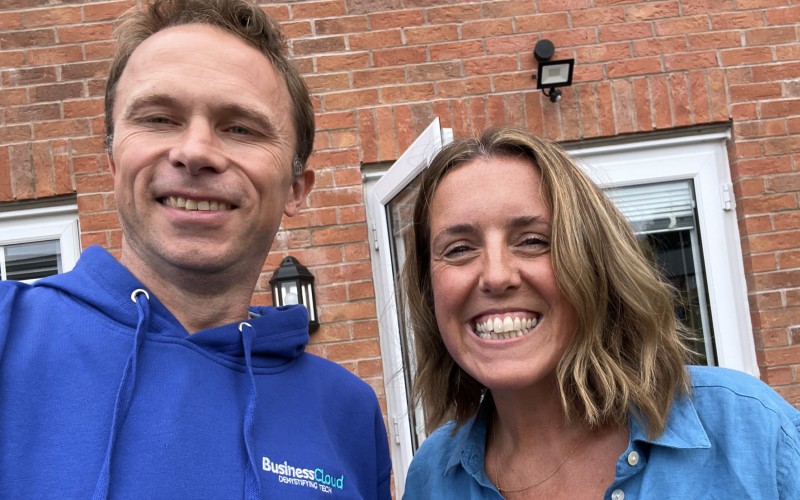
The purpose of my Founder Friday series is to meet entrepreneurs where they live.
With Kate Heath, that turns out to literally be the case.
Her EdTech business Gaia Learning is fully remote and so when I ask where she would like to be interviewed, she answers: “You’re welcome to come to me in Crewe. We have a nice garden to sit in with my pup!”
So it is that over cups of tea – with friendly border terrier Mabel pleading for attention – I come to see the ‘four Ps’ driving one of the North West’s most promising founders.
Early life & career
After studying marketing at university, Kate’s early career was spent in senior marketing roles. She then founded a consultancy which would lead to You in Mind, a platform which improved access to mental health services.
The motivation came from a very personal place. “My marketing agency was commissioned by several NHS clinical commissioning groups to do research into clinical pathways, social prescribing and lived experience,” she says.
“Around that time – the summer of 2015 – three things happened: my friend’s daughter was self-harming; a member of my family, who was already diagnosed with schizophrenia, was sectioned again; and one of the surgeons that had saved my life as a baby took his own life.”
When she was born, Kate had liver cancer which caused three heart attacks and two heart failures.
“My liver was the size of a rugby ball because it was being pumped with blood from my heart and it had cancerous growth on the inside,” she explains. “It was literally sucking the life out of me.
“I underwent world-first surgery.. I have a huge scar across the middle of my body that looks like I’ve been bitten by a shark, or sliced in half by a magician!
“This was back in 1985… they literally sliced me open and didn’t know what they were going to find.
“I’ve been told that my chances of survival were something like one in 1.1 million. I had all the churches in Manchester praying for me.”
Thirty years later, she was determined to create something to help people suffering with poor mental health.
“I created You in Mind to help children and young adults find local and national mental health well-being resources,” she explains. “I had quite an insight into mental health systems and the challenges of that within the NHS, care and support.
“One of my skills is about understanding a problem and being able to create a solution and bring people around that – and then commercialise it, if that’s the approach.”
Or, as Kate summarised it for a Tedx video during COVID: purpose, passion, people and profit.
Gaia Learning
Kate is now attracting attention with Gaia Learning, which again draws heavily from those ‘four Ps’.
Her youngest daughter Poppy, now 12, has always been “super sassy” and confident at home but struggled to transfer this to the classroom.
“When Pops was three, I remember going on holiday to Spain and watching her on the kids’ dancefloor: she had 15 bigger kids – aged between eight and 16 – sat in a line holding hands like they were praying,” explains Kate.
“We found it hilarious – but I also looked at it and thought: ‘She’s the only child doing that. She’s not dancing. She’s not running around the disco. She’s getting angry when they don’t do what she says.’
“She always struggled in school but then during COVID – when she was at home – she behaved differently. I couldn’t homeschool – I’m not a teacher – but I thought ‘there has to be another way’.”

Kate created Gaia Learning in 2021. Born from a freelance tuition agency, she and the team turned Gaia into a national specialist for alternative provision.
“We set out to create an alternative way of delivering education to support neurodivergent children. It started as a freelance tuition model which did not aim to emulate school, or to homeschool,” says Kate.
The startup has evolved into a specialist online alternative provision, supporting children and young people across the UK who may be unable to access mainstream education due to autism, ADHD, anxiety, school avoidance, mental health challenges, or other additional needs.
“The challenges that Poppy had were being clearly presented to the teacher. Looking at a room of 30 kids, they could see it from the micro movements and the behaviours,” continues Kate.
“So that’s part of why Gaia came about as a solution: how do you help that child bridge their journey back into school? How do you give them a break, let them breathe, and help them to learn on their journey back into the classroom?”
Gaia formed part of the inaugural cohort of Liverpool-based Baltic Ventures’ startup accelerator in 2023 and secured £550,000 investment in 2024, led by NESTA Impact Investments alongside GC Angels. It recently raised a £400k equity investment round from GC Angels, NESTA and a syndicate of angel investors, alongside its first grant funding.
In Bloom
A key focus of the funding has been the development of Bloom, a SEND infrastructure platform designed to help schools and education providers deliver, track and evidence support for children with additional needs.
Kate describes Bloom as “the infrastructure part of Gaia… the spine that we use in order to deliver, track and evidence the learning a child has experienced”.
The platform is being piloted across Northern Ireland, with additional school pilots scheduled to begin in September.

Kate had the idea last year. “Poppy was in Year 6 and really struggling with her SATs and to go into school – but she would come home and learn,” she says.
“It became even clearer that the pressures of the classroom and tests weren’t helping her… she had the ability, but there was no way to track that so the school could see it.
“A school can use Bloom to deliver live learning and turn all of the insight from the virtual classroom into care and support plans for that child to help them to re-engage. Rather than send a child to an alternative provision like Gaia, or another online school or a tutoring company, it can upskill using the Bloom infrastructure to support those kids themselves.”
Taking reading as an example, a child’s progress can be monitored over time and, potentially, shared with other stakeholders such a speech and language therapist, or a local authority commissioner.
Kate continues: “The kids which we help are often in burnout; they are in very difficult socio-economic situations and personal circumstances; and we have a lot of looked-after children with complex care and complex needs.
“It’s hard enough when a child is struggling in school; it’s then even harder when they then have to readjust to an alternative provision or setting. The school needs to have the infrastructure to be able to support that child wherever they are. That’s the ambition with Bloom.”
Smashing it
Gaia has expanded its team to 24 people across full-time and part-time roles. It is building out a leadership team, with share options one lever being used to tie key staff to the long-term vision.
In the financial year following its first investment tranche, it grew revenue 94% with just a 22% increase in costs; for the current year, ending 31st January 2027, it is forecasting a further 60% revenue increase.
“We should hit a million in the core business by 31st January 2028,” says Kate. “Then there’s the Bloom revenue on top of that. Profit-wise, we’ll hit break-even probably by January 2027.
“We have a grand plan: one educator in every school knowing who we are, and Bloom being launched across the UK then the UAE, America and Australia, in partnership with organisations that we’re ‘professional friends’ with.
“I’ve always been a realist. But part of my founder journey is now giving myself permission to dream as big as the other people around me.”
I have one final question for Kate, a former county standard badminton player. How big?
She bats back: “One of our new investors asked me: ‘Can you turn this into a £30m business?’ And do you know what? I believe we can.”
Good leadership requires a spine of steel and a heart of gold