
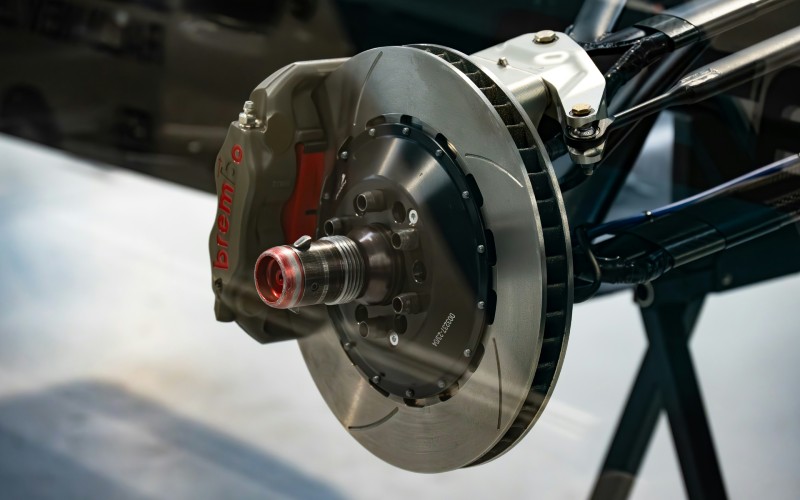
It started with a smell. Not strong, not alarming just a faint burning note that showed up after the morning commute and disappeared by lunchtime. Easy to dismiss. Probably nothing.
Three weeks later, the car was pulling noticeably to the left under braking. The front-left wheel was running hot enough to be uncomfortable to touch after a short drive. The brake pad on that corner was worn down to the metal. The disc was scored beyond saving. Brake calipers are designed to clamp and release thousands of times a year without issue but what had started as a sticking one, a fixable problem that costs relatively little to sort early, had turned into a full corner rebuild.
This is how most caliper problems unfold. Not with a dramatic failure, but with a series of small signs that get explained away until the damage is done.
What a caliper actually does and what goes wrong
The caliper’s job is simple in principle. When you press the brake pedal, hydraulic pressure forces a piston out of its cylinder, pushing the brake pad against the disc. When you release the pedal, the pressure drops, the piston retracts, and the pad clears the disc. Clean, repeatable, thousands of times a year.
What makes it go wrong is almost always one of the same handful of causes and most of them are preventable.
Corrosion. The guide pins and pistons that allow the caliper to move are protected by rubber dust boots. When those boots crack through age, heat cycling, or road damage moisture and road grit get in. Corrosion follows. A corroded pin can’t slide. A corroded piston can’t retract. The pad stays pressed against the disc.
Wrong or absent lubrication. Guide pins need a specific mineral-based grease rated for extreme temperatures. The wrong product dries out, melts, or attacks the rubber bushes. Without lubrication, metal moves against metal until it can’t move at all.
Old brake fluid. Brake fluid absorbs moisture over time it’s hygroscopic by nature. Fluid that hasn’t been changed in years has a significantly higher water content, which corrodes the pistons from the inside and reduces the boiling point of the fluid under heavy braking.
Worn pads left too long. When friction material wears down far enough, the piston has to extend much further than normal to maintain contact with the disc. At that extension, it’s more prone to skewing in the cylinder and a skewed piston doesn’t retract cleanly.
Temperature extremes. Rapid heating and cooling stresses the rubber boots and can cause disc distortion. A warped disc puts uneven load on the caliper with every rotation, which compounds any existing sticking.
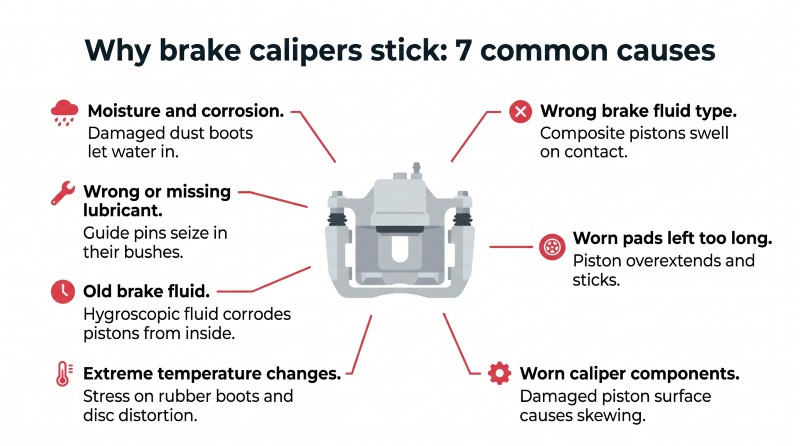
Any one of these causes can lead to sticking on its own. In practice, several often combine old fluid, cracked boots, and lack of lubrication at the last pad change is a pattern mechanics see regularly.
The signs and what each one is actually telling you
Going back to that morning commute: the burning smell was the first signal. Here is what the body of evidence looks like when a caliper is sticking.
Inactivity is one of the most underrated causes of caliper seizure. A car parked outside for several weeks particularly in winter can develop enough corrosion on the slide pins and piston surfaces to cause sticking. The problem is that seized calipers often go undetected until the next MOT, by which point the pad and disc damage is already done.
• A smell of burning after driving. Particularly after motorway runs or long descents. One wheel running noticeably hotter than the others is a near-certain sign that caliper isn’t releasing fully.
• The car pulling to one side under braking. When one caliper applies more force than its opposite number, the car tracks towards that side. It’s easy to attribute this to tyre pressure or alignment but if it only happens under braking, the caliper is the more likely cause.
• A pedal that needs more force. Constant pad drag increases resistance across the whole system. The pedal feels heavier, and stopping distances quietly increase.
• Poor coasting. If the car slows noticeably without any braking input, or fuel consumption has crept up without explanation, dragging pads are often the reason.
• Uneven pad wear. Pads on one side of an axle significantly more worn than the other. This is often only discovered at the next service by which point the disc may already be damaged.
• Vibration or juddering under braking. A disc that’s been subject to uneven heat from a dragging pad develops hot spots and can warp. That shows up as pulsation through the pedal or steering wheel a sign the damage has already progressed beyond the caliper itself.
A seized caliper piston or slide pin means the brake pad on one side of the disc isn’t being applied correctly which shows up as significant brake imbalance during the MOT roller test. Brake imbalance is classified as a critical safety issue: it increases stopping distances and causes the car to pull under braking, reducing driver control in situations where it matters most.
Six rules that prevent the problem from starting
The caliper that caused that corner rebuild hadn’t been touched since the car was new. No lubrication at the last pad change. Dust boots that were visibly cracked but not replaced. Brake fluid that hadn’t been changed in four years. Every rule broken.
Here is what doing it right looks like:
1. Clean and lubricate at every pad change. The guide pins should be removed, cleaned, inspected, and regreased every time pads go on. The dust boot condition should be checked at the same time a cracked boot is a cheap fix that prevents an expensive one.
2. Change brake fluid every two years. Regardless of mileage. Old fluid corrodes from the inside out and reduces performance exactly when you need it most under hard braking in an emergency.
3. Use the right lubricant for each component. Anti-scuff paste for brake shims and pad contact points. Ceramic lubricant for pad seats. Mineral-based high-temperature grease for guide pins. Never near the friction surfaces, never on rubber seals.
4. Use a proper piston retraction tool. Pressing the piston back with a screwdriver risks skewing it in the cylinder. A dedicated tool keeps it square and protects the threads that hold the whole assembly together.
5. Avoid sustained heavy braking where possible. On long descents, a lower gear does the work instead. Less heat through the system means less stress on the boots, pins, and fluid.
6. Consider heat-resistant paint on the caliper body. A thin coat of specialist high-temperature paint applied after cleaning and degreasing slows surface corrosion significantly and makes future inspections quicker, since fresh corrosion shows up clearly against a painted surface.
When cleaning isn’t enough
If a sticking caliper is caught early before the piston surface is scored or the guide pin threads are damaged a thorough clean and regrease can restore normal function. But if the corrosion has gone deep, the housing is cracked, or the piston is visibly damaged, replacement is the right call. A half-fixed caliper tends to stick again within a few thousand miles.
When replacing a caliper, always replace the pads on the same axle at the same time. A caliper that has been sticking means one side of the axle has been working harder the pad wear will be uneven, and fitting new pads on a worn disc creates the same problem all over again.
The burning smell that got ignored for three weeks cost significantly more than it would have done addressed on day one. Calipers don’t announce their problems loudly. But they do announce them.