
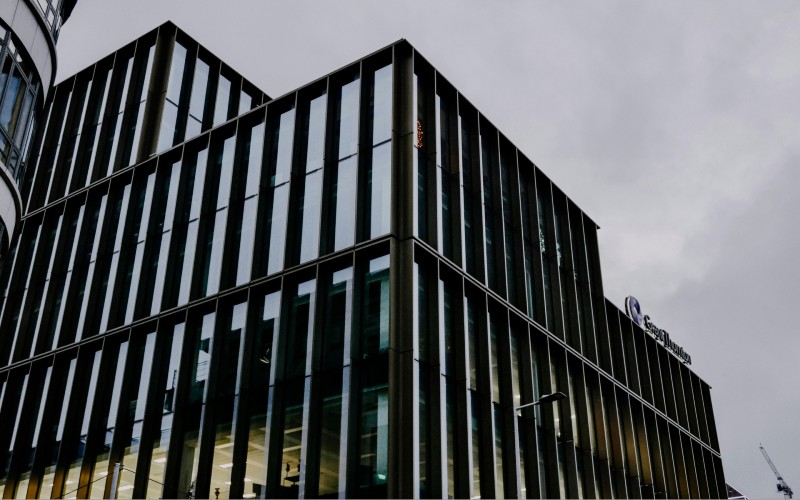
Walk along Barrow Street on a Wednesday and the buildings that made Dublin a tech capital look exactly as advertised: Google, Meta and Airbnb signage, glass frontage, the canal. Walk the same route on a Friday and a good share of those floors sit dark. That gap, between the address and how the space is actually used, is what founders now have to price when deciding where to build a Dublin team. Silicon Docks earned its name the hard way. The cluster around Grand Canal Dock pulled in the European headquarters of Google, Meta, Amazon and Stripe, and by the mid-2010s technology firms employed thousands of people within a few hundred metres of waterfront. The playbook was simple: land in Dublin, sign a long lease on Grade-A space or find meeting rooms in Dublin near the others and grow into it. What has changed is the assumption that any growing company must commit to a decade of fixed floor space to look credible.
The market data itself is contested, which matters to anyone signing a lease. Commercial agents point to take-up running above the five-year average, with vacancy falling for four consecutive quarters. The Central Bank of Ireland and independent property economists place vacancy closer to 19 percent. A TU Dublin analysis cited in the Irish Times argued that the reported fall in vacancy is not supported by the underlying data, a view reinforced by the Central Bank’s own projections. The disagreement stems from churn, subletting, and how technically leased but functionally empty space should be counted. CBRE’s 2026 occupancy benchmark puts average office utilisation at 53 percent, up from 38 percent two years earlier, meaning floors sized for headcount sit roughly half-used most weeks while the rent clears every month. Growing firms have noticed. Many are either moving away from fixed setups or deliberately avoiding long commitments by scaling desks up and down each quarter instead of trying to predict a 2029 headcount in 2026.
A smart Series A company now keeps a modest permanent base and books additional space when the distributed team actually converges. With hybrid schedules, the expensive requirement is no longer a permanent desk per employee, but a reliable room available on the right day, close to the airport or the canal. On-demand meeting rooms in Dublin can cover the board offsite, client pitch, and quarterly all-hands without the company carrying a conference floor it uses twice a month. The cost shifts from fixed overhead to something closer to a usage line, exactly the kind of spend a finance lead can defend.
What remains consistent is that the prestige of a good address still matters. For companies hiring against Google and Stripe for the same engineers, a Docklands footprint remains a credible recruiting signal. What founders have realised, however, is that the signal no longer needs to come bundled with a fifteen-year liability. The companies getting this right in 2026 are holding less space permanently and buying flexibility deliberately, letting the address say one thing while the lease says another. Watch where genuinely growing teams place their money over the next few quarters and that pattern is likely to repeat.