
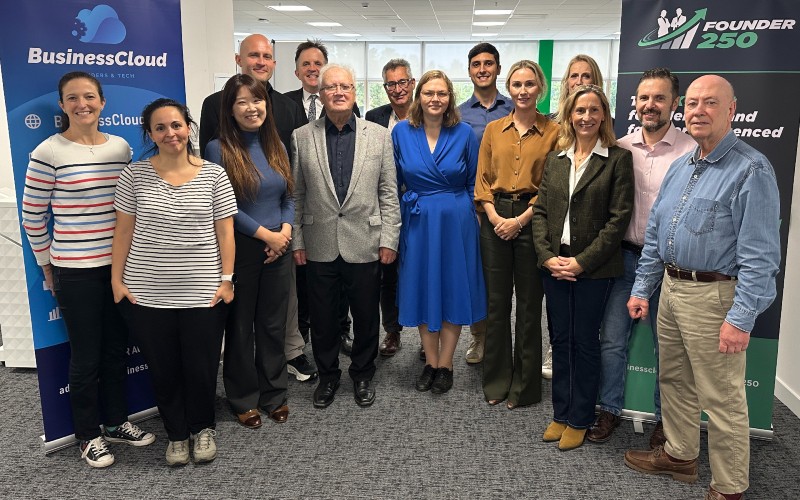
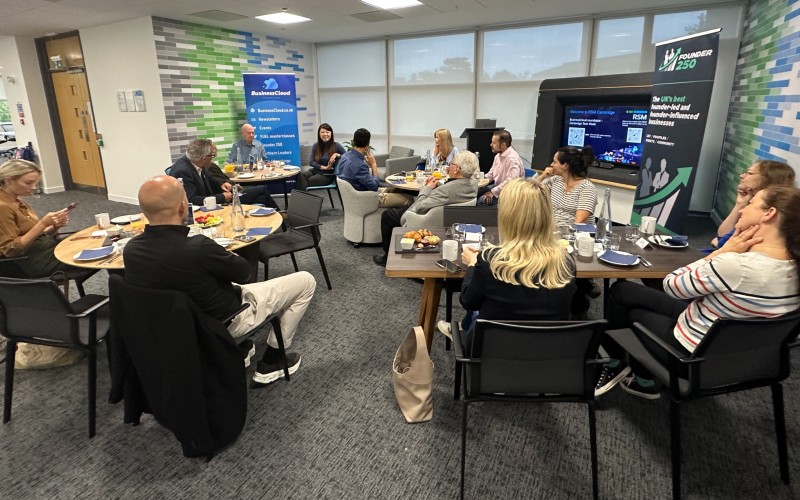
As part of Cambridge Tech Week, BusinessCloud joined forces with RSM UK to canvass the views of some of the city’s leading tech businesses and voices.
Don’t be parochial with funding
1. David Fyfe, founder, Kodiaq Technologies
David Fyfe is the former CEO who led Cambridge Display Technology from university spinout to a NASDAQ-listed company and then an eventual $285m trade sale. He has come out of retirement to found new startup Kodiaq Technologies.
The startup has already completed an £850k funding round backed by more than 20 high-net-worth investors.
He said: “We have to think non-parochially these days. We have to look at where the other sources of funding are. I’m sorry but China is very aggressive. They’re very professional when they do due diligence. They’re quick decision-makers. If you’re not fast enough you’re going to lose the opportunity and the technology is going to go somewhere else.”
We can’t be good at everything
2. Lucy Jung, founder, LYEONS
Lucy Jung was diagnosed with a brain tumour at the age of 24 and underwent brain surgery. “Overnight, I became a patient, and this experience deeply shaped my future,” she explains.
In 2019 she co-founded MedTech Charco Neurotech, which secured over £14m through grants, angels and institutional investment while successfully taking its medical device from research to market.
Desperate to find solutions for other long-term conditions, she recently launched LYEONS, a research project focused on developing innovative solutions to support people with anxiety, depression and sleep disorders caused by neurological conditions.
She said: “One of the most things that we’re all agreed in is that the ecosystem is amazing. There is a lot of support, especially depending on the stage. One of the things that we do is we try and understand what Cambridge is really great at. You can’t be good at everything. I really want to scale from the UK but we do have international support when it comes to funding and expertise. It’s really understanding what Cambridge is really special at and what kind of things we have to look elsewhere for.”
Cambridge is a city of entrepreneurs
3. Charlotte Ridley, founder and CEO, Memorify Technologies
Charlotte Ridley is the founder and CEO of Memorify Technologies. She was inspired to found the startup to capture digital memories after the death of her father and has raised £420k in pre-seed funding.
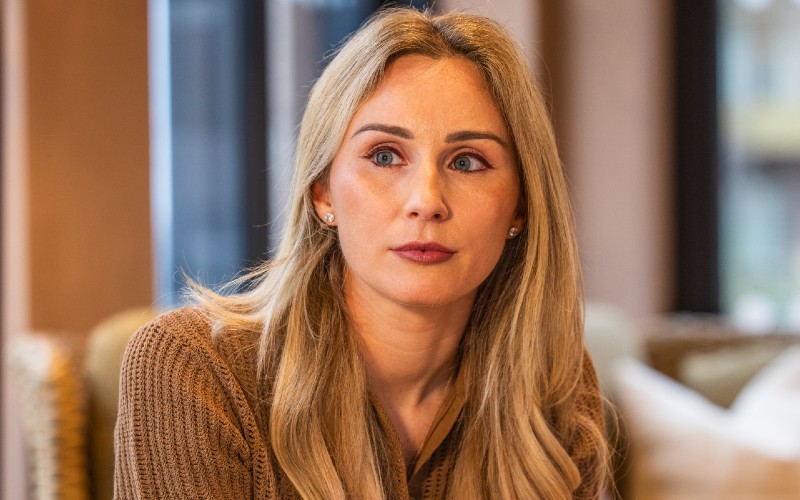
Charlotte Ridley is the founder and CEO of Memorify Technologies
Ridley praised the support from other female founders and said it was ‘slightly more challenging’ to be in consumer tech rather than DeepTech.
She said: “We’re incredibly proud to be building in Cambridge. For as much as Cambridge does have its faults, we all seem to be proud to be associated with the Cambridge ecosystem. As a city we try really hard to create entrepreneurship and we do thrive in that environment. I have met so many wonderful people in Cambridge that have evolved a business and taken it where it is today.”
‘We have two sides of Cambridge’
4. Laragh Jeanroy, office managing partner, RSM Cambridge
Laragh Jeanroy is the office managing partner at RSM Cambridge.
She said: “I was schooled in Cambridge, went away and came back for six months and never left! I’m proud to be part of the ecosystem and support it. I also totally accept the challenges.
“Being a Cambridge person the only point that I would raise is sometimes I’m a bit disappointed that the success of Cambridge doesn’t help the whole of Cambridge.
“We have two sides of Cambridge. We have the academia and the great research and innovation but we also have some parts of Cambridge that are quite deprived. That’s something as a community I’d like to see us work towards improving.”
Cambridge has a pipeline of potential unicorns
5. Rupert Baines, chair, Forefront RF
Serial entrepreneur Rupert Baines was appointed chair of Forefront RF in August 2025, succeeding Phil O’Donovan. He is a seasoned technology executive and serial entrepreneur with a track record of successful company exits, including serving as CEO of UltraSoC until its acquisition by Siemens.
He said: “Just listening to the people in the room there are a dozen companies here, all of whom could be unicorns, could be world-changing. I found several to be intellectually fascinating. We should be very optimistic and excited at this wave of companies are going to be fantastic.
Think as UK plc rather than silos
6. Faye Holland, director, Cambridge x Manchester Partnership
Faye Holland is the newly appointed director of the Cambridge x Manchester Partnership. She has extensive experience, having worked across communications consultancy, innovation and economic development over the course of her career.
She said: “The things that we’ve talked about are not Cambridge specific. They are national things and we have to look beyond our city to solve things around funding, partnership, collaboration, consumer marketing, whatever else it is.
“I think I see a real step change now. Cambridge, Manchester, but nationally, that people do want to start behaving much more like UK plc than behaving in silos. In the midst of all that I do not want to lose the uniqueness that we have in our cities because that’s what gives us our character.”
Challenge is also an opportunity
7. Phil Melia, RSM UK
Phil Melia has a significant amount of experience working with fast-growth and AIM-listed technology companies, having worked closely with many scaling tech businesses at both corporate and shareholder level.
He said: “There are so many businesses here that could be the next big thing. There’s a gap between the early stage and late stage funding and the fact that we have to look outside Cambridge for that is a challenge but it’s also an opportunity.”
Cambridge companies still need support
8. Dr Ruben Ruiz-Mateos Serrano, CEO and founder, Polytecks
Dr Ruben Ruiz-Mateos Serrano is the CEO and founder of Polytecks, a Cambridge-based bioelectronics startup developing non-invasive bioelectrical mapping technologies for healthcare and diagnostics.
He said: “The Cambridge ecosystem is quite unique. We have many gaps that cause the entrepreneurial journey to be hindered and need to be addressed.
Cambridge is home to just 150,000 people but has produced almost 30% of the UK’s 97 unicorns
“In particular, the underlying fact that we assume that because the volume is so large, building companies becomes relatively easier in the sense that other places that have less companies and less volume of research and innovation need more support.
“That’s not true. Companies at any stage and anywhere still need support and that’s something that still needs to be build around.”
Cambridge founders really care
9. Oriane Chausiaux, chief scientific officer, Heartfelt Technologies
Oriane Chausiaux is the chief scientific officer of Heartfelt Technologies, which exists to help patients, families, carers and doctors reduce hospital readmission rates from heart failure decompensation.
He said: “We are in an ecosystem where there is a lot of advice that is coming from incredible people. You never get an email and think you won’t respond.

“Fellow founders always take the time for each other and I don’t think you find that in many places. We are so blessed and lucky.
“People really care about what they’re doing and they do it because they want to change the world in one way of the other. That’s very Cambridge. The passion and purpose that people have makes you want to be on the journey with them.”
Cambridge has a brand that people trust
10. Kärt Tomber, CEO and co-founder, ExpressionEdits
Kärt Tomber is the CEO and co-founder of biotech ExpressionEdits, which has raised $13m in seed funding.
She said: “Cambridge has a brand that is so difficult to recreate because it was created over 800 years.
“There is a trust in the ecosystem that you can build companies here and they can send money from San Francisco, where the time zones absolutely don’t match up to here, but they say ‘you’ll be fine, you’ll return my investment’.”
Infrastructure needs to catch up
11. Monica Saavedra, CEO and founder, Lambda Agri
Monica Saavedra is the CEO and founder of Lambda Agri, which is looking to tackle the global food crisis through innovative agri-tech solutions.
She said: “Cambridge is still growing very, very fast. I’ve read articles of how it’s the fastest growing city in the whole of the UK.
“I do still see a lot of building sites which means we do still need to build the infrastructure to help it progress in a smooth fashion and I don’t really believe the infrastructure is catching up.”
Right mindset is vital
12. Nat Hastings, CEO, Cellestial Health
Nat Hastings is the CEO of University of Cambridge spinout Cellestial Health, which is developing small molecule drugs that protect an overlooked half of the brain – networks of brain cells called astrocytes – to stop the progression of Parkinson’s and other neurological conditions.
She said: “I think it’s about matching up not only the funding but also the right mindset and approach to the team building.”
Cambridge needs to tell its story to the world
13. Lukasz Rzeczkowskii, CCO, LinkGevity
Lukasz Rzeczkowskii is the CCO of LinkGevity, which aims to improve people’s quality of life through innovative drug discovery.
He said: “We should tell the story about Cambridge. I see a lot of scientists and knowledge here but I don’t see enough commercial people.
“I’m certainly an outsider you would think but me coming here, I was blown away but many people in my ecosystems don’t understand what Cambridge is all about.
“They’ve heard that it’s rich in science because of the university and the legacy but let’s tell the story across the UK and internationally for commercial people. The world should come here to invest.”
Take money from the best place
14. Dr Phil O’Donovan, entrepreneur and co-founder, Cambridge Silicon Radio
Entrepreneur Dr Phil O’Donovan is co-founder of Cambridge Silicon Radio (CSR), which was acquired by US company Qualcomm in September 2015 for $2.5bn.
He said: “If you get a good start as a company with the right investors, you’re on a path where hopefully you will start to scale and become a success, then raising money will be no problem at all.
“Stay in Cambridge. Cambridge is a great place to start and to stay but take money from wherever the best money comes from, be it America, China or wherever as long as you manage it the right way.”