


There was a time when comparing esports to traditional sports felt like a stretch – a niche hobby being inflated by enthusiastic projections that never quite materialized. That comparison doesn’t hold up well against the 2026 numbers anymore. Global eSports viewership has climbed past 640 million people this year, and on several metrics, competitive gaming is no longer just catching up to traditional sports – it’s pulling ahead.
The Scale Is No Longer a Projection
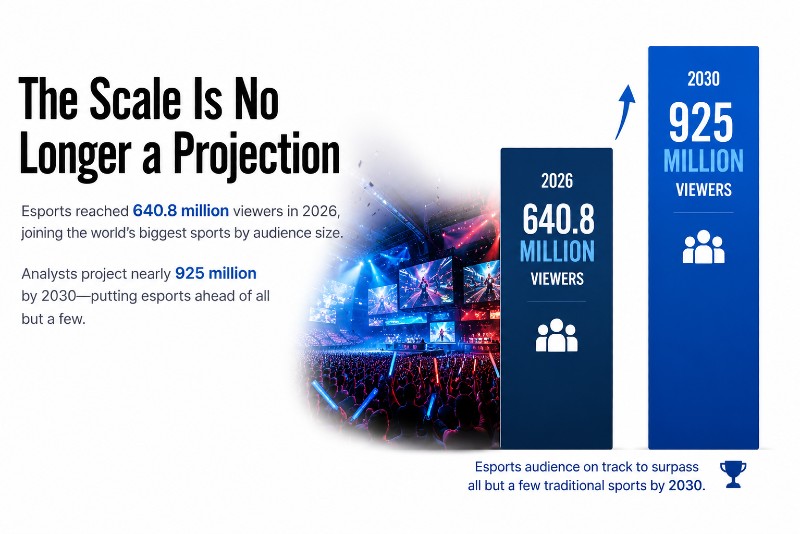
Esports’ global audience reached roughly 640.8 million viewers in 2026, a figure that puts it in the same conversation as some of the largest traditional sports leagues in the world by raw audience size. Industry analysts project that number will continue climbing toward nearly 925 million by the end of the decade, which would put esports’ audience scale ahead of all but a handful of traditional sports globally.
What’s notable isn’t just the size of the audience but the intensity of engagement within it. Surveys of self-identified esports fans have repeatedly found that a clear majority devote more of their entertainment time to competitive gaming than to traditional sports – not a marginal preference, but a genuine reallocation of attention.
Mobile Changed Everything
A meaningful share of this growth traces back to mobile gaming, which now accounts for more than half of all esports viewing hours globally. Titles built specifically for mobile – rather than ported over from PC or console – have driven explosive audience numbers in regions where mobile is the primary or only gaming platform, particularly across Asia-Pacific, which now represents the majority of global eSports viewership on its own.
That mobile-first shift matters structurally, not just numerically. It lowered the barrier to entry for both players and spectators dramatically – watching or playing competitive mobile titles doesn’t require a gaming PC or console, just a phone most people already own, which has opened the audience up to demographics that traditional PC-centric esports never effectively reached.
Why the Demographics Matter More Than the Raw Numbers
Roughly three-quarters of esports’ core audience falls between 18 and 34 – a demographic that traditional sports leagues and broadcasters have struggled to engage at the same intensity for years. That age skew is arguably more significant for the industry’s long-term trajectory than the headline viewership figures, since it represents the audience advertisers and sponsors are actively trying to reach as older sports-viewing demographics age out of peak spending years.
It also explains why traditional sports organizations and media companies have increasingly moved to acquire, sponsor, or directly invest in esports properties rather than treating the space as a separate, competing category. The audience overlap is smaller than executives once assumed, which makes esports a genuine expansion opportunity rather than a cannibalization risk.
Where the Big Numbers Actually Come From
A handful of titles account for a disproportionate share of esports’ headline viewership moments. League of Legends still holds the record for peak concurrent viewership at its World Championship, while mobile-first titles like Mobile Legends: Bang Bang have posted viewership peaks in the millions for their own international finals – numbers that rival the audience for many traditional sports championship broadcasts.
Streaming platform dynamics have shifted alongside the audience growth, with Twitch maintaining a dominant share of total esports viewing hours, while shorter-form platforms have emerged as the fastest-growing distribution channel for esports highlights and clips, reaching casual audiences who’d never sit through a full broadcast.
The Money Is Catching Up to the Audience
Audience growth on this scale was always going to attract serious commercial investment eventually, and 2026 looks like the year that investment caught up to the viewership numbers rather than lagging behind them. Sponsorship revenue has climbed alongside media rights deals, and the overall market valuation for the industry has been revised upward repeatedly over the past year as analysts adjust their models to account for engagement levels that earlier projections consistently underestimated.
That revenue growth isn’t evenly distributed, though. A small number of top-tier titles and leagues absorb the overwhelming majority of sponsorship and media rights money, while the long tail of smaller titles and regional competitions operates on far thinner margins – a dynamic that actually mirrors traditional sports more closely than esports’ “disruptive newcomer” reputation might suggest.
Traditional sports franchises have responded to this maturation by treating esports ownership less like a speculative side bet and more like a genuine extension of their core business. Several major sports organizations now operate esports divisions with the same operational seriousness as their primary teams, complete with dedicated facilities, coaching staff, and performance analytics – a level of institutional investment that would have seemed premature even five years ago.
A Broader Shift in Competitive Entertainment
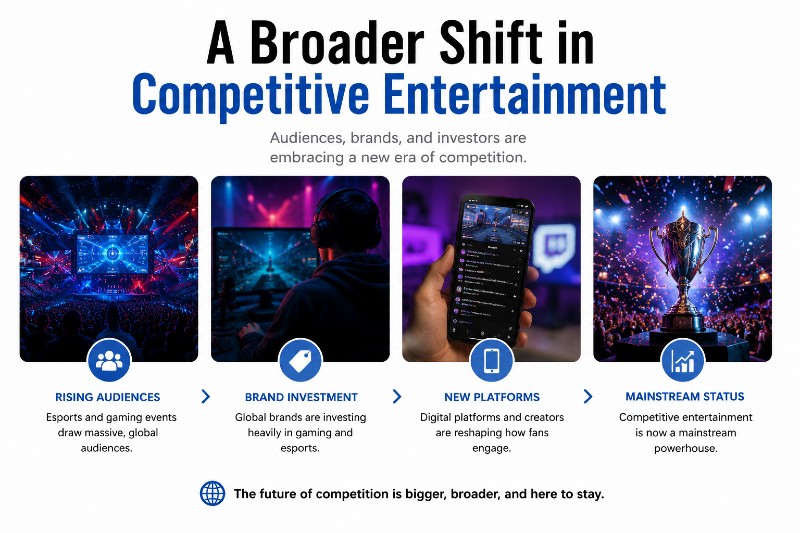
This growth in structured, skill-based competitive entertainment isn’t confined to video games alone. Card-based competitive games have seen a parallel rise in online audiences and structured tournament play, following many of the same engagement patterns — live competition, real stakes, and a spectator culture built around watching skilled decision-making play out in real time. Platforms like JB Casino sit within that broader competitive entertainment ecosystem, drawing on some of the same audience instincts that have fueled esports’ rise: the appeal of watching genuine skill tested under pressure, with outcomes that aren’t scripted.
What Comes Next
If current trajectories hold, esports won’t just close the gap with traditional sports – in several measurable respects, particularly among younger audiences, it already has. The more interesting question for the next few years isn’t whether esports becomes mainstream; by most reasonable definitions, it already is. The real question is how traditional sports, media companies, and advertisers finish adapting to an entertainment landscape where competitive gaming isn’t the alternative anymore – it’s simply one more major category competing for the same attention everyone else is fighting for.