
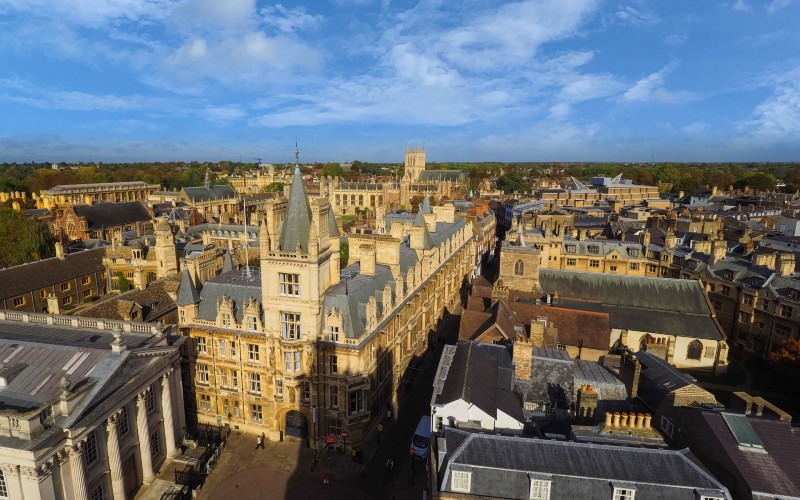
Earlier this year, battery technology firm Nyobolt and AI materials company CuspAI joined the UK’s growing ranks of unicorn businesses.
It also swelled the number of billion-dollar businesses born in Cambridge to 29 – the equivalent of 30 per cent of all the UK’s 97 unicorns.
Cambridge is now ranked No 1 in Europe for unicorns per capita – and there’s no sign of its status changing any time soon.
Between 2015 and 2025, the city attracted a whopping £7.9bn in venture capital investment, while Cambridge is home to the world’s third most innovation-intensive cluster and the first in Europe.
I’ve been attending Cambridge Tech Week to try to understand the secret of the city’s success – and what the rest of the UK can learn from its approach.
At the heart of Cambridge’s success is academia, in particular the world-renowned University of Cambridge – and its 31 colleges – and Anglia Ruskin University (ARU).
This has created a conveyor belt of successful university spinouts, aided by the University of Cambridge’s Cambridge Enterprise, which helps turn research into global impact.

Cambridge is now ranked No 1 in Europe for unicorns per capita
Cambridge Enterprise is run by head of ventures Christine Martin and invests more than £5m each year in young companies.
Some of those companies are exhibiting at Cambridge Tech Week’s Innovation Alley, which is bringing together more than 80 startups, scaleups and other tech sector companies.
Innovation Alley is being hosted over two days at the historic Guildhall and, crucially, is also attended by representatives of Cambridge Angels, whose members have contributed to many of the ‘Cambridge Phenomenon’ success stories over recent years.

Cambridge Angels celebrated its 25th anniversary in July and has a capped membership of 65, nearly all of whom are exited founders.
Members include Unlikely AI founder William Tunstall-Pedoe, who was a key member of the team that built Amazon Alexa. Serial entrepreneur Jonathan Milner, founder of Abcam, is also a member.
Emmi Nicholl is the CEO and self-styled ‘deal sorcerer’ at Cambridge Angels.
She told BusinessCloud: “The angels like to help and like to be involved. It’s not just about the money.
“Cambridge is an innovation hotbed. It’s just an incredible ecosystem with an enormous amount of support.
“Founders really can’t go wrong being here because they will nearly always find an answer to a question or a support system.
“Our angels really like IP-rich innovation. They like something with a high level of defensibility that does include science, engineering, biotech, life sciences.”
Cambridge Angels also boasts six VCs as corporate members, who sit alongside the angels, providing a funding ecosystem stretching from pre-seed right through to VC investment.
One of the key figures in Cambridge’s success story is Kathryn Chapman, CEO of Innovate Cambridge.
She said: “Innovate Cambridge makes sure that Cambridge innovation ecosystem is firing on all cylinders (so that) we have the talent we need, we have the investment we need and we have the physical infrastructure for companies to grow.”
Chapman praised the collaboration that exists between local government, business and the academic institutions in Cambridge.
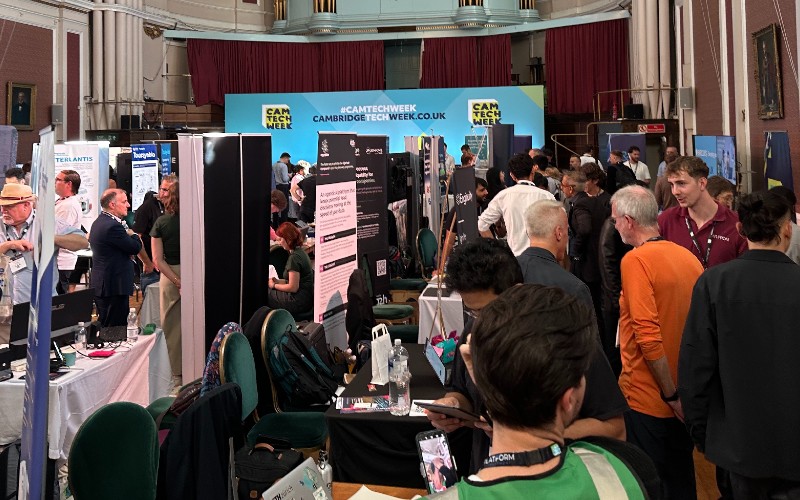
Cambridge Tech Week’s Innovation Alley
“It’s also purpose and intent,” she said. “Working together to an aligned vision to deliver research and innovation for the region and the UK.
“Purposeful means that it’s designed. Cambridge is very good at recognising gaps and what it needs to do.
“We knew that we needed to raise more venture capital so Cambridge set up Cambridge Innovation Capital to raise capital for companies that are based in Cambridge. We’re very purposeful about knowing what we need to do.
Safe place to do risky things
“There’s a culture in Cambridge that it’s a safe place to do risky things. A lot of the people and talent in Cambridge is not afraid to fail.
“They might create a new company and see if it works or it doesn’t work. If it doesn’t, we’ll create another one. We’ve managed to create this culture for risk-taking that is globally competitive.
“Cambridge is incredibly lucky in that it has an 800-year-old university that has a track record and a global brand and that means that we can attract international expertise, talent from around the world, but also capital for our companies.
“It’s very much open for business. If anybody is looking for the next future founder, the next big AI business, the next big tech business or the next life science business that is going to change the future direction of cancer treatment, come and have a look at Cambridge. You’d be amazed at the level of ambition but also the level of ideas and research that we have here.”
Last year, Cambridge joined forces with Manchester to launch the Cambridge x Manchester Partnership, which is designed to expand and strengthen the innovation ecosystems in both cities, drive investment and define a new model of collaboration for the UK.
Faye Holland was appointed earlier this year as the Cambridge x Manchester Partnership director, bringing a depth of experience in the Cambridge innovation cluster to the role.
Originally from Manchester, she came to Cambridge in 1989 to do a music degree – and never left.
Holland explained: “The idea behind the partnership is it’s the UK’s first cross city innovation partnership and it’s been designed specifically to take two disparate cities, to put them together and see if they can achieve better innovation-led growth by working together instead of working apart.”